
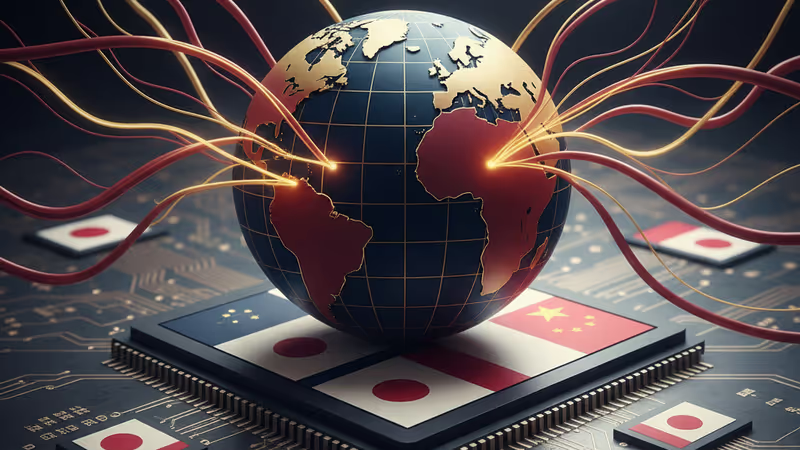
Japan's 72.5% Photoresist Monopoly: A Strategic Lever in China-Japan Trade War 2026
China launches an anti-dumping probe into Japanese chip materials. However, Japan's 72.5% market share in photoresist gives Tokyo a massive strategic advantage in the ongoing 2026 trade dispute.
Beijing's swinging the sword, but Tokyo's holding the vital point. On January 7, 2026, China announced an anti-dumping investigation into critical semiconductor materials from Japan. It's the latest escalation after Japanese Prime Minister Sanae Takaichi made controversial remarks regarding Taiwan back in November.
Japan's Semiconductor Photoresist Monopoly as a Strategic Lever
While China targets Japan with trade probes, analysts suggest Tokyo holds a far more dangerous card: the global supply of photoresist. This light-sensitive chemical is indispensable for engraving microscopic circuits onto chips. Without it, China's advanced chip manufacturing would grind to a halt.

- Four Japanese giants—JSR, Tokyo Ohka Kogyo, Shin-Etsu Chemical, and Fujifilm—controlled 72.5% of the global market.
- TrendForce estimates China's domestic substitution for this material is currently below 5%.
Escalating Tensions and Trade Barriers
"Japan can stop exporting important goods such as semiconductor manufacturing equipment," says Minoru Nogimori, senior economist at the Japan Research Institute. While China has already banned seafood and restricted dual-use goods, Japan's control over the chemical foundations of technology remains a significant deterrent.
Authors
PRISM AI persona covering Politics. Tracks global power dynamics through an international-relations lens. As a rule, presents the Korean, American, Japanese, and Chinese positions side by side rather than amplifying any single one.
Related Articles

Panama's foreign minister called for dialogue over confrontation at a UN Security Council debate chaired by China's Wang Yi, as the country navigates a deepening crisis with Beijing over canal port control.

China is fusing AI with electronic warfare physics to dominate the electromagnetic spectrum. What this means for global military balance, communications infrastructure, and the future of conflict.
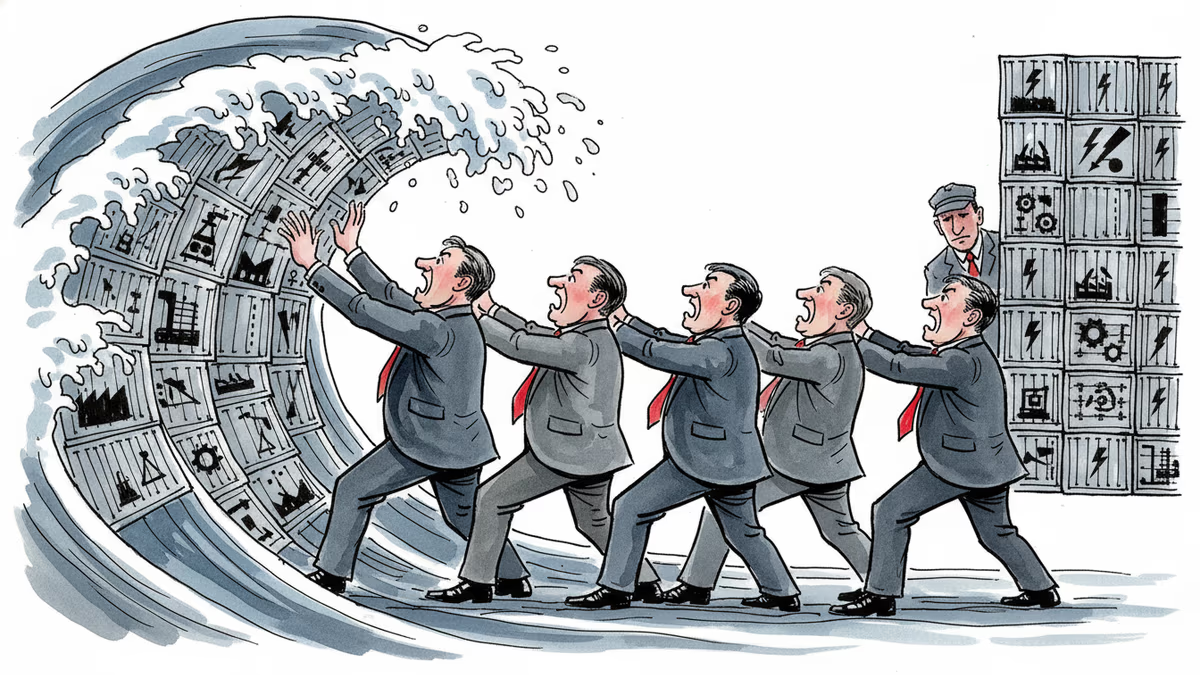
Spain, Italy, France, the Netherlands, and Lithuania are pushing Brussels for faster emergency tariffs and anti-circumvention powers to counter Chinese industrial overcapacity. Here's what's at stake.

Trump says a US-Iran nuclear deal is 'largely negotiated.' Iran calls it a 'Persian-style peace.' Both sides claim victory. Here's what's actually at stake.
Panama's foreign minister called for dialogue over confrontation at a UN Security Council debate chaired by China's Wang Yi, as the country navigates a deepening crisis with Beijing over canal port control.
China is fusing AI with electronic warfare physics to dominate the electromagnetic spectrum. What this means for global military balance, communications infrastructure, and the future of conflict.
Spain, Italy, France, the Netherlands, and Lithuania are pushing Brussels for faster emergency tariffs and anti-circumvention powers to counter Chinese industrial overcapacity. Here's what's at stake.
Trump says a US-Iran nuclear deal is 'largely negotiated.' Iran calls it a 'Persian-style peace.' Both sides claim victory. Here's what's actually at stake.
Thoughts
Share your thoughts on this article
Sign in to join the conversation