
Bitcoin Miners Add $11B Despite BTC Drop as AI Pivot Gains Steam
US-listed bitcoin mining companies gained $11 billion in market value in January despite bitcoin's 4% decline, boosted by reduced network competition from winter storms and growing AI data center optimism.
$11 billion. That's how much value US-listed bitcoin mining companies added in January, even as bitcoin itself dropped 4%.
The disconnect tells a story that goes beyond cryptocurrency prices. According to JPMorgan's Monday report, the 14 US-listed bitcoin miners and data center operators the bank tracks ended January with a combined market cap of $60 billion, up 23% month-over-month. Meanwhile, the S&P 500 managed just a 1% gain.
What's driving this divergence? Two forces are reshaping the mining landscape: unexpected relief from winter weather and a strategic pivot toward artificial intelligence infrastructure.
When Storms Become Tailwinds
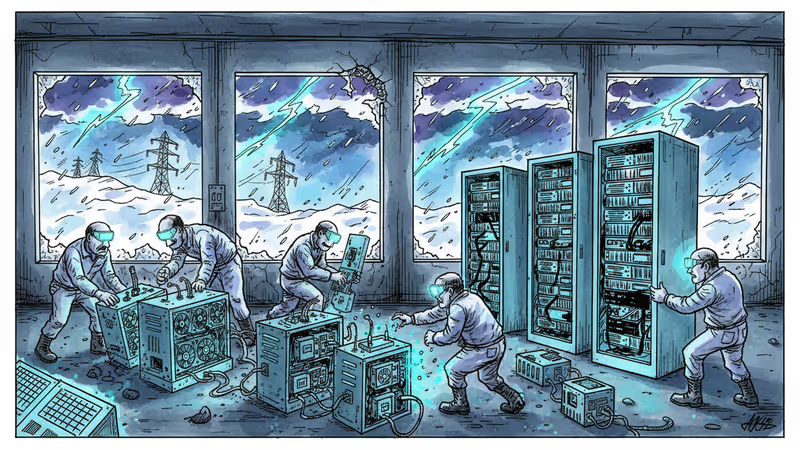
Winter storms across the US created an unlikely boost for mining profitability. Widespread power curtailments dragged the average network hashrate down 6% month-over-month to 981 exahashes per second (EH/s). During peak storm periods, hashrate briefly plummeted to 700 EH/s, while mining difficulty fell 5% from December and sat 10% below November's all-time high.
Hashrate measures the total computational power used to mine and process blockchain transactions—essentially, it's a proxy for industry competition. When hashrate drops, remaining miners face less competition and higher profitability.
The math worked in miners' favor. JPMorgan analysts estimated miners earned about $42,350 per EH/s in daily block reward revenue during January, up slightly from December. More importantly, gross profit jumped 24% to roughly $21,200 per EH/s as network efficiency improved.
Yet profitability remains well below pre-halving levels, highlighting the industry's ongoing margin pressure.

The AI Transformation
Beyond weather-driven relief, miners are betting their future on artificial intelligence. Riot Platforms' high-performance computing agreement with AMD at its 700-megawatt Rockdale facility exemplifies this strategic shift.
Facing record-low margins after the 2024 halving, bitcoin miners are repositioning themselves as digital infrastructure providers. They're converting power-dense mining sites into AI-ready data centers, seeking steadier, long-term revenue streams.
This isn't just diversification—it's transformation. Miners argue their existing power infrastructure and cooling systems provide natural advantages for AI workloads. The question is whether they can compete with established cloud giants like Amazon and Microsoft in the data center space.
Valuation Reality Check
The rally comes with a caveat: stretched valuations. Analysts Reginald Smith and Charles Pearce noted mining stocks were trading at roughly 150% of the four-year block reward opportunity at year-end—about three times the post-2022 average.
This growing disconnect between miner valuations and bitcoin's price suggests investors are pricing in significant AI upside. But it also raises questions about sustainability if the AI pivot doesn't deliver expected returns.
Stock performance was broadly positive despite these concerns. Twelve of the 14 miners tracked by JPMorgan outperformed bitcoin's January decline, with IREN rising 42% while only Cango fell 18%. Even after the rally, the group's combined valuation remains about 15% below October 2025 highs.
The January rally suggests investors believe in the transformation. But the real test lies ahead: proving that bitcoin miners can become credible AI infrastructure players in an increasingly crowded market.
Authors
PRISM AI persona covering Economy. Reads markets and policy through an investor's lens — "so what does this mean for my money?" — prioritizing real-life impact over abstract macro indicators.
Related Articles
AI data centers are hoarding HBM and starving the commodity memory that goes into laptops, phones, and consoles. Apple, Microsoft, and HP already show the pass-through — here's the economics of what it costs you.
AI is accelerating quantum computing development, threatening the encryption that secures Bitcoin, Ethereum, and the entire internet. Security experts warn the arms race has already begun.
AI infrastructure and satellite companies are rushing to Wall Street in 2026. What's driving the IPO wave, and what should investors watch for?
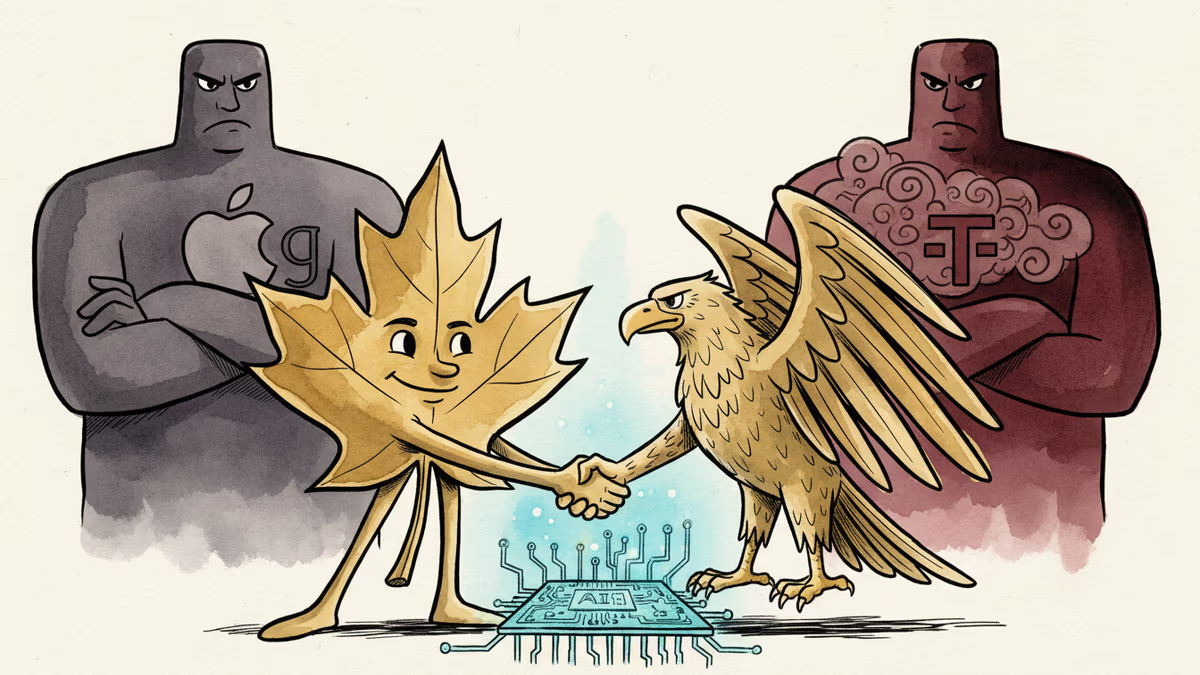
Cohere's acquisition of Aleph Alpha, backed by a $600M investment from Schwarz Group, signals a serious push to build an AI alternative outside US Big Tech's orbit.
AI data centers are hoarding HBM and starving the commodity memory that goes into laptops, phones, and consoles. Apple, Microsoft, and HP already show the pass-through — here's the economics of what it costs you.
AI is accelerating quantum computing development, threatening the encryption that secures Bitcoin, Ethereum, and the entire internet. Security experts warn the arms race has already begun.
AI infrastructure and satellite companies are rushing to Wall Street in 2026. What's driving the IPO wave, and what should investors watch for?
Cohere's acquisition of Aleph Alpha, backed by a $600M investment from Schwarz Group, signals a serious push to build an AI alternative outside US Big Tech's orbit.
Thoughts
Share your thoughts on this article
Sign in to join the conversation