

Israel's Defence Minister Declares 'We Will Never Leave Gaza', Signaling Permanent Presence
On Dec 24, 2025, Israel's Defence Minister declared an intent for a permanent military presence in Gaza, sending shockwaves globally. An analysis of the impact on the two-state solution and Middle East peace.
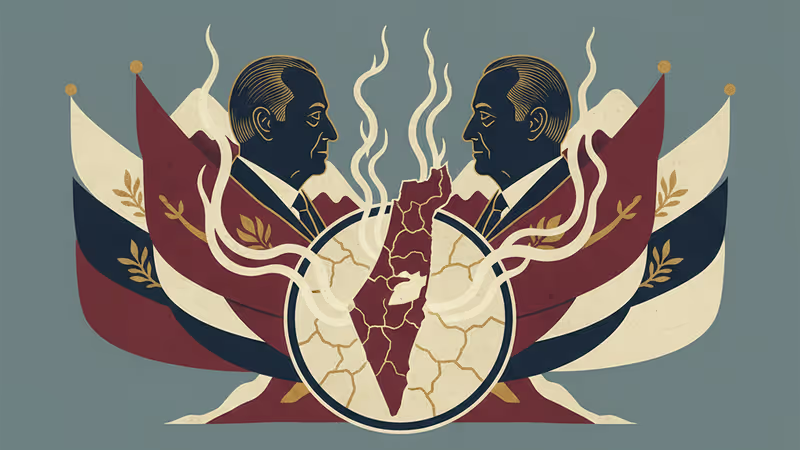
Is a permanent Israeli military presence in Gaza the new reality? In a statement on December 24, 2025, that could reshape the future of the Middle East, Israel's Defence Minister declared the nation's intent to maintain a long-term military foothold in the territory, sparking fears of a permanent occupation.
A New Phase in a Protracted Conflict
The Defence Minister announced in a press briefing, "We will never leave Gaza. Not until our security is fully guaranteed, and even after." He framed the decision as a necessary measure to prevent the resurgence of militant groups like Hamas and ensure the safety of Israel's borders. The statement indicates a strategic shift from targeted military campaigns to indefinite control of the area.
A Divided International Response
The international community's reaction has been swift and divided. The U.S. State Department responded cautiously, stating, "Our support for a two-state solution is unwavering," but stopped short of directly criticizing the Israeli announcement. In contrast, the Palestinian Authority (PA) condemned it as a "de facto annexation and a declaration of permanent occupation." Neighboring Arab nations have reportedly expressed grave concern over the potential for increased regional instability.
Concerns Over Humanitarian Crisis
A permanent Israeli presence is expected to worsen the already dire humanitarian situation in Gaza. International aid organizations are warning that long-term military control could obstruct aid delivery and jeopardize the safety of civilians in makeshift shelters. It's widely believed that basic rights, including freedom of movement, for the civilian population will be severely restricted.
This content is AI-generated based on source articles. While we strive for accuracy, errors may occur. We recommend verifying with the original source.
Related Articles

The British Empire is gone, but its legacy continues to shape 21st-century geopolitics and culture. An analysis of what 'Rule the Waves' means today.

Iran rejects IAEA inspections of its nuclear facilities bombed by the U.S. in June, demanding the UN watchdog first define "post-war conditions." The move escalates tensions as the legal status of the JCPOA is also contested at the UN.

A new forecast indicates the Russia-Ukraine war could continue for another 12 to 18 months. The conflict has evolved into a war of attrition, with a military stalemate fueling projections of a long-term conflict.
Dozens of Palestinians were injured during an Israeli military raid in the occupied West Bank, further escalating tensions and dimming hopes for a two-state solution to the conflict.
The British Empire is gone, but its legacy continues to shape 21st-century geopolitics and culture. An analysis of what 'Rule the Waves' means today.
Iran rejects IAEA inspections of its nuclear facilities bombed by the U.S. in June, demanding the UN watchdog first define "post-war conditions." The move escalates tensions as the legal status of the JCPOA is also contested at the UN.
A new forecast indicates the Russia-Ukraine war could continue for another 12 to 18 months. The conflict has evolved into a war of attrition, with a military stalemate fueling projections of a long-term conflict.
Dozens of Palestinians were injured during an Israeli military raid in the occupied West Bank, further escalating tensions and dimming hopes for a two-state solution to the conflict.