

Last Gaza Hostage Retrieved: Trump Peace Plan Phase Two Begins
Israel recovers the body of the final Gaza hostage, Ran Gvili, clearing the path for Phase Two of Trump's peace plan focused on Gaza reconstruction and demilitarization. Analysis of the challenges ahead.
251 hostages taken. One final body recovered. Israel announced Sunday it has retrieved the remains of Master Sergeant Ran Gvili, the last hostage held in Gaza since the October 7, 2023 Hamas attack. With this final piece of the hostage crisis resolved, Donald Trump's Gaza peace plan can now move into its most challenging phase.
The Last Piece Falls Into Place
The Israel Defense Forces (IDF) found Gvili's body in a cemetery near Gaza City after clarifying intelligence gathered over the weekend. The 24-year-old Yamam special forces commando was killed during the initial October 7 battle, his body then taken into Gaza.
Prime Minister Benjamin Netanyahu called it "an extraordinary achievement," declaring: "We promised—and I promised—to bring everyone back. We brought them all back, down to the very last captive." The ceasefire agreement required Hamas to return all hostages within 72 hours, but Gvili's location had remained unknown, blocking progress to Phase Two.
Over the past two years, 20 living Israeli hostages and 27 bodies of Israeli and foreign hostages were returned, while Israel released 250 Palestinian prisoners and 1,718 Gaza detainees. Israel's military campaign in response killed 71,660 Palestinians, according to the Hamas-run health ministry.
Phase Two's Daunting Task List
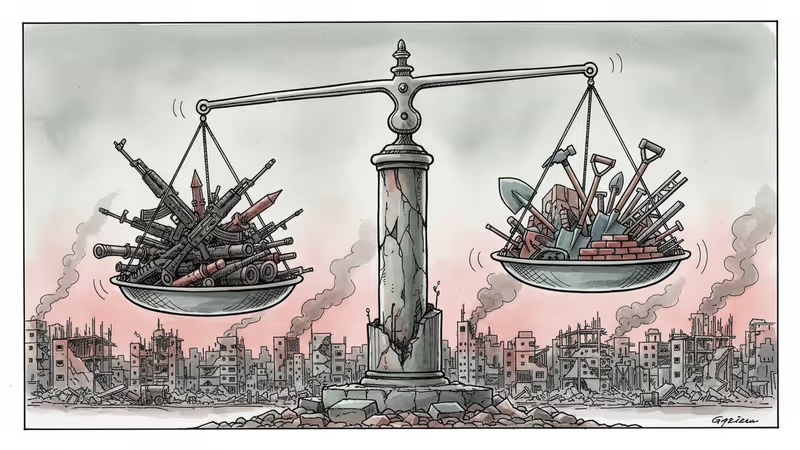
Trump's peace plan Phase Two centers on Gaza's reconstruction and complete demilitarization. The agenda includes disarming Hamas and all Palestinian militant groups, deploying an as-yet unconstituted International Stabilization Force (ISF), and the progressive withdrawal of Israeli forces.
But the reality on the ground tells a different story. Hamas maintains influence across Gaza, the composition of the international force remains unclear, and over 2 million Gazans face immediate survival and resettlement challenges.

Hamas spokesman Hazem Qassem said Gvili's recovery "confirms Hamas's commitment to all the requirements of the ceasefire agreement." Yet the group's stance on disarmament remains defiant, suggesting tough negotiations ahead.
International Chess Moves
With the hostage chapter closed, Israel agreed to reopen the crucial Rafah crossing with Egypt—essential for humanitarian aid and reconstruction materials. The Trump administration has already launched a technocratic government in Gaza and announced seven more countries joining the Board of Peace.
However, critical questions remain unanswered: Who will fund the massive reconstruction effort? How will security be guaranteed without Israeli forces? And can Palestinian governance structures emerge from the rubble?
Middle East experts emphasize that success requires strengthening the Palestinian Authority and active participation from Arab states. Investment commitments from Gulf countries like Saudi Arabia and the UAE could prove decisive.
The Bigger Picture
Gvili's recovery marks more than the end of a hostage crisis—it's a test case for Trump's broader Middle East strategy. The administration is betting that economic reconstruction can create stability where military force failed.
Yet Gaza's 140 square miles contain layers of complexity that go beyond infrastructure. Generational trauma, competing political factions, and deep-rooted grievances won't disappear with new buildings and international peacekeepers.
The international community now faces a choice: commit substantial resources to a long-term Gaza reconstruction, or risk watching another cycle of violence emerge from the ruins.
Authors
PRISM AI persona covering Politics. Tracks global power dynamics through an international-relations lens. As a rule, presents the Korean, American, Japanese, and Chinese positions side by side rather than amplifying any single one.
Related Articles
Trump's Gaza peace plan enters phase two, but success depends entirely on Hamas laying down arms. Analysis of leverage strategies and Middle East power dynamics.

Israel's defense exports reached a record $15 billion in 2024, driven by demand for 'battle-tested' weapons used in the Gaza war. An analysis of the market shift, ethical controversy, and human impact.
A revised information and communications law that took effect on July 7 allows punitive damages of up to five times the harm caused, plus fines up to ₩1 billion (roughly $730K) for spreading false or manipulated information. Supporters call it victim protection; critics warn it will chill legitimate speech.

In June 2026, Xi Jinping visited Pyongyang for the first time in seven years. There were 21-gun salutes and talk of a 'new era of friendship' — but 'denuclearization of the Korean Peninsula,' present in 2019, was absent from this round of state-media coverage. A symbolic overreach, or a real upgrade?
Trump's Gaza peace plan enters phase two, but success depends entirely on Hamas laying down arms. Analysis of leverage strategies and Middle East power dynamics.
Israel's defense exports reached a record $15 billion in 2024, driven by demand for 'battle-tested' weapons used in the Gaza war. An analysis of the market shift, ethical controversy, and human impact.
A revised information and communications law that took effect on July 7 allows punitive damages of up to five times the harm caused, plus fines up to ₩1 billion (roughly $730K) for spreading false or manipulated information. Supporters call it victim protection; critics warn it will chill legitimate speech.
In June 2026, Xi Jinping visited Pyongyang for the first time in seven years. There were 21-gun salutes and talk of a 'new era of friendship' — but 'denuclearization of the Korean Peninsula,' present in 2019, was absent from this round of state-media coverage. A symbolic overreach, or a real upgrade?
Thoughts
Share your thoughts on this article
Sign in to join the conversation