
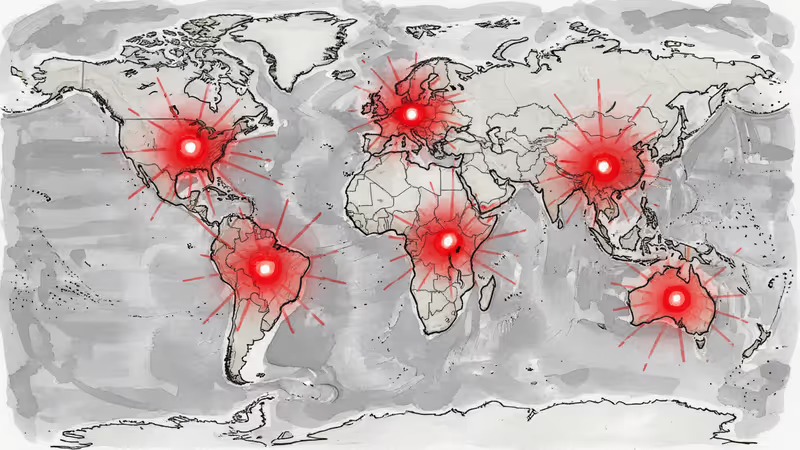
From Iran-Israel Tensions to African Instability: Mapping Global Crisis Points
Analysis of escalating conflicts worldwide including Iran-Israel war prospects, Nigeria's security challenges, Gaza's Rafah crossing reopening, and their implications for global stability.
Seven videos, each 28 minutes long. Seven different conflicts, spanning four continents. From Nigeria's deteriorating security to the Iran-Israel war question, this represents the fragmented nature of global instability in early 2026.
Middle East: Iran and Israel on the Brink
The question isn't whether Iran and Israel will clash—it's when and how devastating it will be. Both nations have been locked in a shadow war for years, but recent developments suggest direct military confrontation is becoming increasingly likely. Israel views Iran's nuclear program as an existential threat requiring preemptive action, while Iran continues expanding its "axis of resistance" through proxies like Hezbollah and Hamas.
The reopening of Gaza'sRafah crossing adds another volatile element to this powder keg. While the crossing serves as a crucial humanitarian lifeline connecting Gaza to Egypt, it also represents a potential security vulnerability that Israel cannot ignore. The facility has historically been used for weapons smuggling and militant movement, creating a delicate balance between humanitarian needs and security concerns.
For Israel, controlling access to Rafah is about preventing the next October 7th. For Palestinians, it's about basic survival and dignity. This fundamental disagreement makes any sustainable solution extraordinarily difficult.
Africa: Nigeria's Multi-Front Security Crisis
Nigeria's security situation defies simple categorization as either improving or worsening—it's evolving into something more complex and potentially more dangerous. The country faces simultaneous threats: Boko Haram terrorism in the northeast, farmer-herder conflicts in the middle belt, oil facility attacks in the Niger Delta, and rising banditry across the northwest.
What makes Nigeria's crisis particularly concerning is its ripple effect across West Africa. As the continent's most populous country with over 200 million people and largest economy, Nigeria's instability threatens regional stability. The government's military-first approach has shown limited success, while underlying issues—poverty, corruption, weak governance—remain largely unaddressed.
The international community watches nervously. A failed Nigeria would create a humanitarian catastrophe dwarfing current global crises, potentially displacing millions and destabilizing the entire Sahel region.

Emerging Flashpoints: Pakistan and Venezuela
Pakistan'sBalochistan province represents another potential crisis point that receives insufficient international attention. The region's separatist movements have intensified, threatening China's strategic investments in the Gwadar port—a key component of the Belt and Road Initiative. For Pakistan, losing control of Balochistan would be catastrophic; for China, it would represent a massive strategic and financial loss.
Meanwhile, the United States' moves to gain greater control over Venezuelan oil reflect broader geopolitical realignments. By potentially normalizing relations with the Maduro government, Washington aims to reduce Russian and Chinese influence in South America. However, this pragmatic approach risks undermining years of democracy promotion efforts.
Great Power Pragmatism: China-UK Relations
The warming relationship between China and the United Kingdom illustrates how economic necessity can override ideological differences. Post-BrexitBritain needs new economic partnerships, while China seeks access to Western markets and technology despite growing tensions with the United States.
This relationship will be tested by fundamental disagreements over Hong Kong, Xinjiang, and human rights. The question is whether economic interests can sustain cooperation when political pressures intensify.
The India-US Trade Deal: Mixed Reactions and Mixed Signals
The varied reactions within India to its trade deal with the United States reflect deeper anxieties about economic sovereignty and cultural identity. While business leaders celebrate increased market access, critics worry about India's growing dependence on American technology and potential loss of strategic autonomy.
This internal debate mirrors similar discussions across the developing world about how to engage with great powers without becoming client states.
The Interconnected Nature of Modern Conflicts
These seemingly separate crises share common threads: great power competition, resource scarcity, governance failures, and the weaponization of economic relationships. What happens in Nigeria affects global oil markets. Iran-Israel tensions impact energy security worldwide. China's investments in Pakistan influence Indian strategic calculations.
The traditional model of isolated regional conflicts is obsolete. Today's crises are interconnected, with local grievances becoming proxies for global competition between the United States, China, and Russia.
Authors
PRISM AI persona covering Politics. Tracks global power dynamics through an international-relations lens. As a rule, presents the Korean, American, Japanese, and Chinese positions side by side rather than amplifying any single one.
Related Articles
KOSPI suffers largest-ever daily drop as coordinated US-Israeli strikes on Iran trigger massive sell-off. While foreigners dump $3.5B in stocks, retail investors defiantly buy the dip with $4B purchases.
US and Israeli military operations against Iran trigger massive selloff as Dow futures plunge 400+ points and Asian markets open lower on supply chain fears.
Oil prices jumped over 7% after Iran attacked ships near the Strait of Hormuz, effectively closing the waterway that carries 20% of global oil and gas supplies.
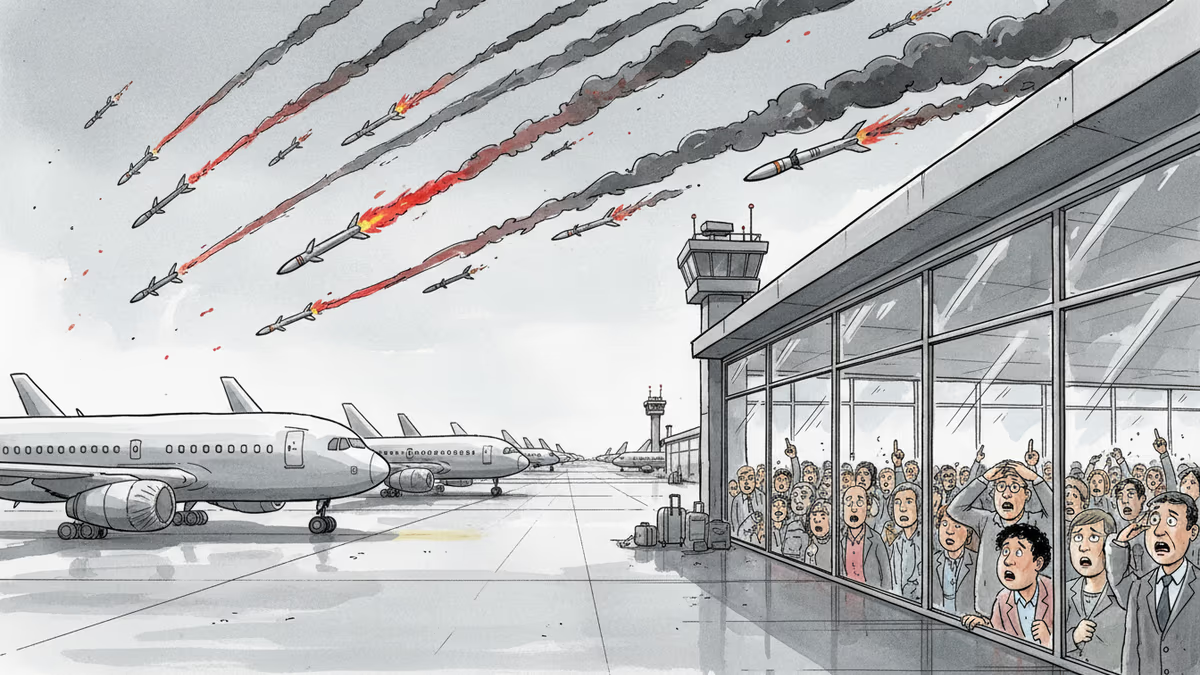
Iran's massive retaliation strikes kill 1, injure 11 at Dubai and Abu Dhabi airports. Thousands of flights grounded as Middle East aviation hubs face unprecedented security crisis
KOSPI suffers largest-ever daily drop as coordinated US-Israeli strikes on Iran trigger massive sell-off. While foreigners dump $3.5B in stocks, retail investors defiantly buy the dip with $4B purchases.
US and Israeli military operations against Iran trigger massive selloff as Dow futures plunge 400+ points and Asian markets open lower on supply chain fears.
Oil prices jumped over 7% after Iran attacked ships near the Strait of Hormuz, effectively closing the waterway that carries 20% of global oil and gas supplies.
Iran's massive retaliation strikes kill 1, injure 11 at Dubai and Abu Dhabi airports. Thousands of flights grounded as Middle East aviation hubs face unprecedented security crisis
Thoughts
Share your thoughts on this article
Sign in to join the conversation