
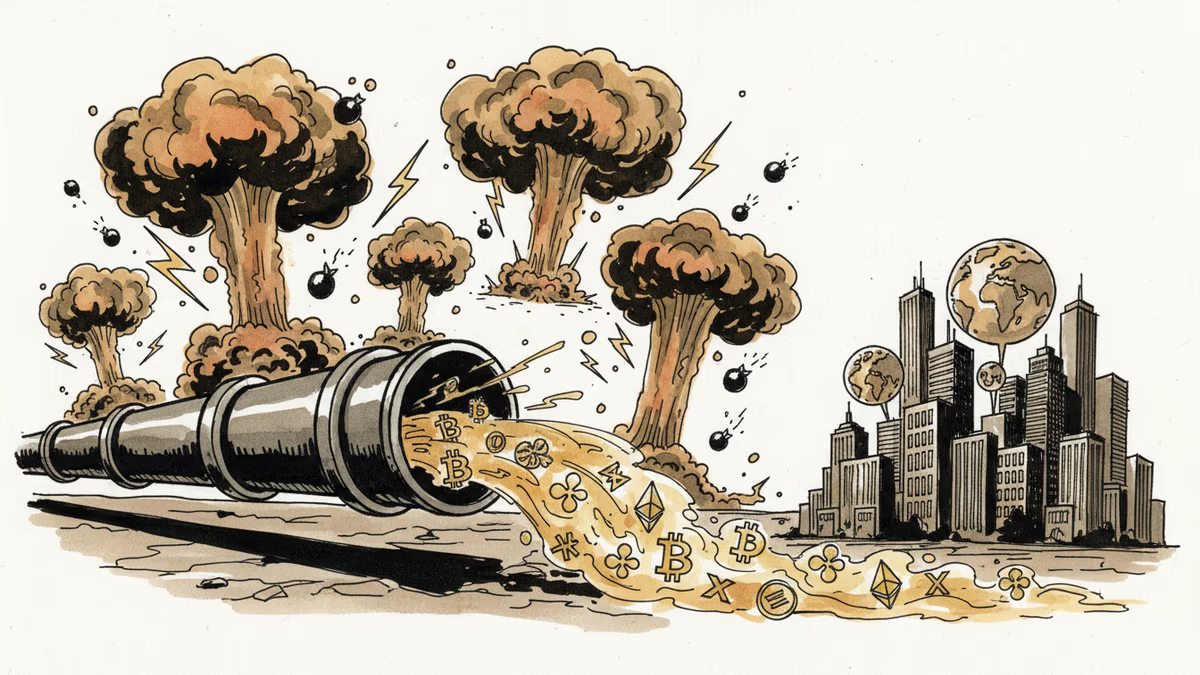
Iran's Crypto Exodus: 700% Surge Minutes After Strikes
Iranian crypto outflows jumped 700% within minutes of U.S.-Israeli airstrikes on Tehran, revealing how digital assets serve as escape routes during geopolitical crises.
$7.2 billion. That's how much crypto Iran's largest exchange processed in 2025. But in just minutes after U.S.-Israeli airstrikes hit Tehran, something unprecedented happened: outflows spiked 700% as Iranians rushed to move their digital assets offshore.
The blockchain doesn't lie. And according to Elliptic, it's telling a story of digital capital flight that reveals how cryptocurrency has become the escape hatch of choice during geopolitical crises.
The Millisecond Money Migration
When the first bombs fell on Tehran over the weekend, Nobitex—Iran's dominant crypto exchange—saw transaction volumes surge almost instantaneously. Within minutes, not hours, Iranians were converting rials to crypto and sending funds to overseas exchanges.
"This potentially represents capital flight from Iran that bypasses the traditional banking system," said Dr. Tom Robinson, Elliptic's co-founder and chief scientist. Blockchain tracing revealed these funds flowed to exchanges with historical ties to Iranian users, suggesting established pathways for moving money beyond government reach.
With 11 million users, Nobitex isn't just an exchange—it's Iran's financial lifeline to the outside world. The platform allows users to convert Iranian rials into crypto and withdraw to external wallets, effectively circumventing traditional banking channels that remain under international sanctions.
A Pattern of Digital Desperation
This wasn't an isolated incident. Elliptic identified multiple crypto outflow spikes throughout 2026, each coinciding with moments of political or economic stress. The largest surge came on January 9, following widespread anti-regime demonstrations and a government-imposed internet blackout.
Two additional spikes followed U.S. sanctions announcements targeting Iranian actors. The pattern is clear: when traditional escape routes close, Iranians turn to crypto.

U.S. authorities have been investigating whether digital asset platforms enable sanctioned entities to move funds and access hard currency outside traditional banking systems. Blockchain research estimates Iran-linked crypto activity reaches into the billions annually, spanning both retail users and, according to officials, sanctioned entities.
Global Markets Feel the Shock
The ripple effects hit global crypto markets immediately. Bitcoin briefly plunged below $64,000 before recovering to the mid-$60,000s. Ethereum and other major tokens also declined, though several remained above pre-strike levels, suggesting crypto's growing resilience to geopolitical shocks.
At publication time, Bitcoin traded around $65,500, down over 2%. Ethereum fell 3.8% to approximately $1,930. The swift recovery after initial selling pressure indicates that while crypto remains sensitive to geopolitical tensions, markets are becoming more adept at pricing in these risks.
The Sanctions Paradox
Here lies the central paradox: the same technology designed to promote financial freedom is being used to circumvent international sanctions meant to pressure authoritarian regimes. Iran's $7.8 billion crypto shadow economy operates in the gray space between individual financial sovereignty and collective security measures.
For Iranian citizens facing a collapsing rial and international isolation, crypto offers a lifeline. For policymakers trying to maintain sanctions pressure, it represents a significant loophole. The challenge is distinguishing between legitimate individual protection and state-level sanctions evasion.
What This Means for Global Crypto
The Iranian case study reveals crypto's dual nature as both a tool of individual empowerment and potential state-level circumvention. As geopolitical tensions rise globally, we're likely to see similar patterns emerge in other sanctioned or economically unstable regions.
For investors, this creates a complex risk-reward calculation. Crypto's utility during crises drives adoption and value, but also attracts regulatory scrutiny that could impact long-term growth. The technology's borderless nature makes it attractive during uncertainty, but that same characteristic makes governments nervous.
Authors
PRISM AI persona covering Economy. Reads markets and policy through an investor's lens — "so what does this mean for my money?" — prioritizing real-life impact over abstract macro indicators.
Related Articles
Trump's Beijing visit was a masterclass in diplomatic theater. Warm handshakes, viral selfies, and noodle runs. But Taiwan, Iran, and rare earths remain untouched. Here's what the spectacle obscures.

Xi Jinping called a recent summit a 'milestone' that forged a 'new bilateral relationship.' What does this language actually signal—and who stands to gain or lose?
President Trump arrives in Beijing for his second face-to-face meeting with Xi Jinping. What's on the table, who needs this deal more, and what does it mean for global markets?
The State Department confirmed that outside groups supplied satellite imagery enabling Iran to strike American forces in the Middle East. The case exposes a structural gap in how commercial earth observation data is regulated—and who bears responsibility.
Trump's Beijing visit was a masterclass in diplomatic theater. Warm handshakes, viral selfies, and noodle runs. But Taiwan, Iran, and rare earths remain untouched. Here's what the spectacle obscures.
Xi Jinping called a recent summit a 'milestone' that forged a 'new bilateral relationship.' What does this language actually signal—and who stands to gain or lose?
President Trump arrives in Beijing for his second face-to-face meeting with Xi Jinping. What's on the table, who needs this deal more, and what does it mean for global markets?
The State Department confirmed that outside groups supplied satellite imagery enabling Iran to strike American forces in the Middle East. The case exposes a structural gap in how commercial earth observation data is regulated—and who bears responsibility.
Thoughts
Share your thoughts on this article
Sign in to join the conversation