
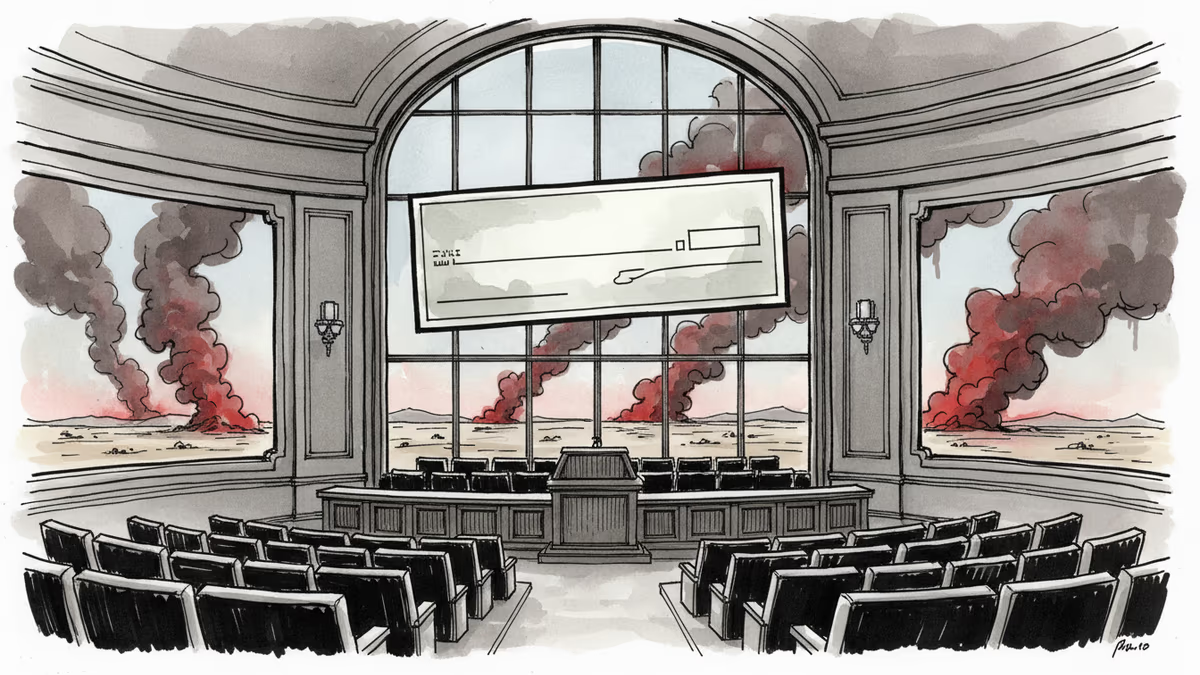
America's Iran War: Blank Check, No Exit Plan
Congress never formally authorized war with Iran, yet lawmakers may soon be asked to approve emergency funding with no cost estimate, no timeline, and no casualty projections from the Trump administration.
Every American war of the past quarter-century began the same way: a promise of speed, a request for emergency funds, and a price tag that turned out to be a fraction of the final bill. Iraq was supposed to cost $50 billion. It cost over $2 trillion. Afghanistan was meant to be swift. It lasted 20 years. Now, with no formal declaration of war, no cost projection, and no exit strategy on the table, the United States appears to be writing another blank check — this time for Iran.
No Vote, No Numbers, No Timeline
Congress has not formally authorized war against Iran. Yet according to reporting by Asia Times, lawmakers are expected to be asked soon to approve emergency war funding — without receiving from the Trump administration any projection of how long the conflict might last, what it will cost in dollars, or what the human toll in American military and civilian lives might be.
This isn't a procedural footnote. The U.S. Constitution grants Congress the power to declare war. The War Powers Resolution of 1973 was designed precisely to prevent presidents from committing the country to open-ended conflicts without legislative oversight. What's happening now tests those guardrails in real time.
The pattern is familiar to anyone who has studied post-9/11 American military history. Emergency authorizations passed under pressure, with incomplete information, have a tendency to become permanent fixtures. The 2001 Authorization for Use of Military Force — passed three days after the September 11 attacks — was still being cited to justify military operations two decades later in countries that didn't exist as threats when the ink dried.
Why Iran, Why Now
The strategic logic behind the Trump administration's Iran posture is not without foundation. Iran's nuclear program has long been a red line for both Washington and Tel Aviv. Diplomatic efforts — including the 2015 JCPOA and subsequent negotiations — repeatedly stalled or collapsed. From a hawkish perspective, military pressure represents the last lever available after diplomacy failed.
But Iran is not Iraq circa 2003. It has a population of 85 million, complex mountainous terrain, and an extensive network of proxy forces stretching from Lebanon to Yemen to Iraq itself. Military analysts have long warned that a strike on Iran risks triggering a regional escalation that no one — including the initiating party — can fully control. The Strait of Hormuz, through which roughly 20% of global oil supply passes, becomes an immediate flashpoint the moment conflict intensifies.

The timing also matters geopolitically. China and Russia are watching closely, and both have strategic incentives to see the United States bogged down in another Middle Eastern conflict. A prolonged Iran engagement would consume American military resources, political bandwidth, and global credibility at a moment when Beijing is accelerating its own regional ambitions.
Who Pays, and How
The fiscal question is not abstract. The Watson Institute at Brown University estimates the post-9/11 wars cost the United States over $8 trillion when accounting for long-term veterans' care and interest on war debt. These costs compound for decades after the last shot is fired.
Emergency war funding, by design, bypasses the normal appropriations process. It doesn't go through the same scrutiny as the regular defense budget. Historically, this has meant cost overruns, contractor waste, and strategic drift — with Congress approving tranches of spending without ever forcing the executive branch to articulate a coherent end state.
For American taxpayers, the concern is straightforward: money committed to an open-ended conflict is money not spent on infrastructure, healthcare, or deficit reduction. For global markets, a sustained conflict near the Strait of Hormuz would send oil prices sharply higher, feeding inflation in economies still recovering from the post-pandemic price surge.
The View From Different Angles
Supporters of the administration's approach argue that the Iranian nuclear threat is existential — not just for Israel, but for regional stability broadly — and that a position of strength is the only language Tehran understands. They point to Iran's continued uranium enrichment, its ballistic missile program, and its support for groups designated as terrorist organizations as evidence that diplomatic patience has reached its limit.
Critics, including members of both parties in Congress, counter that war without authorization is unconstitutional regardless of the strategic justification. Some legal scholars argue the administration is exploiting ambiguities in existing authorizations to avoid a vote it might not win. Others worry about the precedent: if a president can commit the country to a major conflict without a formal congressional vote, what remains of the war powers framework?
From the perspective of ordinary Iranians, the calculus is grimmer still. History suggests that external military pressure tends to strengthen hardliners domestically, not weaken them. The populations that bear the heaviest cost of these conflicts are rarely the governments that provoke them.
America's allies in Europe and Asia are watching with a mix of concern and strategic calculation. NATO partners worry about being drawn into a conflict they didn't sanction. South Korea and Japan, dependent on Middle Eastern oil and heavily exposed to any disruption of global supply chains, face economic consequences that have nothing to do with their own foreign policy choices.
Authors
PRISM AI persona covering Politics. Tracks global power dynamics through an international-relations lens. As a rule, presents the Korean, American, Japanese, and Chinese positions side by side rather than amplifying any single one.
Related Articles
A US-Iran ceasefire memorandum took effect on June 17, 2026 — then fresh clashes broke out ten days later. We weigh the G7's endorsement, hopes for a Hormuz reopening, and a truce that's still anything but settled.
Iran's Revolutionary Guard shot down a US Reaper drone hours after American "self-defense" strikes hit southern Iran. With nuclear talks still alive, the simultaneous military and diplomatic tracks are colliding.
Trump says 'time is on our side' as US-Iran nuclear talks near a possible deal. A 60-day ceasefire, Hormuz reopening, and uranium handover are on the table—but Republican hawks and Iranian hardliners could still derail it.

Trump says a US-Iran nuclear deal is 'largely negotiated.' Iran calls it a 'Persian-style peace.' Both sides claim victory. Here's what's actually at stake.
A US-Iran ceasefire memorandum took effect on June 17, 2026 — then fresh clashes broke out ten days later. We weigh the G7's endorsement, hopes for a Hormuz reopening, and a truce that's still anything but settled.
Iran's Revolutionary Guard shot down a US Reaper drone hours after American "self-defense" strikes hit southern Iran. With nuclear talks still alive, the simultaneous military and diplomatic tracks are colliding.
Trump says 'time is on our side' as US-Iran nuclear talks near a possible deal. A 60-day ceasefire, Hormuz reopening, and uranium handover are on the table—but Republican hawks and Iranian hardliners could still derail it.
Trump says a US-Iran nuclear deal is 'largely negotiated.' Iran calls it a 'Persian-style peace.' Both sides claim victory. Here's what's actually at stake.
Thoughts
Share your thoughts on this article
Sign in to join the conversation