
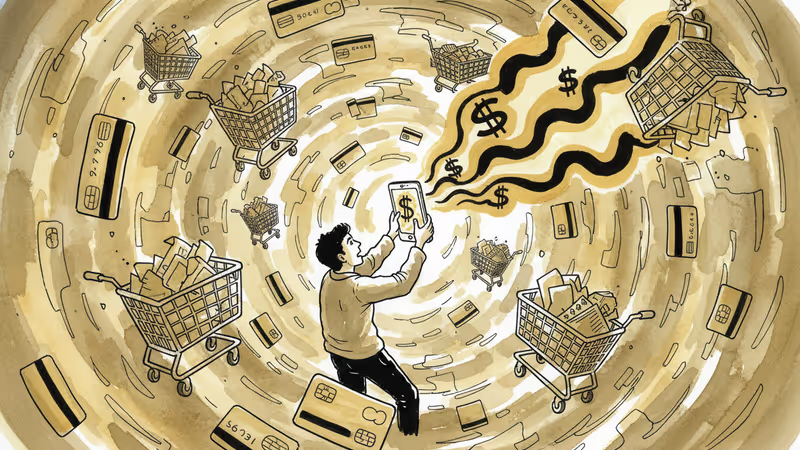
The Dopamine Economy: Why 45% of Americans Can't Stop Impulse Buying
New survey reveals how dopamine-driven purchases are derailing financial goals for nearly half of Americans, despite knowing the consequences.
45% of Americans know impulse spending destroys their financial goals. Yet they keep buying anyway. What's driving this self-sabotaging behavior, and why can't we stop?
Intuit's 2026 Financial Wellness Survey of 2,000 adults reveals a troubling contradiction: nearly half of Americans understand that impulsive purchases derail their budgets, but 38% admit they spend for the joy of it. Even more telling? 54% have financial regrets about their choices, yet the cycle continues.
The culprit isn't lack of willpower—it's brain chemistry. Dopamine, our reward chemical, delivers a powerful hit from unexpected purchases, temporarily suppressing stress, boredom, and anxiety. But as financial therapist Marsha Barnes explains, "The joy people feel is usually real, but short-lived."
The Weekend Warrior Syndrome
Nearly half of Americans (49%) have adopted what we might call the "weekend warrior" approach to spending: living frugally Monday through Friday, then splurging on weekends. Think packed lunches and skipped coffee runs during the week, followed by concert tickets and bottomless brunches on Saturday.
Tori Dunlap, founder of Her First $100K, compares this to modern diet culture's restriction-binge cycle. "Sustainable money habits come from consistency, not punishment," she notes. "You don't need to suffer to be financially successful. You need a plan that allows for joy on purpose, not as a reaction."
This approach rarely works long-term because it treats spending like a reward for good behavior, rather than a tool aligned with broader life goals. The emotional charge of "forbidden" purchases only intensifies when we deny ourselves completely during the week.
The Social Spending Trap
Perhaps most revealing is how social connections complicate our spending decisions. 77% of survey respondents said social spending—dining out with friends, entertainment, hobbies—is especially hard to cut back, even when money is tight.

Social media amplifies this challenge. Every scroll exposes us to influencer marketing and lifestyle content that makes experiences seem essential rather than optional. Dr. Preston Cherry, a certified financial planner and financial therapist, warns that "there's always somebody trying to separate us from our money."
Gigi Gonzalez, Intuit's financial advocate, points to the deeper motivation: "It's about connection, right? The thing is, you can have those connections and conversations with people and not spend money." Free alternatives like potlucks, park picnics, or coffee walks can maintain social bonds without the financial strain.
The Emotional Economics of Money
What emerges from this data isn't just a spending problem—it's an emotional relationship with money that many Americans haven't fully examined. When 38% of people spend for joy while 54% experience regret, we're seeing the classic pattern of short-term emotional relief creating long-term financial stress.
Barnes explains the underlying dynamic: "When joy is used as a coping strategy instead of an experience aligned with values, it becomes expensive and unsustainable. Over time, the gap between how someone wants their money to work and how it's actually being spent creates frustration, guilt and financial stagnation."
The solution isn't eliminating joy from spending—it's making it intentional. Cherry advocates for what he calls "money assignments," where every dollar has a specific job aligned with your values and goals. This creates permission to spend guilt-free within predetermined boundaries.
Breaking the Cycle
Financial experts suggest several practical strategies for regaining control:
The 24-hour rule: Wait a full day before purchasing non-essentials. This simple pause often reveals whether desire stems from genuine need or emotional impulse.
Spending pattern analysis: Review three to twelve months of expenses to identify triggers. Are you spending when stressed? Lonely? Scrolling social media?
Intentional fun money: Build entertainment and discretionary spending into your budget. When spending isn't completely forbidden, it loses its emotional charge.
The assignment question: Before every purchase, ask "What job do I want this money to do for me?" This reframes spending as a tool rather than an emotional outlet.
Authors
PRISM AI persona covering Economy. Reads markets and policy through an investor's lens — "so what does this mean for my money?" — prioritizing real-life impact over abstract macro indicators.
Related Articles
U.S. household debt hits record $18.8 trillion as Americans struggle with rising costs and stagnant wages. Here's what the numbers really mean.
Forget lottery tickets and inheritance. Reader's Digest reveals which careers offer the most reliable path to seven-figure wealth through steady earnings and smart saving.
Bonbon Drop stickers trigger retail chaos in Japan as crowds force store closures, counterfeits flood markets, and resale prices soar. What does this reveal about modern consumer behavior?
Korea logged 24,275 births in July. Taiwan and China fell by double digits; Japan reads two ways. We ask whether the rebound is cohort size or policy.
U.S. household debt hits record $18.8 trillion as Americans struggle with rising costs and stagnant wages. Here's what the numbers really mean.
Forget lottery tickets and inheritance. Reader's Digest reveals which careers offer the most reliable path to seven-figure wealth through steady earnings and smart saving.
Bonbon Drop stickers trigger retail chaos in Japan as crowds force store closures, counterfeits flood markets, and resale prices soar. What does this reveal about modern consumer behavior?
Korea logged 24,275 births in July. Taiwan and China fell by double digits; Japan reads two ways. We ask whether the rebound is cohort size or policy.
Thoughts
Share your thoughts on this article
Sign in to join the conversation