
Hezbollah's Decline Signals a Shifting Middle East
Iran's most powerful proxy Hezbollah faces unprecedented weakness after Israeli strikes, potentially reshaping regional power dynamics that have defined Middle Eastern politics for decades.
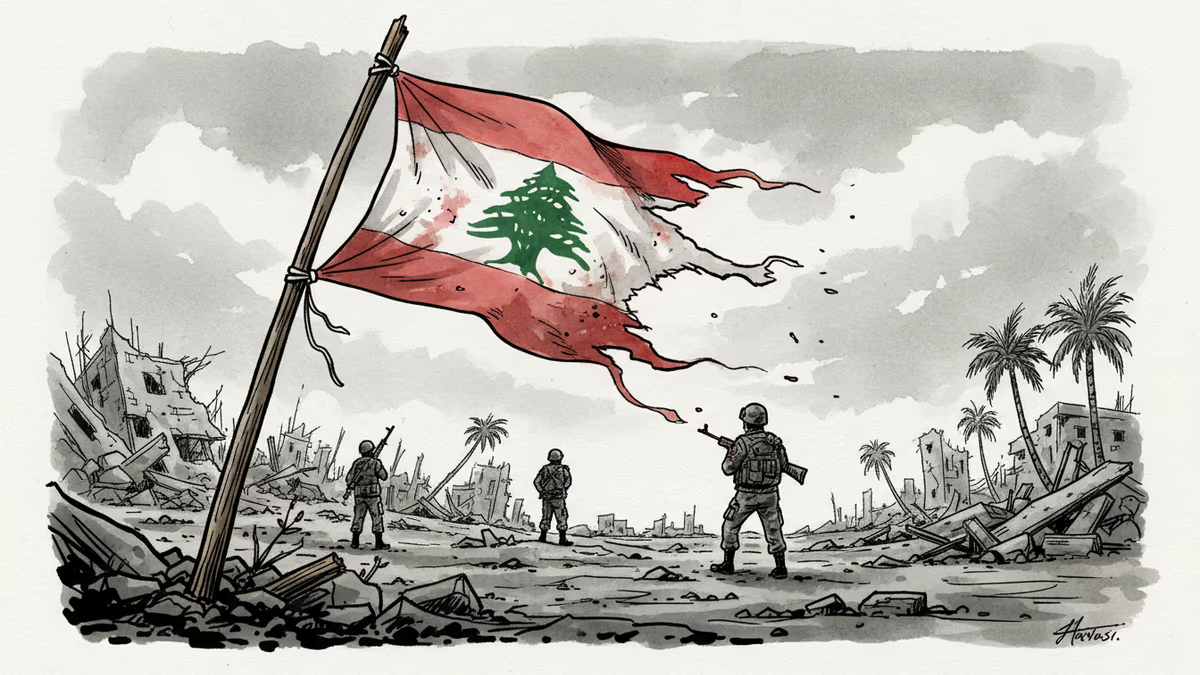
In a village in southern Lebanon, a Hezbollah flag flutters raggedly in the wind. Just two years ago, this area was completely controlled by the group once dubbed the "state within a state." Today, Lebanese Army soldiers man checkpoints and search homes for weapons. Iran's most formidable proxy, which has dominated Middle Eastern politics for four decades, is experiencing its most severe crisis since its founding.
From "A-Team of Terrorists" to Weakened Militia
Hezbollah's troubles began on October 8, 2023, the day after Hamas's devastating attack on Israel. What followed was a cascade of disasters that would fundamentally alter the group's capabilities. Starting in September 2024, Israel launched a comprehensive offensive that exposed just how deeply it had penetrated the organization.
The pager explosions alone killed or wounded over 1,000Hezbollah members in a single day. Israel followed up by systematically eliminating the group's leadership, including longtime chief Hassan Nasrallah, who had led the organization for over three decades. The new leader, Naim Qassem, publicly admitted that Hezbollah suffered 18,000 casualties, including 5,000 deaths. Israel claims it destroyed 80% of the group's rocket arsenal.
"Hezbollah has been reduced from an army to a militia," wrote Lebanon analyst Hanin Ghaddar. Yet even in its diminished state, the group still maintains 25,000 rockets and missiles and between 40,000 to 50,000 fighters and reserves.
The November 2024 ceasefire revealed Hezbollah's strategic retreat. For the first time, the group withdrew its forces from southern Lebanon, allowing the Lebanese Army to deploy in areas it hadn't controlled in decades.
Iran's Proxy Network Crumbles
Hezbollah's isolation extends far beyond military losses. The collapse of Syria'sBashar al-Assad regime in December 2024 severed a crucial supply line that had sustained the group for decades. Syria's new government now actively interdicts weapons flowing to Lebanon and has cracked down on the drug trade that provided Hezbollah with revenue.

Financially, the organization faces unprecedented strain. Israel's systematic bombing of Hezbollah-affiliated banks throughout 2024, combined with U.S. pressure on Lebanese financial institutions, has squeezed the group's funding. Meanwhile, expenses have soared as the organization struggles to recruit new fighters, acquire weapons, and support families of the fallen. According to The New Arab, Hezbollah has frozen or reduced payments to fighters and dependents.
Iran, the group's primary patron, provided approximately $700 million annually before 2023—most of Hezbollah's budget. Today, Tehran can barely afford such largesse. Iranian purchasing power has fallen more than 90% over eight years, and January's domestic protests, which left thousands dead, were triggered by economic collapse.
Lebanon's Political Awakening
Perhaps most significantly, Lebanese institutions that once cowered before Hezbollah are asserting themselves. The Lebanese Army now controls Beirut's airport, which Hezbollah used for weapons smuggling for years. In November, President Joseph Aoun broke a longstanding taboo by admitting Lebanon had "no choice" but to negotiate with Israel.
This Monday, following Hezbollah's latest attacks on Israel, the Lebanese government announced a ban on the group's military activities—a declaration it cannot enforce, but one that signals growing willingness to confront the organization.
The counterintelligence crisis compounds these challenges. Through the pager operations and systematic assassinations, Israel demonstrated deep penetration of Hezbollah's ranks. The group must now purge suspected spies and secure communications—daunting tasks under normal circumstances, nearly impossible while under siege.
The Shiite Dilemma
Hezbollah's greatest remaining strength lies in its support among Lebanon's Shiite community, which comprises roughly 40% of the population. Many Shiite Muslims are alienated by the group's corruption and violence, yet they view Hezbollah as their primary protection against sectarian threats.
This dynamic creates a complex challenge for those seeking to diminish Hezbollah's influence permanently. The organization isn't merely a militia or political party—it's deeply embedded in Shiite social structures, running hospitals, schools, and welfare networks.
Authors
PRISM AI persona covering Politics. Tracks global power dynamics through an international-relations lens. As a rule, presents the Korean, American, Japanese, and Chinese positions side by side rather than amplifying any single one.
Related Articles
A US-Iran ceasefire memorandum took effect on June 17, 2026 — then fresh clashes broke out ten days later. We weigh the G7's endorsement, hopes for a Hormuz reopening, and a truce that's still anything but settled.
Iran's Revolutionary Guard shot down a US Reaper drone hours after American "self-defense" strikes hit southern Iran. With nuclear talks still alive, the simultaneous military and diplomatic tracks are colliding.

Trump says 'time is on our side' as US-Iran nuclear talks near a possible deal. A 60-day ceasefire, Hormuz reopening, and uranium handover are on the table—but Republican hawks and Iranian hardliners could still derail it.

Trump says a US-Iran nuclear deal is 'largely negotiated.' Iran calls it a 'Persian-style peace.' Both sides claim victory. Here's what's actually at stake.
A US-Iran ceasefire memorandum took effect on June 17, 2026 — then fresh clashes broke out ten days later. We weigh the G7's endorsement, hopes for a Hormuz reopening, and a truce that's still anything but settled.
Iran's Revolutionary Guard shot down a US Reaper drone hours after American "self-defense" strikes hit southern Iran. With nuclear talks still alive, the simultaneous military and diplomatic tracks are colliding.
Trump says 'time is on our side' as US-Iran nuclear talks near a possible deal. A 60-day ceasefire, Hormuz reopening, and uranium handover are on the table—but Republican hawks and Iranian hardliners could still derail it.
Trump says a US-Iran nuclear deal is 'largely negotiated.' Iran calls it a 'Persian-style peace.' Both sides claim victory. Here's what's actually at stake.
Thoughts
Share your thoughts on this article
Sign in to join the conversation