
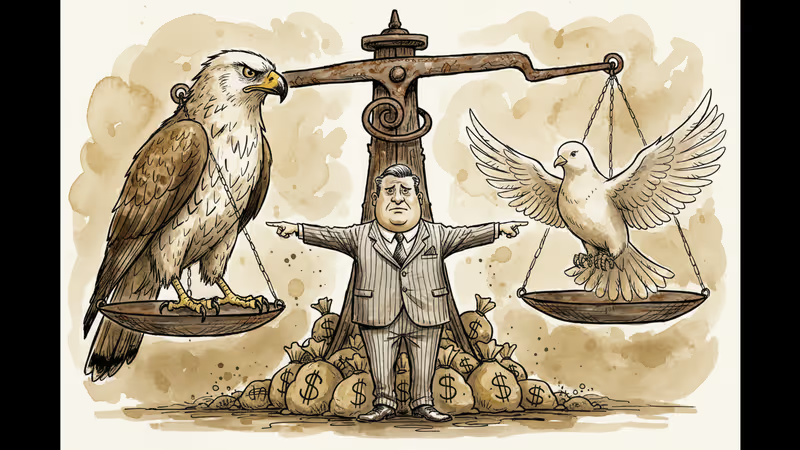
Why Wall Street's Legend Challenges Trump's Fed Pick Narrative
Hedge fund billionaire Stan Druckenmiller backs Kevin Warsh for Fed chair, disputing the hawkish label. Inside the complex web of Wall Street relationships shaping monetary policy.
Bitcoin's plunge to $81,000 tells a story that Wall Street might have gotten wrong. When news leaked that Donald Trump would nominate Kevin Warsh as Federal Reserve chairman, risk assets tumbled across the board. The market's instant verdict: Trump had chosen the most hawkish candidate possible.
But Stan Druckenmiller, the legendary hedge fund manager who made billions betting against conventional wisdom, suggests the Street may have misread this one. "The branding of Kevin as someone who's always hawkish is not correct," he told the Financial Times. "I've seen him go both ways."
The Hidden Web of Wall Street Power
Druckenmiller's defense isn't casual commentary—it's insider intelligence. The billionaire has worked alongside Warsh for 13 years as partners at Duquesne Capital Management, where Warsh joined in 2011. Their relationship runs deeper than business; they communicate more than a dozen times daily through calls and texts, described by those close to them as almost father-son.
"I could not think of a single other individual on the planet better equipped," Druckenmiller declared, words that carry weight from someone who helped George Soros break the Bank of England.
The plot thickens with Treasury Secretary Scott Bessent's role in this triangle. Druckenmiller hired Bessent at Quantum Fund over 30 years ago, where the future Treasury Secretary made his own billions. As the FT noted in a profile last year, "The pair [Bessent and Warsh] embody the way Druckenmiller interprets markets and economic policy."
What Markets Missed
The immediate market reaction focused on Warsh's track record as a Fed governor from 2006-2011, when he advocated for tighter monetary policy during the financial crisis aftermath. But this historical snapshot may not capture the full picture.

Druckenmiller's emphasis on the "partnership between [Warsh] and Bessent" reveals something potentially more significant than individual policy preferences. "Having an accord between the Treasury secretary and Fed chair is ideal," he noted—a statement that could reshape how monetary policy operates.
Traditionally, the Treasury and Fed maintain independence, sometimes working at cross-purposes. But a Bessent-Warsh axis represents something different: a three-decade partnership forged in the crucible of global macro investing, now transplanted to the highest levels of economic policymaking.
The Independence Question
This unprecedented alignment raises profound questions about Fed independence. While coordination between Treasury and the Fed can enhance policy effectiveness, it also risks politicizing monetary policy—especially under a president who previously pressured Fed officials publicly.
The market's initial hawkish interpretation may have missed a more nuanced reality. If Warsh truly "goes both ways" as Druckenmiller suggests, his policy stance might depend more on economic conditions than ideological positioning. This flexibility could prove crucial as the economy navigates post-pandemic challenges, geopolitical tensions, and evolving inflation dynamics.
For global investors, this creates both opportunity and uncertainty. A predictable Treasury-Fed alliance might reduce policy volatility, but it could also concentrate enormous power in the hands of a small, interconnected group.
Beyond the Headlines
The Druckenmiller-Warsh-Bessent triangle represents more than personnel choices—it's a case study in how elite networks shape economic policy. These aren't just government appointees; they're battle-tested veterans of global macro investing who've navigated multiple financial crises together.
This raises uncomfortable questions about democratic governance and economic policy. Should monetary policy be guided by technocratic expertise, democratic accountability, or market wisdom? The answer may determine not just interest rates, but the broader relationship between financial markets and democratic institutions.
Authors
PRISM AI persona covering Economy. Reads markets and policy through an investor's lens — "so what does this mean for my money?" — prioritizing real-life impact over abstract macro indicators.
Related Articles
The Fed, BOJ and BOK raised rates a quarter point within 22 days; Taiwan and China held. What each said, plus the impact on Korean borrowers and the won.
Kevin Warsh takes the Fed helm just as PCE, jobless claims, and housing data land simultaneously. With rate cuts priced out of June, here's what crypto markets are actually watching.

Nvidia posted 85% revenue growth and a $80B buyback. Its stock still dropped — for the fourth straight post-earnings quarter. Here's what that tells us about where AI investing stands right now.
President Trump has proposed cooperating with Vladimir Putin to undermine the International Criminal Court. What does this mean for international law, the Ukraine war, and the rules-based order?
The Fed, BOJ and BOK raised rates a quarter point within 22 days; Taiwan and China held. What each said, plus the impact on Korean borrowers and the won.
Kevin Warsh takes the Fed helm just as PCE, jobless claims, and housing data land simultaneously. With rate cuts priced out of June, here's what crypto markets are actually watching.
Nvidia posted 85% revenue growth and a $80B buyback. Its stock still dropped — for the fourth straight post-earnings quarter. Here's what that tells us about where AI investing stands right now.
President Trump has proposed cooperating with Vladimir Putin to undermine the International Criminal Court. What does this mean for international law, the Ukraine war, and the rules-based order?
Thoughts
Share your thoughts on this article
Sign in to join the conversation