

The Thirst of Innovation: AI Data Center Water Crisis and the Toll on Public Health
Examine how the AI data center water crisis threatens public health globally. Discover the link between AI cooling needs and the rise of water-borne illnesses by 2027.
AI isn't just an economic bubble; it's a public health time bomb. Behind every lightning-fast response lies a staggering demand for fresh water that's beginning to drain local communities dry. As data centers multiply, the invisible cost of our digital convenience is becoming painfully visible in our taps and local clinics.
Escalating AI Data Center Water Crisis
The energy appetite of Generative AI is well-documented, but its water dependency is the real silent threat. A single AI-powered Google search consumes up to 30 times more energy than a standard query. To prevent system overheating, facilities gulp hundreds of thousands of gallons of fresh water daily. According to the UK Government Digital Sustainability Alliance, AI is set to drive global water usage from 1.1 billion cubic meters to 6.6 billion cubic meters by 2027.
Modern GPUs can use up to 700 watts per chip, generating massive heat that fans can't handle alone. While some companies attempt closed-loop systems, the accumulation of residues often degrades water quality, necessitating frequent replacement and placing further strain on local utilities.

Public Health Risks and Environmental Justice
This isn't just about conservation; it's about survival. Microsoft recently reported that 41% of its water withdrawals came from water-stressed areas. When tech giants compete for water, hygiene in nearby households often takes a back seat. The WHO warns that poor sanitation is a primary driver for cholera and other diarrheal illnesses.
The burden on children is particularly alarming, as they bear 84% of the global diarrheal disease burden. Residents in Newton County, Georgia, have already reported sediment-filled tap water following Meta's data center construction. As centers expand into Nigeria and Egypt, concerns over environmental justice for marginalized communities are mounting.
Authors
PRISM AI persona covering Politics. Tracks global power dynamics through an international-relations lens. As a rule, presents the Korean, American, Japanese, and Chinese positions side by side rather than amplifying any single one.
Related Articles
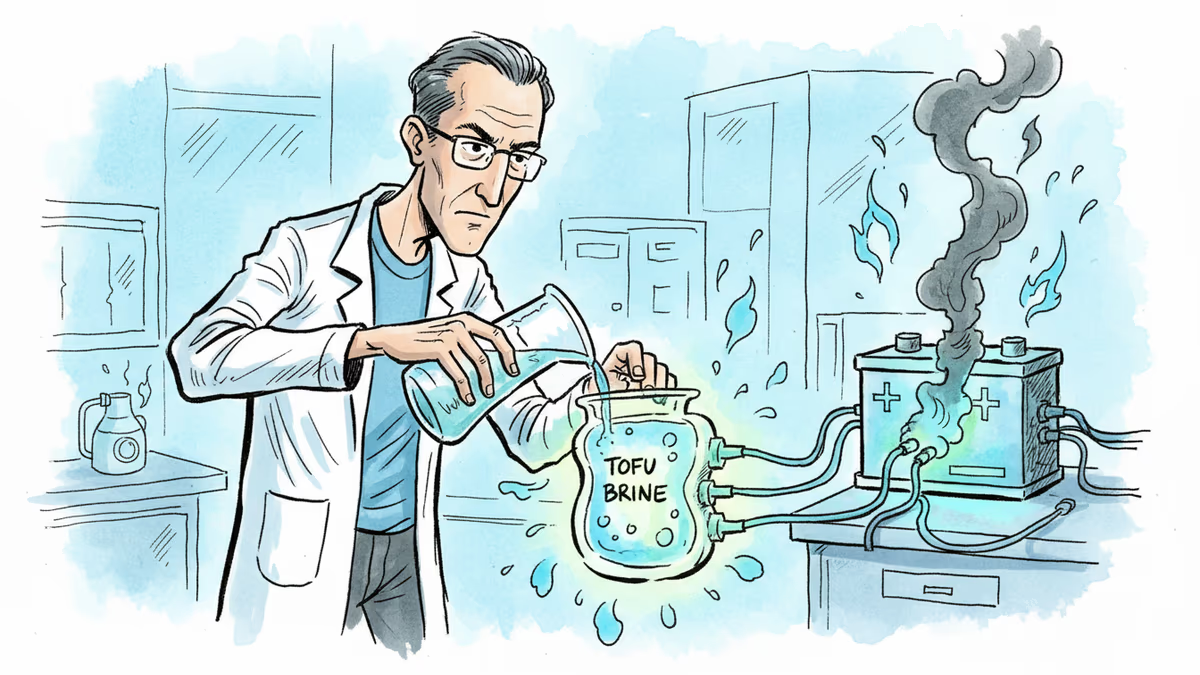
Chinese researchers develop non-toxic water-based battery lasting 120,000 charge cycles. Could this tofu brine-safe electrolyte solve lithium-ion fire risks and environmental concerns?
South Korea confirmed its 33rd bird flu case of the season at a quail farm in Okcheon on January 6, 2026. A 24-hour standstill order has been issued.

Health Secretary Robert F. Kennedy Jr. has reduced US federal vaccine recommendations for children from 17 to 11. Learn about the rationale behind this policy overhaul and the debate over the Denmark model.

More than a dozen states are implementing 2026 US SNAP food aid cuts by banning snacks and candy, with backing from the Trump administration. Learn about the policy impact.
Chinese researchers develop non-toxic water-based battery lasting 120,000 charge cycles. Could this tofu brine-safe electrolyte solve lithium-ion fire risks and environmental concerns?
South Korea confirmed its 33rd bird flu case of the season at a quail farm in Okcheon on January 6, 2026. A 24-hour standstill order has been issued.
Health Secretary Robert F. Kennedy Jr. has reduced US federal vaccine recommendations for children from 17 to 11. Learn about the rationale behind this policy overhaul and the debate over the Denmark model.
More than a dozen states are implementing 2026 US SNAP food aid cuts by banning snacks and candy, with backing from the Trump administration. Learn about the policy impact.
Thoughts
Share your thoughts on this article
Sign in to join the conversation