
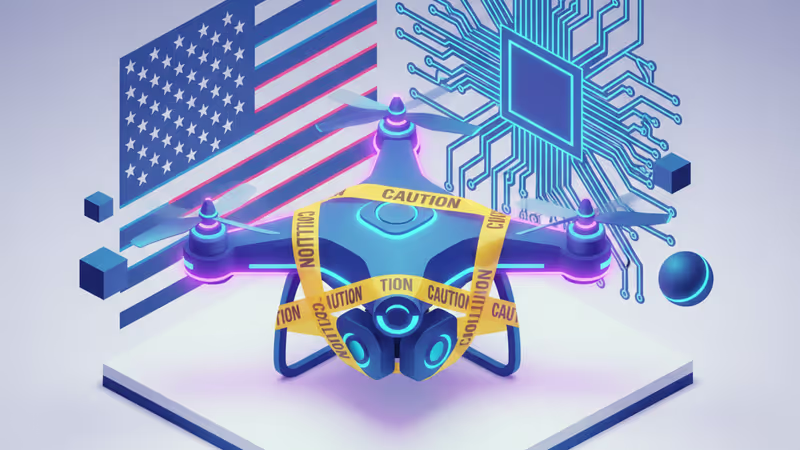
US Grounds Foreign Drones, Including DJI, Just Days Before Christmas
The U.S. FCC has banned new foreign drones, including market leader DJI, citing national security risks. Here's what the ban means for current owners, and why DJI is calling it protectionism.
Just days before Christmas, the U.S. has effectively banned the sale of new foreign drones, a move that targets the world's most popular drone maker, China-based . The decision by the Federal Communications Commission () raises immediate questions for consumers and industries that rely on the technology.
The Ban: National Security vs. Market Dominance
On Monday, the officially added foreign-made drones and their components to its "Covered List," effectively blacklisting them over national security concerns. The move impacts , a company that commands a staggering of the global drone market. According to the source, had recently agreed to comply with audits to avoid the blacklist, but the effort failed.
Brendan Carr, the Trump-appointed chair, stated the administration will "act to secure our airspace and unleash American drone dominance."
What If You Already Own a DJI Drone?
For the millions of U.S. consumers and businesses—from law enforcement to agriculture—who already use these drones, there’s some relief. The confirmed the ban doesn't affect existing drones. Americans can continue to own and operate their current devices.
In his statement, Carr clarified that the order "does not disrupt the ongoing use or purchase of previously authorized drones." This means retailers can also continue to sell off existing stock that has already been approved.
DJI Fires Back, Citing 'Protectionism'
DJI expressed its disappointment, criticizing the lack of transparency in the decision. "No information has been released regarding what information was used by the Executive Branch in reaching its determination," the company said in a statement. asserted that its products are among the "safest and most secure on the market," backed by reviews from U.S. government agencies. The company claims the concerns are not "grounded in evidence and instead reflect protectionism, contrary to the principles of an open market."
This ban is less about a single product and more about a strategic move in the ongoing U.S.-China tech decoupling. By citing national security, the U.S. is signaling a clear intent to build a domestic drone ecosystem, even if it disrupts a market dominated by a foreign player. The real story is the long-term push to control critical technology supply chains.
This content is AI-generated based on source articles. While we strive for accuracy, errors may occur. We recommend verifying with the original source.
Related Articles
The U.S. Federal Communications Commission (FCC) has banned new foreign-made drones, including those from DJI, adding them to its 'Covered List' due to national security risks.

The White House has paused five major offshore wind projects totaling 6 GW, citing national security concerns over radar interference. The move could exacerbate energy shortages for the East Coast's growing data center industry.

A critical flaw in humanoid robots allows a single voice command to trigger a network-wide takeover. Chinese researchers demonstrated the vulnerability, highlighting a new era of physical threats from AI agent exploits.
Hailed as a 'dark horse,' Chinese AI startup DeepSeek is being touted as a 'secret weapon' that could alter the AI tech war with the U.S. We analyze its geopolitical significance.
The U.S. Federal Communications Commission (FCC) has banned new foreign-made drones, including those from DJI, adding them to its 'Covered List' due to national security risks.
The White House has paused five major offshore wind projects totaling 6 GW, citing national security concerns over radar interference. The move could exacerbate energy shortages for the East Coast's growing data center industry.
A critical flaw in humanoid robots allows a single voice command to trigger a network-wide takeover. Chinese researchers demonstrated the vulnerability, highlighting a new era of physical threats from AI agent exploits.
Hailed as a 'dark horse,' Chinese AI startup DeepSeek is being touted as a 'secret weapon' that could alter the AI tech war with the U.S. We analyze its geopolitical significance.