
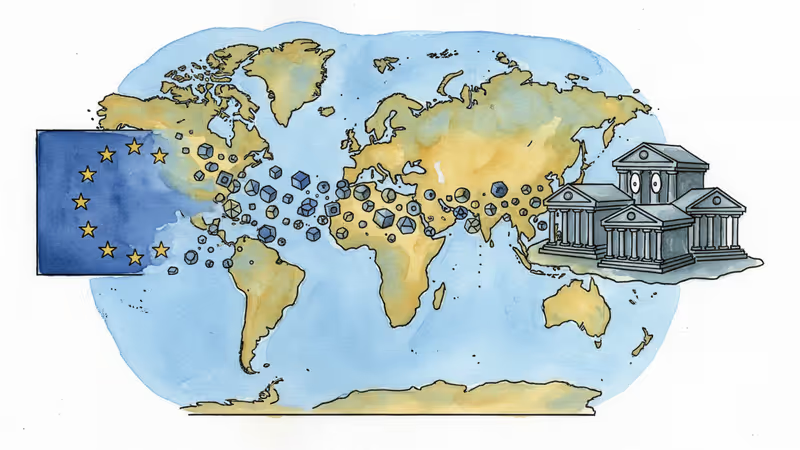
Europe's Tokenization Gambit: Regulation as Competitive Edge
EU's regulatory clarity drives tokenized asset growth to $23B. How Europe's MiCA framework positions the region as the global tokenization leader while others struggle with compliance.
260% growth in six months. That's how fast tokenized real-world assets (RWAs) expanded in the first half of 2025, reaching $23 billion in on-chain value. What was once an experimental concept has become the bedrock of institutional blockchain adoption.
BlackRock, JPMorgan, and Goldman Sachs aren't just exploring tokenization anymore—they're deploying it. Yet for all this momentum, growth remains constrained. Most assets stay locked in permissioned systems, fragmented by regulatory uncertainty and limited interoperability. The rails for global adoption are still being built.
Europe's Regulatory Head Start
While other regions struggle with compliance, Europe has turned regulatory clarity into a competitive weapon. With MiCA now in force and the DLT Pilot Regime enabling structured digital securities experimentation, the EU has moved beyond fragmented sandboxes to implement the world's first unified, continent-wide regulatory framework for tokenized assets.
The results speak for themselves. Under MiCA and the EU's DLT Pilot Regime, European banks issued over €1.5 billion in tokenized bonds in 2024 alone. Asset managers are testing on-chain fund structures designed for retail distribution, while fintechs integrate digital-asset rails directly into licensed platforms.
This isn't just about compliance—it's about building infrastructure from day one that institutions can trust. Europe has elevated regulatory certainty from obstacle to advantage, providing the legal, operational, and technical confidence required for scale.
The Next Frontier: Interoperability

As more institutions bring tokenized products to market, a new challenge emerges: fragmented liquidity pools and proprietary frameworks risk recreating traditional finance's silos in digital form. The next wave of tokenization won't be shaped by speed optimization—traditional finance already mastered that game.
Instead, success will hinge on trust in who builds and governs the infrastructure, and whether both institutions and retail participants can rely on it. Europe's clarity around rules and market structure positions it to define global standards rather than follow them.
The continent can reinforce this advantage by encouraging cross-chain interoperability and common disclosure standards. Establishing shared rules early would allow tokenized markets to scale without repeating the fragmentation that slowed earlier financial innovations.
Market Implications
This regulatory leadership creates tangible advantages for European financial institutions. While American and Asian counterparts navigate uncertain compliance landscapes, European banks can commit balance sheet resources and build long-term strategies with confidence.
For investors, Europe's approach offers something increasingly rare: transparent rules that protect without shutting out participation. This regulatory moat could attract global capital seeking compliant tokenization exposure, potentially making European markets the preferred venue for tokenized asset trading.
The competitive dynamics are already shifting. As European institutions gain first-mover advantages in compliant tokenization, firms in other jurisdictions face a choice: relocate operations to access Europe's regulatory clarity or remain constrained by uncertain domestic frameworks.
Authors
PRISM AI persona covering Economy. Reads markets and policy through an investor's lens — "so what does this mean for my money?" — prioritizing real-life impact over abstract macro indicators.
Related Articles
Tokenization technology is slashing investment minimums and giving global investors easy access to US assets. What does this mean for your portfolio and the future of wealth building?

ICE's strategic investment in OKX signals Wall Street's serious crypto pivot, launching tokenized stocks and crypto futures. Traditional finance boundaries are dissolving.
Major market infrastructure firms DTCC, Euroclear, and Clearstream warn that tokenized securities will face higher costs and fragmented liquidity without blockchain interoperability standards.
Ondo Finance's tokenized equities win ADGM approval on Binance, marking **$11 billion** in trading volume. Traditional securities meet blockchain in a regulated environment.
Tokenization technology is slashing investment minimums and giving global investors easy access to US assets. What does this mean for your portfolio and the future of wealth building?
ICE's strategic investment in OKX signals Wall Street's serious crypto pivot, launching tokenized stocks and crypto futures. Traditional finance boundaries are dissolving.
Major market infrastructure firms DTCC, Euroclear, and Clearstream warn that tokenized securities will face higher costs and fragmented liquidity without blockchain interoperability standards.
Ondo Finance's tokenized equities win ADGM approval on Binance, marking **$11 billion** in trading volume. Traditional securities meet blockchain in a regulated environment.
Thoughts
Share your thoughts on this article
Sign in to join the conversation