
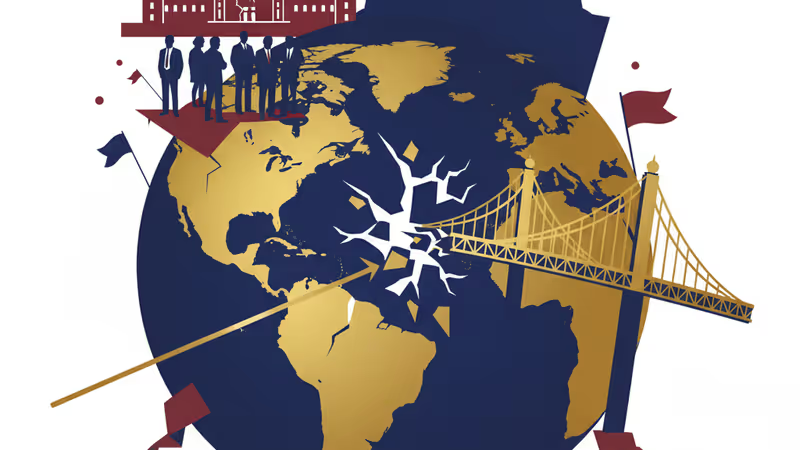
EU-Mercosur Implosion: Why Europe's Internal Division Is a Geopolitical Gift to China
The collapse of the EU-Mercosur trade deal is a strategic failure, creating a power vacuum in Latin America that China is poised to fill. Analysis and implications.
The Lede: A Strategic Failure, Not Just a Failed Deal
The near-collapse of the EU-Mercosur trade agreement, over two decades in the making, is far more than a diplomatic hiccup. For global executives, it’s a critical signal of Europe's waning geopolitical agility and a flashing red light for supply chain diversification strategies. As Brazilian President Lula issues a final ultimatum, the failure to create the world's largest free-trade area reveals a fractured Europe incapable of unified action, inadvertently ceding vast economic and strategic ground in Latin America to its primary global competitor: China.
Why It Matters: The Ripple Effects of a Power Vacuum
The immediate fallout is the loss of a market integrating over 780 million people. But the second-order effects are where the real risk lies:
- Supply Chain Recalibration: The deal was meant to be a cornerstone of 'friend-shoring' for both blocs. For the EU, it promised diversified access to agricultural products and critical raw materials for its green transition. For Mercosur, it was a gateway for value-added goods. Its failure forces businesses to double down on existing, often riskier, supply lines and signals to Latin America that Europe is not a reliable long-term partner.
- Geopolitical Dominance: Nature abhors a vacuum. China, already the top trading partner for Brazil and other Mercosur nations, will accelerate its influence. This isn't just about buying soybeans; it's about financing infrastructure, setting technological standards (like 5G and AI), and securing long-term resource contracts, effectively locking the EU out.
- Industry-Specific Setbacks: German auto manufacturers and Spanish industrial firms lose preferential access to a massive growth market. Conversely, Latin American agricultural exporters, from Brazilian beef producers to Argentine winemakers, are denied entry to 450 million European consumers, leaving them more dependent on Chinese demand.
The Analysis: A Classic Tale of Protectionism vs. Geostrategy
This deadlock is a textbook case of short-term domestic politics overriding long-term strategic imperatives. The conflict pits two distinct camps within the EU against each other:
The Industrial North: Led by Germany, this faction sees Mercosur as a vital export market and a necessary counterbalance to US protectionism and Chinese expansion. For them, the deal is a geopolitical necessity to maintain global relevance and secure future growth for their manufacturing base.
The Agrarian Bloc: Led by France and now joined by Italy, this group is beholden to powerful agricultural lobbies. They fear that a flood of cheaper South American beef, sugar, and ethanol will devastate their domestic farmers. Environmental concerns, such as Amazon deforestation, have become a convenient and publicly palatable justification for what is, at its core, economic protectionism.
President Lula’s threat to walk away is not a bluff. Brazil has made significant concessions, and with a potentially more protectionist and unpredictable Argentina under new leadership, the political window for Mercosur to act in unison is closing. Lula cannot afford to be seen by his domestic audience or regional partners as endlessly capitulating to European demands that are perceived as neo-colonialist.
PRISM Insight: The Digital and Green Supply Chain at Risk
Beyond traditional goods, this failure directly impacts the supply chains of the future. Latin America's 'Lithium Triangle' (Argentina, Bolivia, Chile) is critical for the EV batteries fueling Europe's green ambitions. The EU-Mercosur pact was designed to build a framework of trust, shared standards, and investment to secure these resources. Without it, Chinese firms, backed by state capital and a higher risk tolerance, are better positioned to dominate the extraction and processing of these critical minerals. This jeopardizes the EU’s entire 'Green Deal' and its goal of technological sovereignty, potentially making it dependent on its chief rival for the core components of its 21st-century economy.
PRISM's Take: Europe Is Playing Checkers in a Game of Geopolitical Chess
The inability to finalize the Mercosur deal is a profound strategic self-inflicted wound for the European Union. While the concerns of French and Italian farmers are politically potent, they are dwarfed by the long-term cost of ceding an entire continent's economic alignment to China. In an era defined by great power competition, the EU's failure to overcome internal divisions demonstrates a critical lack of strategic foresight.
This episode proves that for the EU to be a credible global power, it must be able to subordinate powerful domestic interests to achieve paramount geopolitical objectives. By failing this test, Brussels has not just lost a trade deal; it has signaled to the world that its internal politics make it an unreliable partner, leaving the door wide open for competitors to shape the future of global trade and alliances.
Related Articles
A US-South Africa diplomatic clash over Afrikaner refugees is more than a spat. It's a strategic shift ceding influence to rivals and creating new risks.
Trump's move to reclassify cannabis isn't just about drug policy. It's a calculated political gambit set to unlock Wall Street capital and reshape global markets.
A potential Trump peace plan for Gaza relies on international troops, but global reluctance reveals a critical flaw in post-war strategy and a new power vacuum.
Beijing is issuing longer-term rare earth export licenses. PRISM analyzes if this is a genuine policy shift or a strategic move to undermine Western supply chains.