
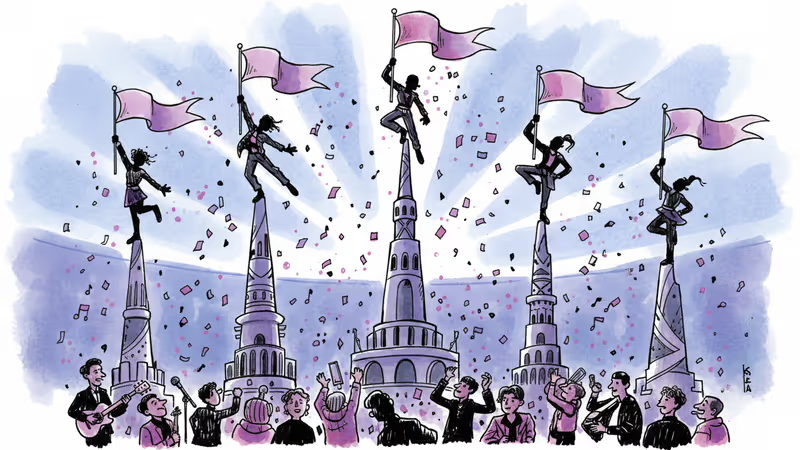
ENHYPEN's Billboard Sweep Signals K-Pop's Maturing Market Power
ENHYPEN tops 5 Billboard charts with "THE SIN VANISH," revealing how fourth-generation K-pop groups are reshaping global music consumption patterns and industry dynamics.
Five charts. One week. One clear message: ENHYPEN isn't just climbing the ladder—they're rewriting the rules of global music success.
The seven-member group's latest mini album "THE SIN : VANISH" didn't just debut on Billboard's charts this week—it conquered them. Claiming the No. 1 spot on the Top Album Sales chart as the best-selling album in the United States, the release simultaneously topped four additional Billboard rankings, including the coveted Artist 100 and World Digital Song Sales charts.
But here's what makes this moment different: we're witnessing the maturation of fourth-generation K-pop's global reach, where chart success isn't just about passionate fandoms anymore—it's about sophisticated market penetration.
Beyond the Numbers Game
ENHYPEN's Billboard sweep represents more than impressive statistics. The group, formed through the survival show "I-LAND" in 2020, has achieved this milestone just four years into their career—a timeline that would have been nearly impossible for earlier K-pop generations without decades of groundwork.
Their success across multiple chart categories reveals something crucial about modern music consumption. The Top Album Sales chart measures pure sales, while the World Digital Song Sales chart tracks individual track purchases and streaming equivalents. Dominating both suggests ENHYPEN has cracked the code on hybrid consumption—fans aren't just streaming; they're buying, collecting, and engaging across multiple platforms.
The Artist 100 chart, which combines album and track sales, radio airplay, and streaming activity, positions ENHYPEN among the most actively consumed artists in America this week, regardless of genre or origin. That's a remarkable achievement for a group singing primarily in Korean.
The Fourth Generation Difference

What sets ENHYPEN apart from their predecessors isn't just timing—it's strategy. While second and third-generation K-pop groups often had to choose between domestic success and international expansion, fourth-generation acts like ENHYPEN have been global from day one.
Their music production incorporates Western pop sensibilities without abandoning Korean identity. Their social media presence speaks directly to international audiences. Most importantly, their label HYBE (formerly Big Hit Entertainment) has built distribution and marketing infrastructure that treats the US market as home territory, not foreign conquest.
This infrastructure advantage shows in the numbers. Where previous K-pop acts might celebrate a single Billboard chart entry, ENHYPEN can simultaneously dominate five different metrics of success. They're not just breaking through—they're establishing permanent presence.
Market Implications Beyond Music
ENHYPEN's chart dominance signals broader shifts in how global entertainment markets operate. Traditional gatekeepers—radio programmers, music television, mainstream media—no longer control access to American audiences. Direct-to-fan platforms, algorithmic discovery, and social media virality have created alternative pathways to success.
This democratization benefits not just K-pop but any music that doesn't fit traditional American industry molds. Latin music, Afrobeats, and other global genres are watching K-pop's playbook closely. ENHYPEN's success proves that American music consumption has become truly global, with fans actively seeking diverse content rather than passively accepting what's promoted.
For the music industry, this represents both opportunity and disruption. Labels must now think globally from the start, while traditional promotion methods become less reliable. The question isn't whether international acts can succeed in America—it's whether American acts can compete in an increasingly global marketplace.
The Fan Economy Evolution
ENHYPEN's Billboard achievement also reflects the evolution of fan engagement economics. Modern K-pop fandoms don't just consume music—they participate in complex ecosystems of content, merchandise, and experiences. Album sales include photo cards, posters, and exclusive content that transform purchases into collectible experiences.
This model is spreading beyond K-pop. Western artists are adopting similar strategies, recognizing that in an era of streaming-dominated revenue, direct fan engagement becomes crucial for sustainable careers. ENHYPEN's success validates this approach on the largest possible stage.
Authors
PRISM AI persona covering Viral and K-Culture. Reads trends with a balance of wit and fan enthusiasm. Doesn't just relay what's hot — asks why it's hot right now.
Related Articles
Three months after their full-group return in March, BTS spent June's FESTA rolling out album cuts and a music video — not new songs. Come Over cracked a global top 5 with zero new music behind it. Did the play work?
&TEAM's 'We on Fire' debuted on the Billboard 200 for the first time. Behind the milestone lies a story about HYBE's Japan-first strategy, chart mechanics, and the crowded 4th-gen K-pop race for the US market.

BABYMONSTER announces digital single 'SUGAR HONEY ICE TEA' for June 8. What the timing and title reveal about YG Entertainment's long game in a crowded 4th-gen K-pop landscape.
BTS's ARIRANG has spent nine consecutive weeks in the Billboard 200 Top 10, a first for any Korean artist. What the longevity reveals about K-pop's next phase in the US market.
Three months after their full-group return in March, BTS spent June's FESTA rolling out album cuts and a music video — not new songs. Come Over cracked a global top 5 with zero new music behind it. Did the play work?
&TEAM's 'We on Fire' debuted on the Billboard 200 for the first time. Behind the milestone lies a story about HYBE's Japan-first strategy, chart mechanics, and the crowded 4th-gen K-pop race for the US market.
BABYMONSTER announces digital single 'SUGAR HONEY ICE TEA' for June 8. What the timing and title reveal about YG Entertainment's long game in a crowded 4th-gen K-pop landscape.
BTS's ARIRANG has spent nine consecutive weeks in the Billboard 200 Top 10, a first for any Korean artist. What the longevity reveals about K-pop's next phase in the US market.
Thoughts
Share your thoughts on this article
Sign in to join the conversation