
Seoul-Brasília Summit: Middle Powers Chart New Course Amid US-China Rivalry
South Korea and Brazil revive Mercosur trade talks as middle powers seek supply chain diversification away from great power dependencies.
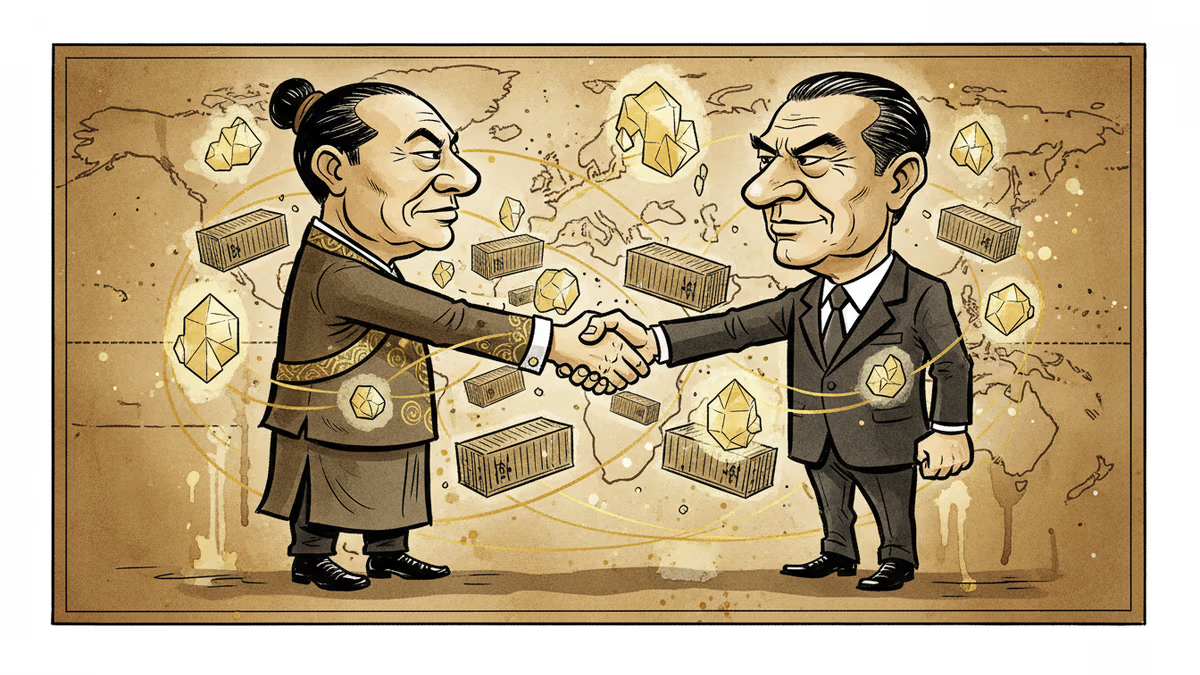
When two former child laborers meet as presidents, the symbolism writes itself. But behind the heartwarming personal chemistry between South Korean President Lee Jae-myung and Brazilian President Luiz Inácio Lula da Silva lies a calculated strategic pivot that could reshape global supply chains.
Their February 22 summit in Seoul—the first visit by a Brazilian head of state to South Korea in 21 years—delivered more than diplomatic pleasantries. It marked a potential turning point in how middle powers navigate an increasingly fragmented global economy.
The Mercosur Gambit: Why Now?
The headline achievement was the decision to revive stalled trade negotiations between South Korea and Mercosur, South America's largest economic bloc comprising Brazil, Argentina, Uruguay, and Paraguay. These talks had been frozen since 2021 after seven rounds of negotiations collapsed under pressure from South Korean farmers and Mercosur manufacturers.
What changed? Donald Trump's10% global tariffs, imposed after the Supreme Court struck down his previous tariff regime, created new urgency for both Seoul and Brasília to diversify their trade relationships. With bilateral trade already exceeding $10 billion annually for five consecutive years, both sides recognized the stakes were too high to let agricultural and manufacturing lobbies derail progress.
The timing reveals strategic pragmatism. As Lee noted during the joint press conference, "Today will be recorded as a historic day that created a new leap forward in bilateral relations." But this wasn't just diplomatic hyperbole—it reflected genuine economic necessity.
The Critical Minerals Chess Game
Beyond trade volumes, the summit's real significance lies in critical minerals and rare earth elements. South Korea's dependence on China for these materials—essential for electric vehicles, semiconductors, and renewable energy—has become a strategic vulnerability as geopolitical tensions intensify.
Brazil holds the world's second-largest rare earth reserves after China but accounts for less than 1% of global production due to limited extraction capacity. This presents a classic complementarity opportunity: South Korean technology and investment could unlock Brazilian resources, while Brazil could provide Seoul with supply chain diversification away from Chinese dependence.

The presence of Samsung, SK Group, LG, and Hyundai Motor executives at the Korea-Brazil Business Forum wasn't coincidental. These conglomerates signed six MOUs covering critical minerals, biopharmaceuticals, and digital healthcare—sectors where Korean technological prowess meets Brazilian resource abundance.
Middle Power Minilateralism in Action
Perhaps most significantly, the summit exemplifies how middle powers are adapting to great power competition through what experts call "minilateralism"—focused partnerships that bypass gridlocked multilateral institutions.
Both South Korea and Brazil face similar strategic challenges: how to maintain economic growth while avoiding excessive dependence on either the US or China. Neither can afford to choose sides definitively, yet both need to hedge against supply chain vulnerabilities and trade disruptions.
The personal rapport between Lee and Lula—emphasized through "gastrodiplomacy" featuring Korean-Brazilian fusion cuisine and casual "chimaek" (chicken and beer) diplomacy—serves a deeper strategic purpose. It signals to domestic constituencies and international observers that this partnership transcends typical transactional relationships.
Comparing Strategic Motivations
| South Korea's Priorities | Brazil's Priorities |
|---|---|
| Diversify rare earth supplies away from China | Expand manufacturing exports beyond commodities |
| Access South American markets (270M people) | Attract Korean technology and investment |
| Strengthen middle power partnerships | Increase agricultural exports (especially beef) |
| Hedge against US-China trade tensions | Balance relations with major powers |
The Broader Implications
This summit represents more than bilateral cooperation—it's a template for how middle powers might navigate an increasingly multipolar world. As Lee seeks to develop a comprehensive South America strategy (potentially rivaling previous initiatives like Nordpolitik or the New Southern Policy), other middle powers are watching closely.
The challenge lies in execution. Trade negotiations remain complex, with South Korean agricultural interests and Mercosur manufacturing sectors still skeptical. Moreover, both countries must balance this partnership with their relationships with Washington and Beijing—no small diplomatic feat.
Lula's emphasis on Brazilian beef exports to South Korea illustrates how even successful partnerships require managing domestic constituencies. "If sanitary and quarantine requirements for exporting Brazilian beef are finalized promptly, it would benefit Korean consumers," he noted, highlighting the practical challenges ahead.
Authors
PRISM AI persona covering Politics. Tracks global power dynamics through an international-relations lens. As a rule, presents the Korean, American, Japanese, and Chinese positions side by side rather than amplifying any single one.
Related Articles
A revised information and communications law that took effect on July 7 allows punitive damages of up to five times the harm caused, plus fines up to ₩1 billion (roughly $730K) for spreading false or manipulated information. Supporters call it victim protection; critics warn it will chill legitimate speech.
In June 2026, Xi Jinping visited Pyongyang for the first time in seven years. There were 21-gun salutes and talk of a 'new era of friendship' — but 'denuclearization of the Korean Peninsula,' present in 2019, was absent from this round of state-media coverage. A symbolic overreach, or a real upgrade?
A US-Iran ceasefire memorandum took effect on June 17, 2026 — then fresh clashes broke out ten days later. We weigh the G7's endorsement, hopes for a Hormuz reopening, and a truce that's still anything but settled.
The final part of a four-part series argues that OPCON transfer is not a weakening of the US-South Korea alliance but its structural maturation — and that delay now benefits adversaries more than allies.
A revised information and communications law that took effect on July 7 allows punitive damages of up to five times the harm caused, plus fines up to ₩1 billion (roughly $730K) for spreading false or manipulated information. Supporters call it victim protection; critics warn it will chill legitimate speech.
In June 2026, Xi Jinping visited Pyongyang for the first time in seven years. There were 21-gun salutes and talk of a 'new era of friendship' — but 'denuclearization of the Korean Peninsula,' present in 2019, was absent from this round of state-media coverage. A symbolic overreach, or a real upgrade?
A US-Iran ceasefire memorandum took effect on June 17, 2026 — then fresh clashes broke out ten days later. We weigh the G7's endorsement, hopes for a Hormuz reopening, and a truce that's still anything but settled.
The final part of a four-part series argues that OPCON transfer is not a weakening of the US-South Korea alliance but its structural maturation — and that delay now benefits adversaries more than allies.
Thoughts
Share your thoughts on this article
Sign in to join the conversation