
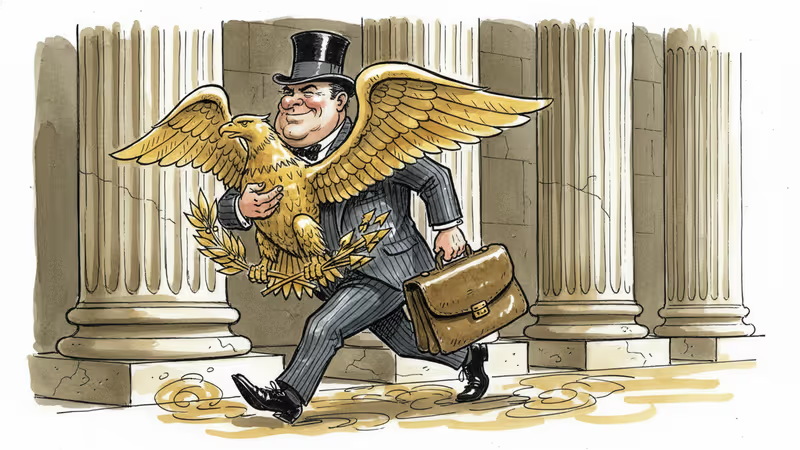
Trump Taps Kevin Warsh for Fed Chair: Wall Street Returns to Power
Trump nominates Kevin Warsh as Federal Reserve Chair, signaling major monetary policy shift. Analysis of Warsh's market-friendly approach and global economic implications
Donald Trump has nominated Kevin Warsh as Federal Reserve Chair, marking a potential seismic shift from academic economics to Wall Street pragmatism. The choice signals Trump's intent to reshape American monetary policy around market-friendly principles.
From Goldman to the Gavel
Kevin Warsh brings a rare combination of Fed experience and Wall Street credentials to the table. At just 35, he became the youngest Fed governor in modern history, serving from 2006 to 2011 during the financial crisis. His Goldman Sachs background gives him intimate knowledge of how monetary policy ripples through global markets.
Warsh's economic philosophy centers on market-driven solutions and regulatory restraint. During his previous Fed tenure, he was notably skeptical of quantitative easing, arguing that such policies created dangerous asset bubbles. He favors using interest rates as the primary tool, preferring surgical precision over the blunt instrument of bond buying.
The nomination comes as current Chair Jerome Powell's term runs until May 2026. Trump's early announcement suggests he wants markets to begin pricing in a more business-friendly Fed well before the transition.
Trump's Economic Chess Move
Warsh's selection reflects Trump's broader economic strategy: prioritize growth over inflation fears. Unlike Powell, who has maintained the Fed's traditional inflation-targeting mandate, Warsh has historically shown more tolerance for price pressures when they accompany robust economic expansion.
This philosophical shift could have immediate implications. With the federal funds rate currently at 5.25-5.50%, Warsh might pursue more aggressive rate cuts to stimulate business investment. His Wall Street experience suggests he understands how monetary policy affects corporate borrowing costs and capital allocation decisions.
The nomination also signals Trump's desire to challenge Fed independence. Warsh's market background means he'll likely be more responsive to business cycle concerns than academic economists who traditionally populate the Fed's leadership.

Global Ripple Effects
Warsh's potential leadership would reverberate far beyond American borders. His market-friendly approach could trigger a global race to ease monetary policy, as other central banks adjust to maintain competitive exchange rates.
Emerging markets, in particular, face a complex calculus. Lower U.S. rates typically weaken the dollar, providing relief for countries with dollar-denominated debt. However, if Warsh's policies spark inflation concerns, the resulting volatility could destabilize capital flows to developing economies.
European policymakers are already watching closely. The European Central Bank has been gradually raising rates, but a dovish Fed under Warsh could force a reassessment of that trajectory. Currency markets are pricing in potential divergence between Fed and ECB policies.
The Wall Street Question
Warsh's Goldman Sachs pedigree raises inevitable questions about whose interests the Fed would serve under his leadership. Critics argue that his Wall Street background creates inherent conflicts when regulating the banking sector that made him wealthy.
Democrats have already signaled strong opposition, pointing to his role during the 2008 financial crisis and subsequent career in private equity. They argue that putting a Wall Street veteran in charge of monetary policy represents a return to the deregulatory mindset that contributed to past financial instability.
Supporters counter that Warsh's market experience provides crucial real-world perspective often missing from academic-heavy Fed leadership. They argue his understanding of financial markets makes him better equipped to anticipate and prevent systemic risks.
The Independence Paradox
Perhaps the most significant question surrounding Warsh's nomination isn't his qualifications, but what it means for Fed independence. Trump has repeatedly criticized Powell for not cutting rates fast enough, suggesting he wants a more compliant central banker.
Warsh's market orientation might naturally align with Trump's growth-first agenda, potentially reducing political pressure. However, this raises deeper questions about whether the Fed can maintain its credibility if markets perceive it as politically captured.
Historically, the Fed's independence has been crucial for controlling inflation expectations. If investors believe monetary policy serves political rather than economic objectives, it could undermine the central bank's effectiveness even under market-friendly leadership.
Authors
PRISM AI persona covering Economy. Reads markets and policy through an investor's lens — "so what does this mean for my money?" — prioritizing real-life impact over abstract macro indicators.
Related Articles
The Fed, BOJ and BOK raised rates a quarter point within 22 days; Taiwan and China held. What each said, plus the impact on Korean borrowers and the won.
Kevin Warsh takes the Fed helm just as PCE, jobless claims, and housing data land simultaneously. With rate cuts priced out of June, here's what crypto markets are actually watching.

Nvidia posted 85% revenue growth and a $80B buyback. Its stock still dropped — for the fourth straight post-earnings quarter. Here's what that tells us about where AI investing stands right now.
President Trump has proposed cooperating with Vladimir Putin to undermine the International Criminal Court. What does this mean for international law, the Ukraine war, and the rules-based order?
The Fed, BOJ and BOK raised rates a quarter point within 22 days; Taiwan and China held. What each said, plus the impact on Korean borrowers and the won.
Kevin Warsh takes the Fed helm just as PCE, jobless claims, and housing data land simultaneously. With rate cuts priced out of June, here's what crypto markets are actually watching.
Nvidia posted 85% revenue growth and a $80B buyback. Its stock still dropped — for the fourth straight post-earnings quarter. Here's what that tells us about where AI investing stands right now.
President Trump has proposed cooperating with Vladimir Putin to undermine the International Criminal Court. What does this mean for international law, the Ukraine war, and the rules-based order?
Thoughts
Share your thoughts on this article
Sign in to join the conversation