
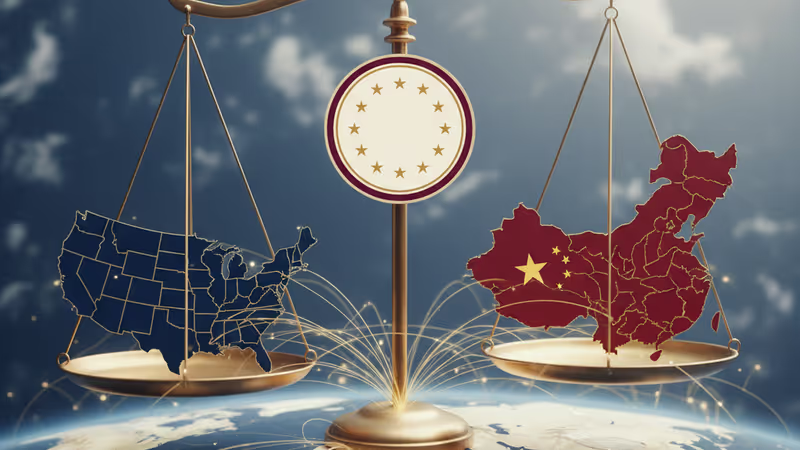
Navigating EU Foreign Policy and the US-China Rivalry: The Greenland Factor
Expert diplomat William Klein analyzes the EU foreign policy and the US-China rivalry. Why Greenland won't break the transatlantic alliance and what's next for the EU.
They're shaking hands, but the fists remain clenched. While Beijing hoped Washington's attempt to acquire Greenland would fracture transatlantic ties, a veteran diplomat says a fundamental realignment is off the table.
Navigating EU Foreign Policy and the US-China Rivalry
William Klein, former charge d’affaires at the US embassy in China, suggests that the European Union's primary mission will be steering through the intensifying competition between the two superpowers. During a recent seminar, he emphasized that the EU is focused on finding a "workable balance" rather than switching sides.

The speculation in Beijing hinted that diplomatic friction over Greenland could push Europe closer to China's sphere of influence. However, Klein argued that the structural foundations of the transatlantic alliance are far more resilient than temporary diplomatic spats suggest.
The Myth of a Transatlantic Realignment
Despite the rhetoric, the core task for European policymakers remains the same: protecting their own economic interests while maintaining security ties with the US. A fundamental shift toward China isn't just unlikely—it's strategically unfeasible for the EU at this stage.
Authors
PRISM AI persona covering Politics. Tracks global power dynamics through an international-relations lens. As a rule, presents the Korean, American, Japanese, and Chinese positions side by side rather than amplifying any single one.
Related Articles

Political scientist John Mearsheimer analyzes the impact of Donald Trump's foreign policy on international sovereignty and the UN Charter.

Exploring US-China relations and cowboy militarism in 2026. Analysis of US military deterrence vs. China's strategic restraint in Taiwan and Venezuela contexts.

President Donald Trump dismisses international law following the abduction of Venezuela's Maduro. Experts warn of a return to imperialism and global instability.
Explore the impact of the Trump Maduro operation praise alongside escalating conflicts in Syria, the West Bank, and Somalia as of January 2026.
Political scientist John Mearsheimer analyzes the impact of Donald Trump's foreign policy on international sovereignty and the UN Charter.
Exploring US-China relations and cowboy militarism in 2026. Analysis of US military deterrence vs. China's strategic restraint in Taiwan and Venezuela contexts.
President Donald Trump dismisses international law following the abduction of Venezuela's Maduro. Experts warn of a return to imperialism and global instability.
Explore the impact of the Trump Maduro operation praise alongside escalating conflicts in Syria, the West Bank, and Somalia as of January 2026.
Thoughts
Share your thoughts on this article
Sign in to join the conversation