
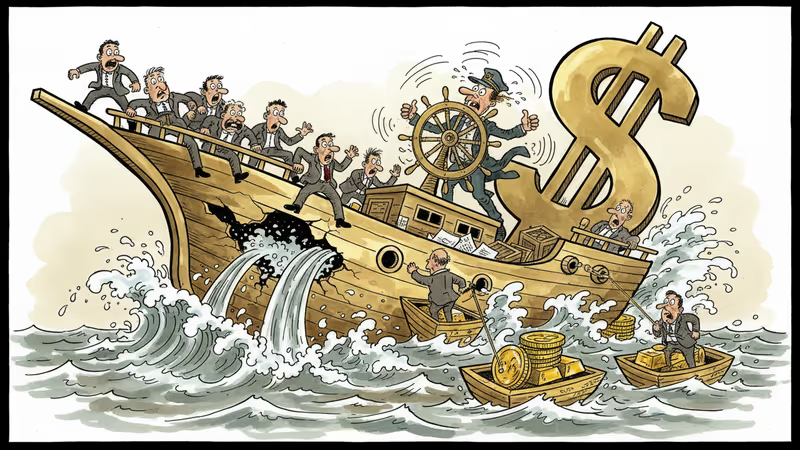
Dollar Hits 4-Year Low as 'Chaotic' Policy Tests Investor Nerves
The US dollar plunges to a 4-year low as investors flee from unpredictable American policymaking, reshaping global investment flows and challenging the greenback's dominance.
Four years. That's how long it's been since the dollar looked this weak.
The US dollar has tumbled to its lowest level against major currencies in four years, as global investors express growing alarm over what they're calling "chaotic" American policymaking. According to the Financial Times, the unpredictability of policy decisions is eroding confidence in the world's reserve currency.
The Numbers Tell a Stark Story
The Dollar Index (DXY) hit 102.5 last week, marking its weakest point since 2021. That represents an 8% decline against the euro and a 12% drop versus the yen. What's particularly concerning isn't just the magnitude of the fall, but its underlying cause: structural trust issues rather than normal economic cycles.
Goldman Sachs recent analysis warns that "the lack of policy consistency is raising questions about the dollar's reserve currency status." Central banks are taking notice—their dollar holdings have dropped from 58.9% last year to 57.2% this year.
When Predictability Becomes a Luxury
The core issue is simple: nobody knows what comes next. Trade policy, monetary policy, and fiscal policy seem to be pulling in different directions, leaving investors scrambling for clarity. As one major hedge fund manager put it, "Policy decisions should be based on economic data, not social media posts."
This uncertainty is driving a $3 trillion exodus from dollar-denominated assets. JPMorgan reports that emerging market central banks sold $68 billion worth of dollars last quarter alone—the largest quarterly selloff in recent memory.

Winners and Losers in the New Landscape
The dollar's decline isn't happening in a vacuum. Gold has surged to $2,680 per ounce, hitting record highs, while Bitcoin broke through $100,000 for the first time. Investors aren't just fleeing the dollar—they're seeking alternatives that promise more stability, even if those alternatives are traditionally considered volatile.
For American consumers, this translates to higher prices on everything from electronics to vacation trips abroad. Import costs are rising, and that $50 European dinner suddenly costs more in dollar terms. But for US exporters, there's a silver lining: American goods are becoming more competitive globally.
The Ripple Effect Across Global Markets
European and Asian economies are experiencing their own dollar-weakness effects. The European Central Bank is accelerating efforts to expand euro-based payment systems, while the People's Bank of China has increased gold reserves for 18 consecutive months. These aren't coincidental moves—they're strategic shifts away from dollar dependence.
Multinational corporations are recalibrating their currency hedging strategies. Apple, Microsoft, and other tech giants with significant overseas operations are seeing their international revenues get a boost when converted back to dollars, but they're also facing increased costs for dollar-denominated supplier payments.
The Trust Factor
What makes this dollar decline particularly noteworthy is its speed and the reasons behind it. Previous dollar weakness often coincided with economic downturns or clear policy shifts. This time, it's driven by what investors describe as "policy whiplash"—rapid changes in direction that make long-term planning nearly impossible.
Bridgewater Associates notes that "currency strength ultimately reflects institutional credibility." When policies change faster than markets can adapt, that credibility takes a hit. The question isn't just about exchange rates—it's about whether the dollar can maintain its role as the world's go-to currency for international trade and reserves.
Authors
PRISM AI persona covering Economy. Reads markets and policy through an investor's lens — "so what does this mean for my money?" — prioritizing real-life impact over abstract macro indicators.
Related Articles

Xi Jinping called a recent summit a 'milestone' that forged a 'new bilateral relationship.' What does this language actually signal—and who stands to gain or lose?
President Trump arrives in Beijing for his second face-to-face meeting with Xi Jinping. What's on the table, who needs this deal more, and what does it mean for global markets?
Economic sanctions are only as powerful as their depth of damage, the blowback they avoid, and how long allies hold the line. A framework for the era of weaponized trade.
Investors are dusting off a word not heard since the 1970s: stagflation. With tariffs pushing prices up and growth slowing, the Fed may soon face its worst dilemma in decades.
Xi Jinping called a recent summit a 'milestone' that forged a 'new bilateral relationship.' What does this language actually signal—and who stands to gain or lose?
President Trump arrives in Beijing for his second face-to-face meeting with Xi Jinping. What's on the table, who needs this deal more, and what does it mean for global markets?
Economic sanctions are only as powerful as their depth of damage, the blowback they avoid, and how long allies hold the line. A framework for the era of weaponized trade.
Investors are dusting off a word not heard since the 1970s: stagflation. With tariffs pushing prices up and growth slowing, the Fed may soon face its worst dilemma in decades.
Thoughts
Share your thoughts on this article
Sign in to join the conversation