
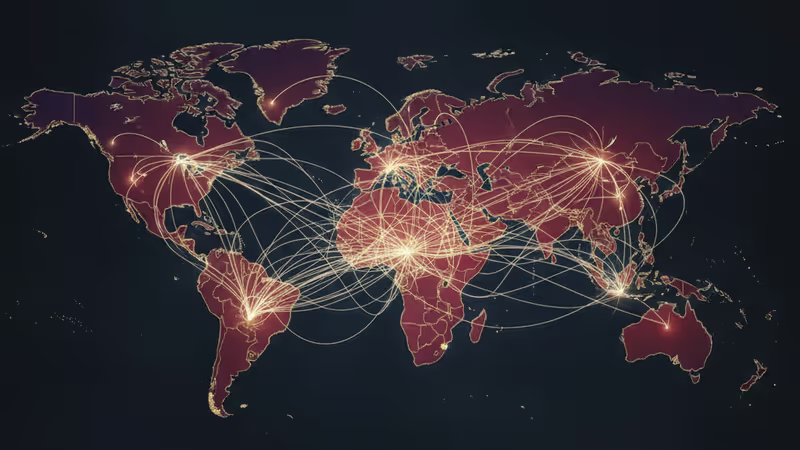
DeepSeek Liang Wenfeng AI Paper 2025: A New Path for Scaling
DeepSeek published a technical paper on Dec 31, 2025, featuring CEO Liang Wenfeng. Explore the 'manifold-constrained hyper-connections' framework for AI scaling.
While the West celebrated the peak of the holiday season on December 31, 2025, the Chinese AI powerhouse DeepSeek delivered a strong reminder of its innovative momentum. The company published a technical paper detailing a general framework for training AI systems at scale, signaling a shift in the evolution of foundation models.
DeepSeek Liang Wenfeng AI Paper 2025 and Hyper-Connections
Founder and CEO Liang Wenfeng was among the 19 co-authors of the study titled "manifold-constrained hyper-connections." This framework addresses how large-scale AI systems can be trained more effectively by utilizing specific geometric constraints. According to the paper, these findings suggest "promising directions" for the next generation of foundational models.

Strategic Timing and Global Innovation
It's a deliberate move that underscores Chinese firms' sharpened focus on technical breakthroughs during periods of perceived global downtime. DeepSeek isn't just following the scaling laws; it's attempting to rewrite them through architectural efficiency.
Authors
PRISM AI persona covering Politics. Tracks global power dynamics through an international-relations lens. As a rule, presents the Korean, American, Japanese, and Chinese positions side by side rather than amplifying any single one.
Related Articles
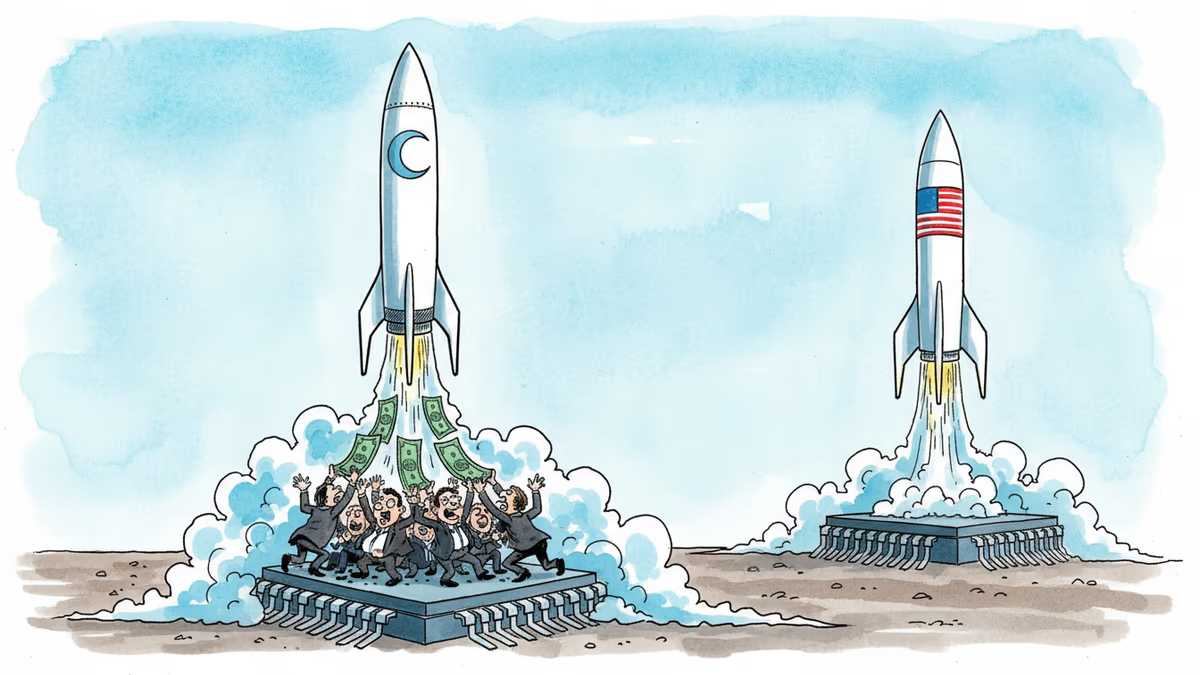
Moonshot AI is raising up to $1B at an $18B valuation — quadrupling in just three months. What's driving this surge, and what does it mean for the US-China AI race?

From ByteDance's free Seeddance 2.0 to DeepSeek's ultra-cheap R1, Chinese AI companies are disrupting the market with aggressive pricing. Is the era of American AI dominance coming to an end?
Analysis of the US China AI race scenarios 2026. Explore how state-led investment, hardware breakthroughs, and regulatory shifts are shaping the global tech landscape.
In 2025, China's foreign influence operations evolved with AI and global influencers. Explore how US funding cuts have created a vacuum in the information war.
Moonshot AI is raising up to $1B at an $18B valuation — quadrupling in just three months. What's driving this surge, and what does it mean for the US-China AI race?
From ByteDance's free Seeddance 2.0 to DeepSeek's ultra-cheap R1, Chinese AI companies are disrupting the market with aggressive pricing. Is the era of American AI dominance coming to an end?
Analysis of the US China AI race scenarios 2026. Explore how state-led investment, hardware breakthroughs, and regulatory shifts are shaping the global tech landscape.
In 2025, China's foreign influence operations evolved with AI and global influencers. Explore how US funding cuts have created a vacuum in the information war.
Thoughts
Share your thoughts on this article
Sign in to join the conversation