
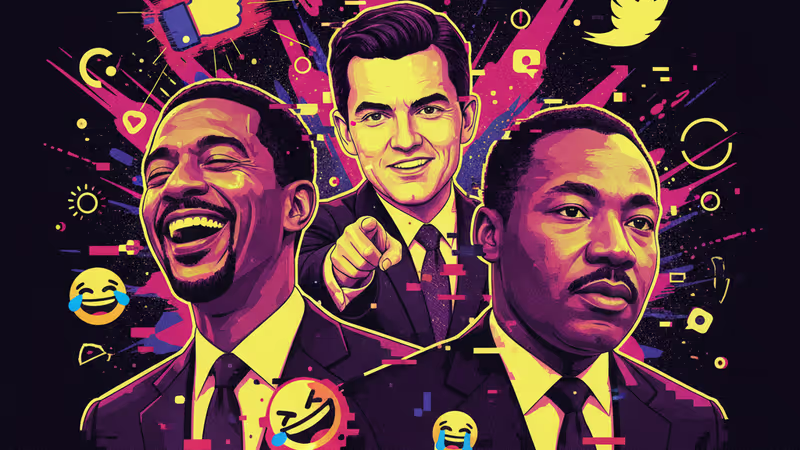
Dave Chappelle Unpacks Charlie Kirk, MLK, and the Perilous Architecture of Internet Fame
The Lede: Beyond the Laughs, A Scathing Look at Digital Influence
Dave Chappelle’s latest Netflix special, 'The Unstoppable,' delivers more than just boundary-pushing comedy; it offers a stark, unfiltered commentary on the very mechanisms of modern influence and the alarming ease with which historical legacies are distorted. By dedicating significant airtime to the recent death of conservative media personality Charlie Kirk and lampooning his supporters' comparisons to Martin Luther King Jr., Chappelle isn't just landing jokes—he's diagnosing the structural flaws in our digital public square. For any executive navigating media, tech, or brand reputation, Chappelle's analysis is a crucial, albeit uncomfortable, mirror reflecting the realities of virality, outrage, and the commodification of truth.
Why It Matters: The Shifting Sands of Authority and Authenticity
Chappelle's 'The Unstoppable' isn't merely celebrity gossip; it's a critical barometer for several interconnected industries:
- Media & Entertainment: It underscores the enduring power of raw, unedited commentary in an era of curated narratives. Netflix's continued investment in Chappelle despite past controversies highlights a strategic bet on 'unfiltered' content as a draw, signaling a demand for artists who dare to provoke. This is a blueprint for content strategies that prioritize impact over consensus.
- Tech & Social Media Platforms: Chappelle's assertion that 'Internet n----s are negative because they have to be' isn't just a punchline; it's a searing indictment of algorithmic design. Platforms that reward engagement above all else inadvertently incentivize outrage, division, and superficiality. This poses existential questions about platform responsibility, content moderation, and the long-term health of digital discourse.
- Brand & Reputation Management: The special serves as a cautionary tale. In the digital age, figures like Kirk can amass immense followings rapidly, but their influence is often built on an unstable foundation of reactive, often negative, engagement. Understanding this dynamic is crucial for brands seeking genuine connection, not just fleeting attention. The ease with which figures are co-opted or mislabeled ('this generation's MLK') reveals a dangerous fluidity in public perception.
The Analysis: Echoes of the Past, Algorithms of the Present
Chappelle's unique position—a legacy artist observing and critiquing the digital landscape from a seasoned, somewhat detached perspective—lends his commentary significant weight. He draws a stark, uncomfortable parallel between Kirk and King not through shared ideals, but through a shared fate of public assassination, immediately tearing down any genuine comparison. “They both got shot in the neck,” he deadpans, before clarifying, “But that’s about where those similarities ended.” This brutal truth-telling forces a re-evaluation of what constitutes 'legacy' and 'impact' in an age saturated with digital noise.
The core of Chappelle's critique lies in his dissection of the 'internet personality.' He argues that figures like Kirk are fundamentally different from historical leaders because their very existence is predicated on generating engagement through negativity. Martin Luther King Jr.'s movement was built on a vision of unity, justice, and systemic change, requiring profound moral courage and sustained, often dangerous, organizing. Charlie Kirk, by contrast, leveraged digital platforms to amplify a partisan viewpoint, thriving on controversy and the immediate, often reactive, feedback loops of the internet. This isn't just a difference in ideology; it's a difference in the very physics of their influence. One sought to transcend division; the other often amplified it.
PRISM Insight: The Unseen Costs of the Attention Economy
The 'Chappelle-Kirk' dynamic illuminates a critical trend for investors and innovators: the increasing fragility and cost of digital fame. While the creator economy booms, the careers of 'internet personalities' are often volatile, their longevity tied to maintaining a constant stream of viral content, which, as Chappelle notes, often defaults to negativity. This creates a high-burnout, high-risk environment. The true innovation and investment opportunity lies not just in *creating* more platforms for voices, but in developing models that incentivize healthier, more constructive forms of engagement—or, failing that, understanding the precise mechanics of how 'negative engagement' generates value, and the societal cost it extracts.
Furthermore, the episode highlights the ongoing battle for narrative control. In a post-truth era, the ability to co-opt historical figures or redefine public personas (e.g., calling Kirk 'this generation's MLK') represents a powerful, and often dangerous, form of informational warfare. Technologies like AI and deepfakes will only accelerate this trend, making it harder to discern authentic legacy from manufactured narrative. Understanding who is shaping these narratives, and why, becomes an essential intelligence for any forward-looking enterprise.
PRISM's Take: The Digital Mirror Reflects Our Fractured Reality
Dave Chappelle, in his inimitable fashion, acts as a societal mirror, reflecting back the uncomfortable truths about our digital existence. His comedic takedown of the Kirk-MLK comparison isn't just a joke; it's a stark warning against the historical illiteracy and algorithmic pressures that conflate viral outrage with genuine impact. For businesses and leaders, the takeaway is clear: the architecture of the internet incentivizes division, and the 'fame' it produces is often a double-edged sword, built on foundations of controversy rather than contribution. To thrive in this environment, one must not only understand the platforms but also the profound psychological and sociological undercurrents that Chappelle so expertly exposes. Ignoring these signals means operating blind in an increasingly complex and morally ambiguous digital landscape.
Related Articles

Gisele Bündchen's private wedding signals a strategic shift in celebrity branding, prioritizing privacy and authenticity over public spectacle in the digital age.

The heavily redacted Epstein files spark global outrage, revealing a critical disconnect between institutional transparency and public trust in the digital age. PRISM analyzes the impact.

The bizarre demand for Trump's 'peace prize' to match the World Cup trophy reveals the escalating spectacle of modern politics and its implications for global brands.
An 86-year-old was fined $334 for spitting a leaf. PRISM explores how this seemingly absurd event highlights the dangers of over-enforcement, eroding common sense, and the need for ethical 'smart city' tech.