
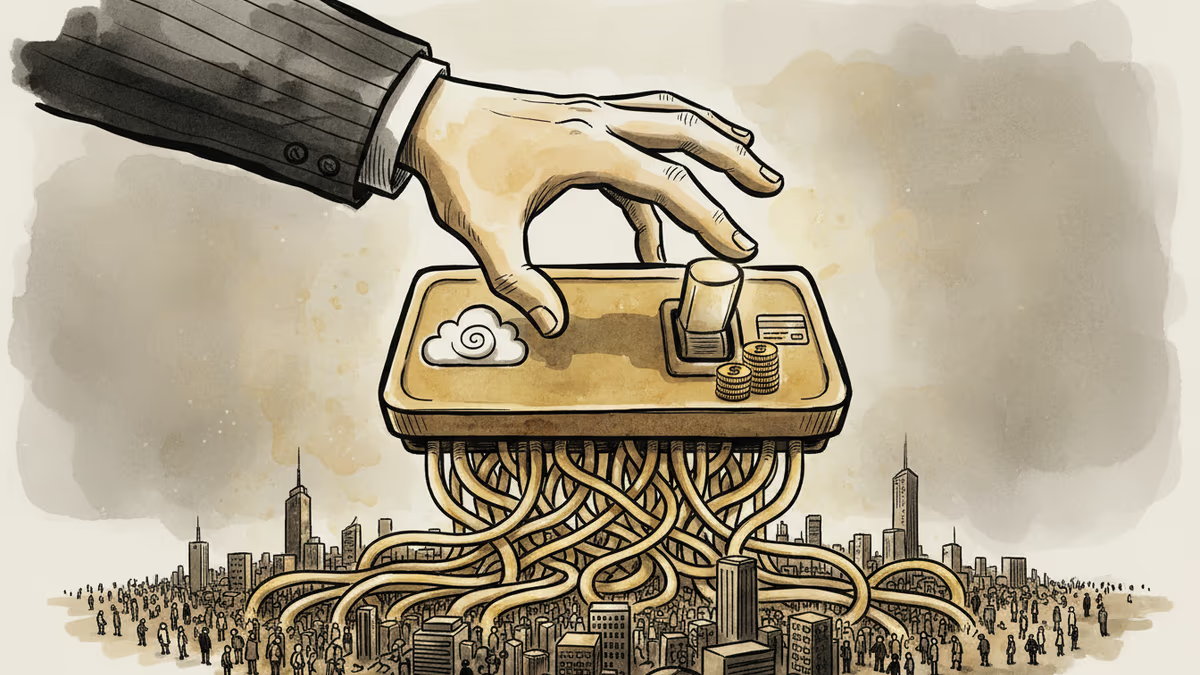
Who Controls the Off Switch for the Global Internet?
From cloud servers to payment rails, the world's digital infrastructure runs through a handful of American companies. What happens if Washington pulls the plug?
In March 2022, Russia didn't lose a war on a battlefield. It lost one in a server room.
Within days of the Ukraine invasion, Visa and Mastercard suspended Russian operations. Apple and Google pulled state media apps from their stores. Microsoft halted new sales. Oracle and SAP walked out. None of this required an act of Congress. No treaty was invoked. Private companies, responding to a mix of sanctions pressure and reputational calculus, effectively severed a G20 economy from the global digital system—faster and more completely than any military embargo in history.
That's what a digital kill switch looks like when it's actually used.
The Infrastructure You Don't See
The phrase "digital kill switch" sounds dramatic. The underlying reality is more mundane—and more unsettling for that reason.
Three American companies—Amazon Web Services, Microsoft Azure, and Google Cloud—control 66% of the global cloud infrastructure market. The majority of international internet traffic flows through undersea cables majority-owned or operated by US entities. More than 95% of global payment transactions touch Visa, Mastercard, or SWIFT—the last of which operates under significant US regulatory influence. The dominant mobile operating systems, iOS and Android, are American. The chip design software that every major semiconductor fab on earth depends on—Synopsys and Cadence—is American.
This isn't a conspiracy. It's the residue of three decades of American technological leadership, network effects, and first-mover advantage. But it has a geopolitical consequence that is only now being fully reckoned with: Washington holds a structural veto over the digital operations of nearly every country on earth.
The Huawei Precedent
The Russia case was dramatic, but the more instructive precedent is Huawei.

In May 2019, the US Commerce Department added Huawei to its Entity List. Google was compelled to revoke Huawei's Android license. Overnight, the world's second-largest smartphone maker lost access to the Google Play Store, Gmail, and Maps on all future devices. Huawei's global smartphone market share collapsed from second place to effectively out of the top five within two years.
The lesson wasn't lost on anyone. A single regulatory filing in Washington had more impact on a $100 billion company than any competitive product launch could have. And crucially, the mechanism didn't require military force, trade negotiations, or even a formal embargo. It required one government agency adding one name to one list.
Three Layers of Exposure
Not all digital dependency is equal. It's useful to think in layers.
Consumer services—YouTube, Instagram, Netflix—sit at the top. Losing them is disruptive. Alternatives exist, even if inferior. This is the layer most people think of when they imagine digital decoupling.
Enterprise infrastructure—AWS, Salesforce, Microsoft 365—is the middle layer, and far more consequential. Banks run their core systems here. Manufacturers run their supply chain software here. Hospitals run their patient records here. Losing access doesn't mean inconvenience; it means operational paralysis.
Deep infrastructure—semiconductor EDA tools, networking protocols, cryptographic standards—is the layer that almost nobody talks about publicly, and the one that matters most. There is currently no non-American alternative to Synopsys or Cadence for advanced chip design. Countries that want to build next-generation semiconductors must use American software to do it. Full stop.
This tiered structure means that even countries with robust domestic consumer tech—China's WeChat, South Korea's KakaoTalk, Russia's VKontakte—remain exposed at the infrastructure and deep-tech layers in ways that consumer-facing alternatives cannot fix.
The Alternatives Are Harder Than They Look
Europe tried. The Gaia-X project, launched in 2020 with considerable fanfare, aimed to build a sovereign European cloud ecosystem. By 2022, Amazon, Google, and Microsoft had all joined as members. The initiative's independence credentials were, to put it diplomatically, complicated.
China took a harder path: mandatory data localization, aggressive domestic cloud champions (Alibaba, Huawei, Baidu), and effective exclusion of foreign providers from sensitive sectors. The result is genuine autonomy within China's borders—but at the cost of near-total disconnection from the global digital economy. It's sovereignty purchased with isolation.
The European and Chinese experiences reveal a structural dilemma that no country has cleanly resolved: the same network effects that make American platforms so useful are the ones that make them so hard to leave. Switching costs aren't just financial. They're measured in compatibility, talent pipelines, developer ecosystems, and years of institutional muscle memory.
This content is AI-generated based on source articles. While we strive for accuracy, errors may occur. We recommend verifying with the original source.
Related Articles
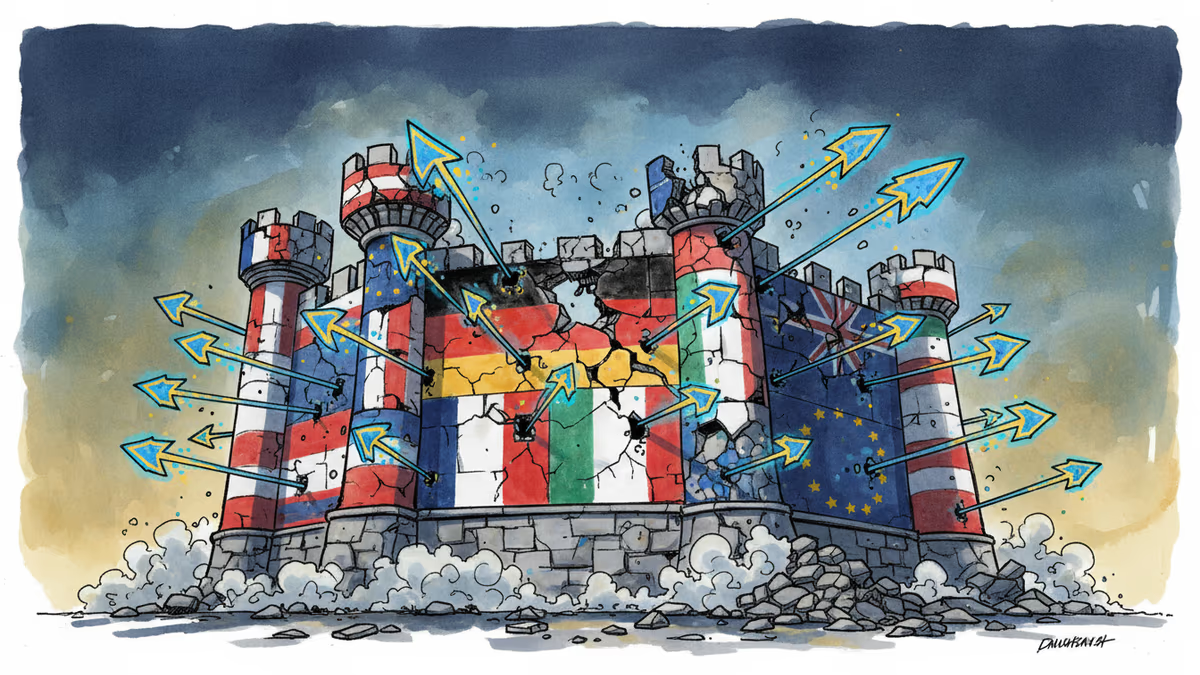
EU's push for digital sovereignty is creating dangerous security gaps, military officials warn. Here's why the cure might be worse than the disease.
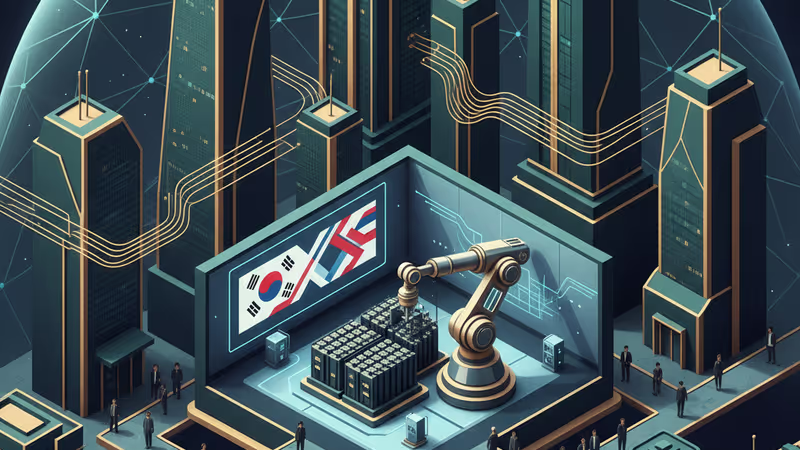
US battery makers are shifting their supply chains from China to South Korea in 2026 to comply with Washington's drone and eVTOL restrictions. Learn about the economic impact.
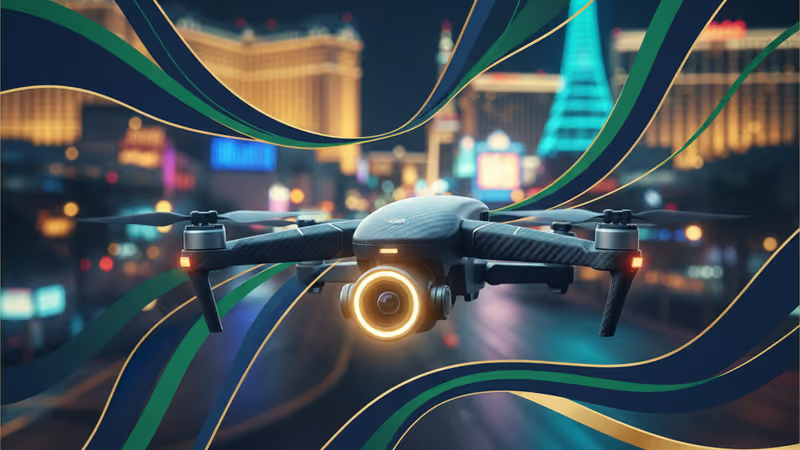
At CES 2026, Insta360 announced its entry into the US drone market with the Antigravity A1, seizing the opportunity left by DJI's regulatory bans.
Nestle has issued a global baby formula recall in 2026 due to cereulide toxin fears. Learn which batches of SMA, Beba, and Guigoz are affected and the impact on the company.
EU's push for digital sovereignty is creating dangerous security gaps, military officials warn. Here's why the cure might be worse than the disease.
US battery makers are shifting their supply chains from China to South Korea in 2026 to comply with Washington's drone and eVTOL restrictions. Learn about the economic impact.
At CES 2026, Insta360 announced its entry into the US drone market with the Antigravity A1, seizing the opportunity left by DJI's regulatory bans.
Nestle has issued a global baby formula recall in 2026 due to cereulide toxin fears. Learn which batches of SMA, Beba, and Guigoz are affected and the impact on the company.
Thoughts
Share your thoughts on this article
Sign in to join the conversation