
Xi Jinping Orders China's State-Owned Enterprises to Secure Critical Tech
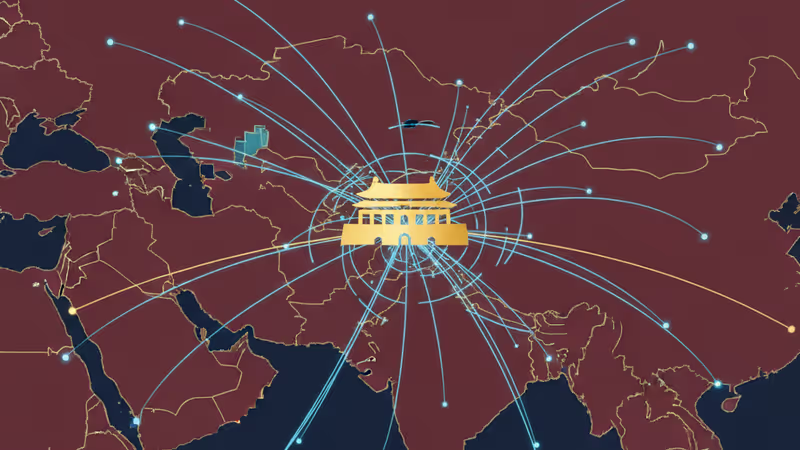
President Xi Jinping has mandated China's central state-owned enterprises to lead industrial upgrading and secure key technologies, signaling a major push in the state-led development model amid global tech rivalries.
The state is officially back in the driver's seat of China's tech ambitions. President Xi Jinping has instructed the nation's massive central state-owned enterprises (SOEs) to become the 'bedrock of national development' by spearheading industrial upgrades and securing critical technologies. The move signals a clear pivot towards state-led control to win the next phase of global competition.
A Directive from the Top
In remarks delivered to a meeting of central SOE leaders in Beijing this week, Xi stressed that these companies must "fully recognise the responsibilities and missions they shoulder and better serve the overall priorities of the party and the state." This effectively tasks the state-controlled giants with achieving technological self-sufficiency in areas like semiconductors, AI, and biotech, shielding China's economy from external pressures.
Why Double Down on State Control?
China's SOEs wield enormous capital and operate with the full backing of the government, allowing them to make long-term, high-risk investments that private firms might shun. As the tech rivalry with the United States intensifies, Beijing appears to view its private sector as vulnerable to foreign sanctions. Empowering SOEs is a strategic bet on creating a more resilient, state-controlled innovation pipeline.
However, this approach isn't without its critics. Opponents argue that a heavy-handed state role could stifle the very dynamism and creativity that fueled China's tech boom, potentially leading to inefficient capital allocation and politically motivated projects rather than true market-driven innovation.
This content is AI-generated based on source articles. While we strive for accuracy, errors may occur. We recommend verifying with the original source.
Related Articles
Brazil is preparing to waive visa requirements for Chinese tourists and business travelers, with an announcement expected in early 2026. The move aims to deepen ties with its largest trading partner, China.
Former Trump adviser Robert O'Brien calls South Korea's probe into Coupang's 33.7M user data leak an "aggressive targeting," sparking fears of a US-Korea trade dispute.
Four prisoners in the UK linked to Palestine Action are continuing a hunger strike despite severe health risks. This article covers their demands and the escalating political fallout.
The US, China, and Russia have clashed at the United Nations over Washington's seizure of Venezuelan oil tankers, with Beijing accusing the US of violating international law.
Brazil is preparing to waive visa requirements for Chinese tourists and business travelers, with an announcement expected in early 2026. The move aims to deepen ties with its largest trading partner, China.
Former Trump adviser Robert O'Brien calls South Korea's probe into Coupang's 33.7M user data leak an "aggressive targeting," sparking fears of a US-Korea trade dispute.
Four prisoners in the UK linked to Palestine Action are continuing a hunger strike despite severe health risks. This article covers their demands and the escalating political fallout.
The US, China, and Russia have clashed at the United Nations over Washington's seizure of Venezuelan oil tankers, with Beijing accusing the US of violating international law.