
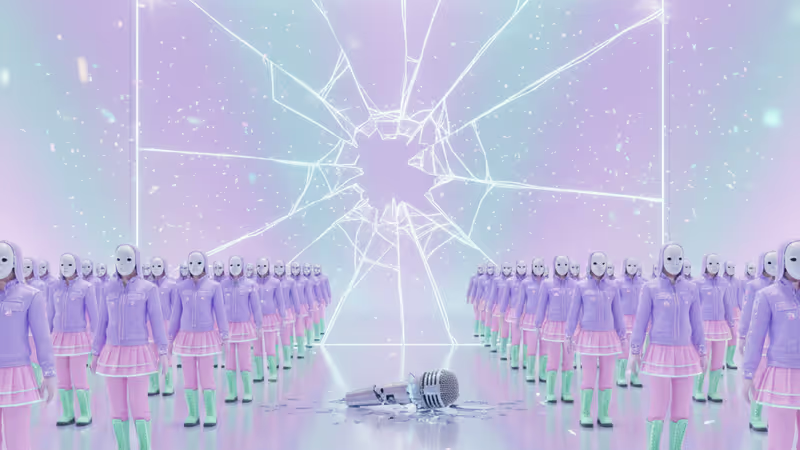
China's Idol Factory Implodes: Why the SNH48 Rebellion Is a Warning Shot for the Global Entertainment Industry
An ex-SNH48 member's exposé of China's idol industry reveals a broken business model. This is a critical warning for global entertainment.
The Lede: Beyond Fan Drama, A Business Model on the Brink
When a former member of a multi-million dollar idol franchise accuses her agency of forgery and running a system of indentured servitude, executives should pay attention. The public fallout surrounding China’s SNH48 and its agency, SIBA Media, is far more than celebrity gossip. It’s a case study in the catastrophic failure of a talent management model built on total control in an era of creator empowerment. This isn't a C-Pop problem; it's a canary in the coal mine for any business that leverages human talent as its primary asset.
Why It Matters: The Systemic Risks of the Idol Factory
The SNH48 controversy exposes critical vulnerabilities in the high-investment, high-return idol production system pioneered in Japan and supercharged by Korea. These are the second-order effects that can cascade into total franchise collapse:
- The Weaponization of Social Media: A decade ago, a disgruntled idol had little recourse. Today, former members like Zeng YanFen can directly access millions of fans on platforms like Weibo, bypassing corporate PR to detonate reputational bombs. This shifts power from the agency to the individual, turning former assets into significant liabilities.
- Franchise & Talent Pipeline Poisoning: The 'AKB48' model, on which SNH48 was based, relies on a constant influx of new, hopeful talent and a hyper-engaged fanbase willing to spend heavily. Allegations of forged signatures, 20-year "slave contracts," and mistreatment poison this well. It deters aspiring artists and signals to fans that their financial support is funding an exploitative system.
- Inviting Regulatory Intervention: Public outcries over unethical industry practices are a lightning rod for government scrutiny, particularly in China. Beijing has already cracked down on fan culture and the entertainment sector's excesses. A high-profile dispute involving claims of fraud and labor exploitation is a direct invitation for new, restrictive regulations on contracts, profit-sharing, and talent management.
The Analysis: A Broken Model, A Decade Too Late
To understand SIBA Media’s miscalculation, we must look at the history. SNH48 was born in 2012 as a licensed sister group to Japan's AKB48. The core Japanese concept was "idols you can meet," fostering a deep, symbiotic relationship between fans, idols, and management. Zeng YanFen’s allegation that SIBA abandoned this principle of “mutual respect” after splitting from its Japanese counterpart in 2016 is the crux of the issue.
SIBA Media appears to have retained the model's most extractive elements—mass recruitment, intense fan-funded competition, and strict control—while discarding the cultural ethos that made it sustainable. The alleged practices, such as claiming portrait rights in perpetuity and enforcing contracts lasting decades, are relics from the darkest days of K-Pop's past.
South Korea’s entertainment industry faced its own reckoning over a decade ago with landmark lawsuits, like TVXQ vs. SM Entertainment, that led to the Korea Fair Trade Commission mandating a 7-year cap on standard entertainment contracts. That SIBA Media is allegedly attempting to enforce a contract until 2033 for an artist who debuted in the 2010s demonstrates a dangerous refusal to evolve. It’s an attempt to run a 2005 playbook in a 2025 world, and the system is now rejecting it violently.
PRISM Insight: The Inevitable Collision of Centralized IP and the Creator Economy
The fundamental conflict here is between a legacy view of talent as a controllable corporate asset and the modern reality of the creator economy. An idol today is not just a performer; she is a multimedia creator with a direct, personal brand and a community-driven following.
SIBA Media’s alleged actions—controlling social media, withholding pay, and claiming an artist's very likeness post-contract—represent a desperate attempt by a centralized authority to maintain 100% control over a decentralized brand asset (the idol herself). This model is fundamentally broken. The future of talent management lies in frameworks that acknowledge artists as partners and stakeholders in their own IP. We are seeing early experiments in Web3 with fractionalized IP ownership and DAOs for fan management that, while nascent, point toward a more equitable and stable future than the powder keg SIBA Media is sitting on.
PRISM's Take: Adapt or Perish
The SNH48 implosion is not an anomaly. It is the logical conclusion for any entertainment entity that views talent as a disposable resource to be squeezed dry. Zeng YanFen's whistleblowing is a powerful act of defiance against a system that has failed to keep pace with technology, ethics, and the expectations of a new generation of artists and fans.
Agencies globally, whether in K-Pop, C-Pop, or the West, must see this as a final warning. The factory model of producing cultural icons is obsolete if it doesn't build in fairness, transparency, and a viable off-ramp for its talent. Those who cling to archaic, exploitative contracts are not just risking lawsuits; they are risking total brand annihilation in the court of public opinion, a court where every former member now has a microphone.
Related Articles
An FSS raid on HYBE founder Bang Si-hyuk's home isn't just a scandal; it's a critical stress test for K-Pop's corporate governance and global ambitions.
SHINee Key's tribute to Jonghyun sparked backlash, revealing a dangerous new era of parasocial policing and the weaponization of celebrity grief.

The backlash against LE SSERAFIM's Sakura isn't just fan drama. It's a critical stress test for HYBE and the entire K-Pop industry's global strategy.

Beyond a viral photo, BLACKPINK Jennie's Instagram strategy signals a major power shift in the K-Pop industry, redefining brand-building and talent leverage.