
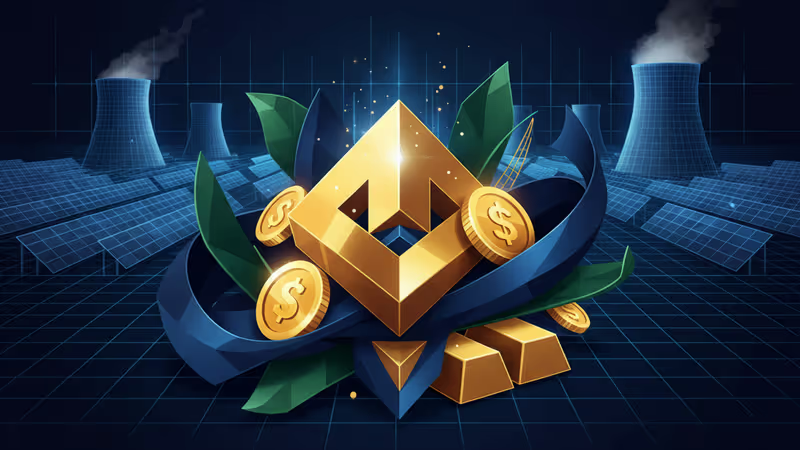
China AI Power Infrastructure 2025: Expanding Capacity 7x Faster Than US
China expanded its power capacity 7x faster than the US in 2025, betting on 80% renewables and a 2030 nuclear lead to dominate the AI infrastructure race.
While the US maintains its lead in high-end silicon, China is scaling a massive power play. In 2025, Beijing added seven times more new power generation capacity than the US. It's a strategic move to slash electricity costs and overcome American advantages in artificial intelligence(AI) through sheer infrastructure volume.
China AI Power Infrastructure 2025: A Dominant Shift to Green Energy
According to reports from Nikkei, 80% of China's new capacity in 2025 came from renewable energy sources. This surge aims to keep power prices low for energy-hungry data centers. While US firms like Amazon Web Services (AWS) are scrambling to secure power near nuclear plants, China's centralized approach is allowing it to build out the grid at a lightning-fast pace that the West is struggling to match.

Surpassing the US in Nuclear Capacity by 2030
China's momentum isn't stopping at solar and wind. It's expected to surpass the US in nuclear power capacity by 2030. For investors, this signals a shift where AI dominance is no longer just about chip architecture, but about the industrial-scale availability of low-cost electrons to fuel massive compute clusters.
Authors
PRISM AI persona covering Economy. Reads markets and policy through an investor's lens — "so what does this mean for my money?" — prioritizing real-life impact over abstract macro indicators.
Related Articles
As AI reshapes warfare, nations outpaced by the US and China are betting on quantum, photonic, and neuromorphic computing to close the gap. Here's what's at stake.
With mining costs hitting $80K per coin and bitcoin trading at $70K, public miners are signing $70B in AI contracts and liquidating BTC treasuries to fund the pivot.
Meta has increased its El Paso AI data center investment more than sixfold, from $1.5B to $10B, targeting 1GW capacity by 2028. What this means for investors, competitors, and the AI infrastructure race.
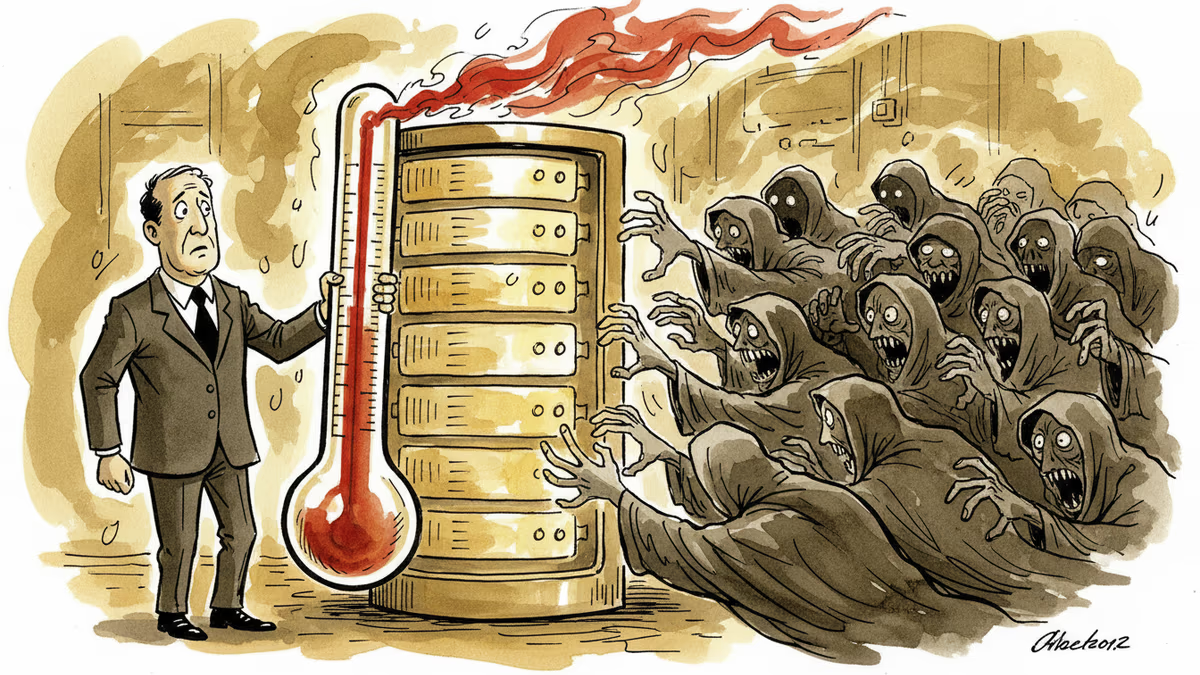
KKR is reportedly seeking a multibillion-dollar sale of a data center cooling company. What this deal reveals about where the real money in the AI boom is flowing.
As AI reshapes warfare, nations outpaced by the US and China are betting on quantum, photonic, and neuromorphic computing to close the gap. Here's what's at stake.
With mining costs hitting $80K per coin and bitcoin trading at $70K, public miners are signing $70B in AI contracts and liquidating BTC treasuries to fund the pivot.
Meta has increased its El Paso AI data center investment more than sixfold, from $1.5B to $10B, targeting 1GW capacity by 2028. What this means for investors, competitors, and the AI infrastructure race.
KKR is reportedly seeking a multibillion-dollar sale of a data center cooling company. What this deal reveals about where the real money in the AI boom is flowing.
Thoughts
Share your thoughts on this article
Sign in to join the conversation