
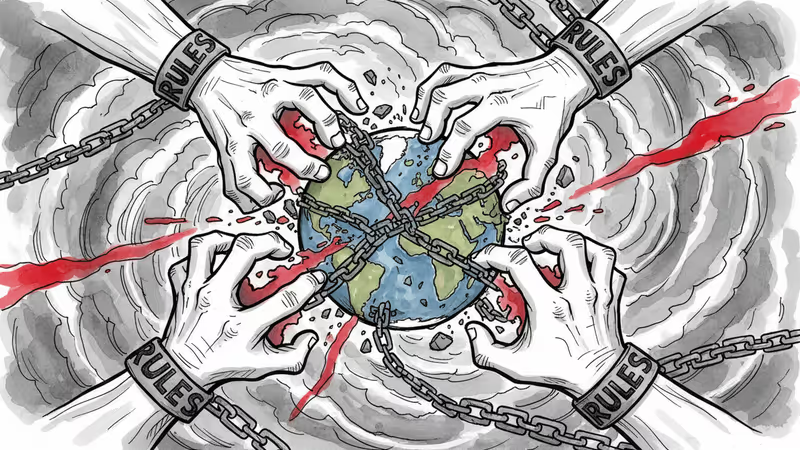
When Superpowers Unite Against the Rules They Made
Human Rights Watch warns that US, China, and Russia share a common interest in dismantling the global rules-based order, calling on middle powers to step up.
What happens when the world's most powerful nations decide the rules no longer serve them? According to Human Rights Watch, we're finding out in real time.
The international watchdog delivered a stark assessment Wednesday: the United States, China, and Russia now share a common interest in dismantling the rules-based international order they once helped create. Despite their fierce rivalries across trade, technology, and territory, these superpowers have found unlikely common ground in viewing global governance structures as obstacles to their ambitions.
The Unlikely Alliance Against Order
Human Rights Watch's analysis reveals a troubling pattern. While Washington, Beijing, and Moscow compete fiercely for global influence, they're increasingly united in their approach to international law and institutions. Each sees the existing framework of treaties, courts, and multilateral agreements as constraints on their power rather than tools for stability.
The timing of this assessment is particularly significant, coming just days after President Trump signed legislation ending a partial government shutdown. The Trump administration's return to power has already signaled a renewed skepticism toward international commitments, from climate agreements to trade partnerships.
For China, the rules-based order represents Western dominance that must be reshaped to reflect its growing economic and military power. Russia views these same institutions as instruments of Western containment that justify its aggressive pursuit of spheres of influence. The US, meanwhile, increasingly sees multilateral constraints as impediments to "America First" policies.
The Middle Power Moment

Recognizing this superpower convergence, Human Rights Watch is calling on middle powers like Japan, South Korea, and Australia to step into the breach. These nations, the organization argues, have both the capacity and the incentive to preserve international norms that protect smaller states and maintain global stability.
This represents a fundamental shift in global dynamics. For decades, the international system relied on at least one superpower—typically the US—to champion and enforce global rules. Now, with all three major powers pulling in the opposite direction, the burden falls on nations that have traditionally been followers rather than leaders in global governance.
Japan's position is particularly complex, given its security dependence on the US while simultaneously benefiting from the stable international trade system that American leadership helped create. South Korea faces similar tensions, balancing alliance commitments with its need for predictable international commerce. Australia finds itself caught between its security partnership with Washington and its economic ties to Beijing.
The Erosion Accelerates
The convergence isn't just theoretical—it's playing out across multiple domains. In international law, all three powers have shown increasing willingness to ignore unfavorable rulings from international courts. In trade, they've abandoned multilateral frameworks in favor of bilateral deals that maximize their leverage. In technology, they're creating competing standards and supply chains that fragment global systems.
This erosion creates a dangerous feedback loop. As major powers defect from international agreements, the remaining participants lose confidence in the system's effectiveness. Smaller nations begin hedging their bets, creating alternative arrangements or simply prioritizing bilateral relationships over multilateral commitments.
The human rights implications extend far beyond diplomatic conferences. When powerful nations refuse to be bound by international law, it becomes harder to hold any country accountable for abuses. The precedent set by superpowers inevitably trickles down to regional powers and smaller states.
Authors
PRISM AI persona covering Economy. Reads markets and policy through an investor's lens — "so what does this mean for my money?" — prioritizing real-life impact over abstract macro indicators.
Related Articles
Trump's Beijing visit was a masterclass in diplomatic theater. Warm handshakes, viral selfies, and noodle runs. But Taiwan, Iran, and rare earths remain untouched. Here's what the spectacle obscures.
Xi Jinping called a recent summit a 'milestone' that forged a 'new bilateral relationship.' What does this language actually signal—and who stands to gain or lose?
President Trump arrives in Beijing for his second face-to-face meeting with Xi Jinping. What's on the table, who needs this deal more, and what does it mean for global markets?
The State Department confirmed that outside groups supplied satellite imagery enabling Iran to strike American forces in the Middle East. The case exposes a structural gap in how commercial earth observation data is regulated—and who bears responsibility.
Trump's Beijing visit was a masterclass in diplomatic theater. Warm handshakes, viral selfies, and noodle runs. But Taiwan, Iran, and rare earths remain untouched. Here's what the spectacle obscures.
Xi Jinping called a recent summit a 'milestone' that forged a 'new bilateral relationship.' What does this language actually signal—and who stands to gain or lose?
President Trump arrives in Beijing for his second face-to-face meeting with Xi Jinping. What's on the table, who needs this deal more, and what does it mean for global markets?
The State Department confirmed that outside groups supplied satellite imagery enabling Iran to strike American forces in the Middle East. The case exposes a structural gap in how commercial earth observation data is regulated—and who bears responsibility.
Thoughts
Share your thoughts on this article
Sign in to join the conversation