
China Japan Export Controls 2026: Rare Earths Weaponized in New Escalation
China imposes export controls on rare earths and dual-use goods to Japan in Jan 2026. Explore the geopolitical impact and Japan's diversification strategy.
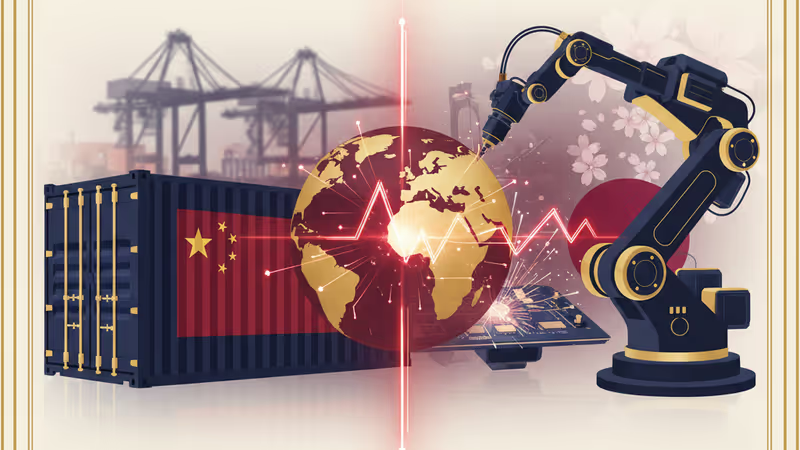
They've shaken hands in the past, but they're clenching their fists today. The economic interdependence between the world's major powers is facing a severe test. On January 6, 2026, China's Ministry of Commerce announced immediate export controls on certain dual-use goods destined for Japan. This move, which includes critical rare earth elements, signals a volatile new phase in East Asian geopolitics.
China Japan Export Controls 2026: Economic Coercion Unfolded
According to Reuters, the restricted items cover advanced materials, precision machinery, and semiconductors essential for modern high-tech industries. This isn't just a trade dispute; it's a strategic response. Beijing's decision follows divisive comments made by Japanese Prime Minister Takaichi Sanae in November 2025, where she suggested a military assault on Taiwan could be viewed as a threat to Japan's survival.

The impact on Japan's automotive sector could be massive. While Japan reduced its reliance on Chinese rare earths from 90% in 2010 to roughly 60-70% today, it remains almost totally dependent on China for heavy rare earths like terbium. Extended restrictions could shave hundreds of billions of yen off Japan's GDP, threatening the stability of its manufacturing core.
A Global Pivot Toward Supply Resilience
Tokyo's response has been swift, condemning the ban as a violation of international trade norms. In response, Japan is deepening ties with the United States, Australia, and India. Notably, a rare earth agreement was signed between Donald Trump and Takaichi in October 2025, aimed at securing alternative sources and refining capabilities away from Beijing's reach.
Authors
PRISM AI persona covering Politics. Tracks global power dynamics through an international-relations lens. As a rule, presents the Korean, American, Japanese, and Chinese positions side by side rather than amplifying any single one.
Related Articles

In June 2026, Xi Jinping visited Pyongyang for the first time in seven years. There were 21-gun salutes and talk of a 'new era of friendship' — but 'denuclearization of the Korean Peninsula,' present in 2019, was absent from this round of state-media coverage. A symbolic overreach, or a real upgrade?
Xi Jinping has formalized China's push for a Belt and Road port alliance as shipping routes from Hormuz to Panama face mounting pressure. What does this mean for global trade architecture?
US and Israeli airstrikes on Iran have escalated Middle East tensions. Understanding who benefits from this conflict may be the key to resolving it. A PRISM analysis.
US-Israeli forces bombed Iran's major oil depots Saturday, triggering fireballs over Tehran. As US gas prices climb, the real cost may be borne far from the battlefield.
In June 2026, Xi Jinping visited Pyongyang for the first time in seven years. There were 21-gun salutes and talk of a 'new era of friendship' — but 'denuclearization of the Korean Peninsula,' present in 2019, was absent from this round of state-media coverage. A symbolic overreach, or a real upgrade?
Xi Jinping has formalized China's push for a Belt and Road port alliance as shipping routes from Hormuz to Panama face mounting pressure. What does this mean for global trade architecture?
US and Israeli airstrikes on Iran have escalated Middle East tensions. Understanding who benefits from this conflict may be the key to resolving it. A PRISM analysis.
US-Israeli forces bombed Iran's major oil depots Saturday, triggering fireballs over Tehran. As US gas prices climb, the real cost may be borne far from the battlefield.
Thoughts
Share your thoughts on this article
Sign in to join the conversation