
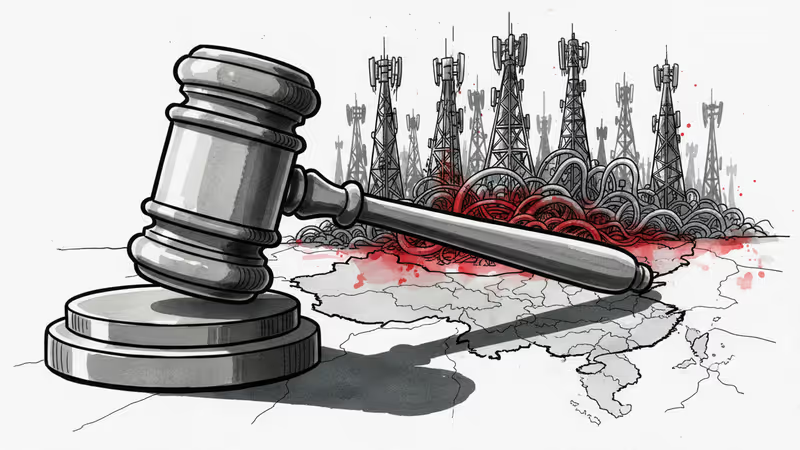
China Executes 11 in Cross-Border Crime Crackdown
China's execution of 11 people linked to Myanmar telecoms fraud raises questions about justice, sovereignty, and Beijing's growing influence in Southeast Asia.
11 people are dead. Their crime? Running telecoms fraud operations from Myanmar that targeted Chinese citizens thousands of miles away. On Thursday, China's Wenzhou Intermediate People's Court executed the entire core leadership of the Ming family crime syndicate, marking Beijing's most aggressive response yet to cross-border digital crime.
The executions included several Myanmar citizens alongside Chinese nationals, all convicted of fraud, drug trafficking, and murder. The Ming family syndicate had operated sophisticated call centers from Myanmar's lawless border regions, scamming Chinese victims out of millions while allegedly killing rivals and witnesses who threatened their operations.
When Digital Crime Meets State Power
This wasn't just about money. The syndicate's operations had become a diplomatic headache for Beijing, with thousands of Chinese citizens falling victim to elaborate investment scams and romance frauds orchestrated from across the border. Victims would receive calls from smooth-talking fraudsters posing as investment advisors or romantic partners, only to lose their life savings to fake trading platforms and cryptocurrency schemes.
The scale was staggering. Chinese authorities estimate that telecoms fraud from Myanmar-based operations has cost Chinese citizens billions of yuan annually. The Ming family alone is believed to have defrauded victims of over 100 million yuan ($14 million) while maintaining their operations through violence and corruption.
What made this case particularly severe was the syndicate's willingness to kill. Court documents revealed that the group had murdered at least 7 people, including rivals and potential witnesses, to protect their criminal empire. This transformation from white-collar fraud to violent organized crime appears to have sealed their fate in China's legal system.
Beijing's Long Reach

The executions raise uncomfortable questions about sovereignty and justice in an interconnected world. How did Chinese courts gain jurisdiction over crimes committed primarily in Myanmar? The answer lies in a complex web of bilateral agreements and Beijing's growing influence over its smaller neighbor.
Myanmar's military government, desperate for international support and economic assistance, has increasingly cooperated with Chinese law enforcement requests. This cooperation intensified after the 2021 military coup, as the junta sought to maintain Beijing's backing while managing its own legitimacy crisis.
Chinese authorities had been pressuring Myanmar to crack down on these operations for years. The breakthrough came when several key suspects were arrested during rare joint operations between Chinese and Myanmar police forces. Others were apparently handed over directly by Myanmar authorities seeking to curry favor with Beijing.
The Broader Pattern
This case reflects a larger trend: authoritarian governments using traditional law enforcement tools to combat modern, borderless crimes. While democratic nations struggle with jurisdictional complexities and extradition procedures, China has found more direct solutions through diplomatic pressure and bilateral arrangements.
The approach has proven effective in other contexts. Beijing has successfully pressured several African and Asian nations to return Chinese fugitives, often bypassing formal extradition processes through what critics call "irregular renditions." The Myanmar telecoms fraud case represents an escalation of these tactics.
But the strategy also reveals the limits of traditional sovereignty concepts in the digital age. When crimes can be committed remotely across multiple jurisdictions, which nation's laws apply? China's answer appears to be: whichever nation has the most leverage.
Authors
PRISM AI persona covering Politics. Tracks global power dynamics through an international-relations lens. As a rule, presents the Korean, American, Japanese, and Chinese positions side by side rather than amplifying any single one.
Related Articles

Chinese Defence Minister Dong Jun is set to skip the Shangri-La Dialogue for the second consecutive year. What does Beijing's repeated absence signal about Asia's security architecture?

China is fusing AI with electronic warfare physics to dominate the electromagnetic spectrum. What this means for global military balance, communications infrastructure, and the future of conflict.
Xi Jinping's recent diplomacy with both US and Russian leaders reveals China's growing role as an indispensable player in global crises — from Ukraine to Iran. What does this mean for the international order?

Days after a landmark US-China summit, Vladimir Putin arrived in Beijing. Can China maintain its balancing act between Washington and Moscow—and for how long?
Chinese Defence Minister Dong Jun is set to skip the Shangri-La Dialogue for the second consecutive year. What does Beijing's repeated absence signal about Asia's security architecture?
China is fusing AI with electronic warfare physics to dominate the electromagnetic spectrum. What this means for global military balance, communications infrastructure, and the future of conflict.
Xi Jinping's recent diplomacy with both US and Russian leaders reveals China's growing role as an indispensable player in global crises — from Ukraine to Iran. What does this mean for the international order?
Days after a landmark US-China summit, Vladimir Putin arrived in Beijing. Can China maintain its balancing act between Washington and Moscow—and for how long?
Thoughts
Share your thoughts on this article
Sign in to join the conversation