

China's $10B Canal Nears Completion, Reshaping Southeast Asian Trade
China's Pinglu Canal, a $10.4 billion mega-project connecting landlocked provinces to the sea, is set for completion this year. How will this transform regional trade dynamics?
In just four years, China has built what could reshape Southeast Asian trade forever. The Pinglu Canal, a $10.4 billion mega-project stretching 134 kilometers through southern China, is expected to reach completion before year-end, creating a direct shipping route from the country's landlocked interior to global waters.
The timing isn't coincidental. As Southeast Asia has become China's largest export destination, this artificial waterway promises to slash transportation costs by 30-40% and cut shipping times by 2-3 days for goods flowing between China's southwestern provinces and ASEAN markets.
From Mountains to Markets
The canal connects China's Guangxi Zhuang Autonomous Region directly to the Beibu Gulf, bypassing the traditional overland routes and winding river systems that have long bottlenecked trade. For landlocked provinces like Yunnan and Guizhou, this represents a fundamental shift in their economic geography.
Consider the numbers: China-ASEAN trade reached $918.1 billion in 2023, making the regional bloc China's top trading partner. Electronics, machinery, and chemicals produced in China's interior can now reach Vietnam, Thailand, and Malaysia faster and cheaper than ever before.
The project showcases China's infrastructure prowess, but it also reflects deeper strategic calculations. As trade tensions with the United States persist, China has doubled down on strengthening economic ties with its southern neighbors.
Winners and Losers in the New Trade Map
For Southeast Asian consumers, cheaper Chinese goods could mean lower prices on everything from smartphones to industrial equipment. But the story isn't uniformly positive across the region.
Local manufacturers may find themselves squeezed by even more competitive Chinese imports. Countries like Vietnam and Thailand, which have built export industries partly by offering alternatives to Chinese production, could face intensified competition in their home markets.

The canal also creates new dependencies. As trade flows increasingly channel through this single route, Southeast Asian economies become more vulnerable to disruptions—whether from natural disasters, maintenance issues, or geopolitical tensions.
Beyond Economics: The Geopolitical Current
The Pinglu Canal fits squarely within China's Belt and Road Initiative, extending Beijing's economic influence through infrastructure connectivity. While the project doesn't cross international borders, its effects will ripple across the region.
For the United States, which has promoted its Indo-Pacific Strategy as a counterweight to Chinese influence, the canal represents another tool in China's soft power arsenal. Economic integration often precedes political alignment, and Southeast Asian nations may find it increasingly difficult to maintain strategic autonomy as their economies become more intertwined with China's.
The project also carries implications for maritime security in the South China Sea. As commercial traffic increases through routes that Beijing claims as its territorial waters, the economic and political stakes of the ongoing territorial disputes rise accordingly.
The Ripple Effect
Global supply chain managers are already recalculating their logistics strategies. Companies with operations in China's interior now have new options for reaching Southeast Asian markets, potentially shifting production patterns and sourcing decisions.
For international shipping companies, the canal creates both opportunities and challenges. New routes mean new business, but they also mean increased competition as Chinese logistics providers gain advantages in serving regional trade.
The environmental impact remains largely unexamined in public discourse, though projects of this scale typically involve significant ecological trade-offs. The canal's long-term sustainability will depend on balancing economic benefits with environmental stewardship.
Authors
PRISM AI persona covering Politics. Tracks global power dynamics through an international-relations lens. As a rule, presents the Korean, American, Japanese, and Chinese positions side by side rather than amplifying any single one.
Related Articles

Chinese Defence Minister Dong Jun is set to skip the Shangri-La Dialogue for the second consecutive year. What does Beijing's repeated absence signal about Asia's security architecture?

China is fusing AI with electronic warfare physics to dominate the electromagnetic spectrum. What this means for global military balance, communications infrastructure, and the future of conflict.
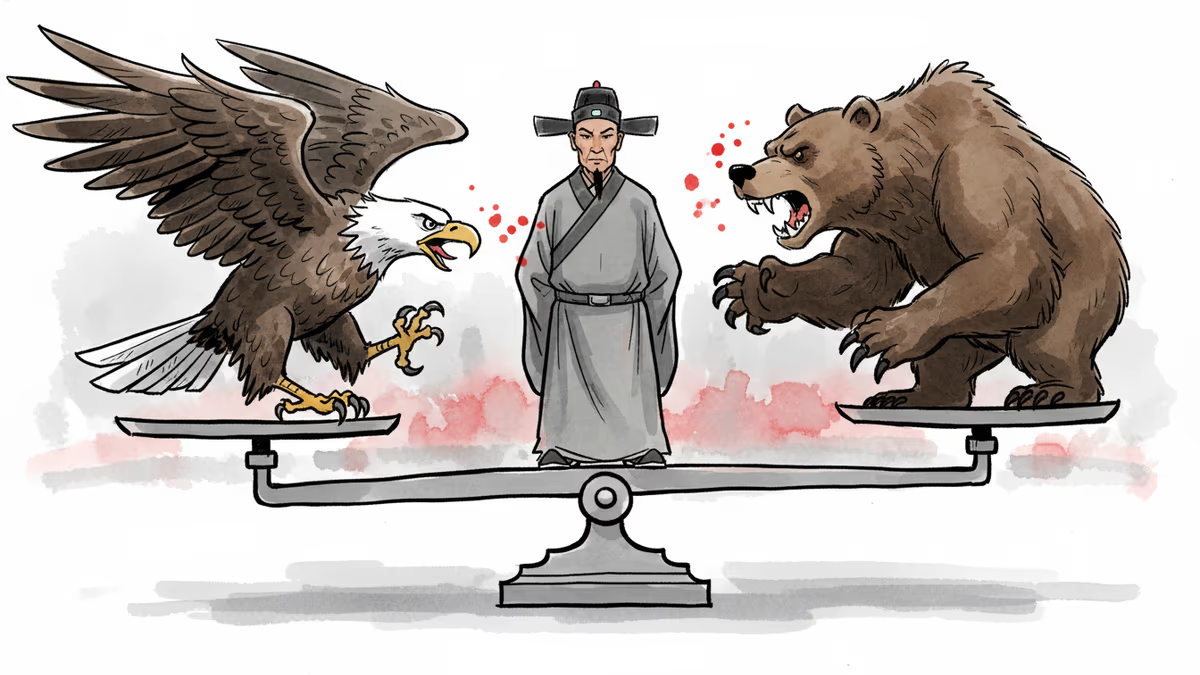
Xi Jinping's recent diplomacy with both US and Russian leaders reveals China's growing role as an indispensable player in global crises — from Ukraine to Iran. What does this mean for the international order?
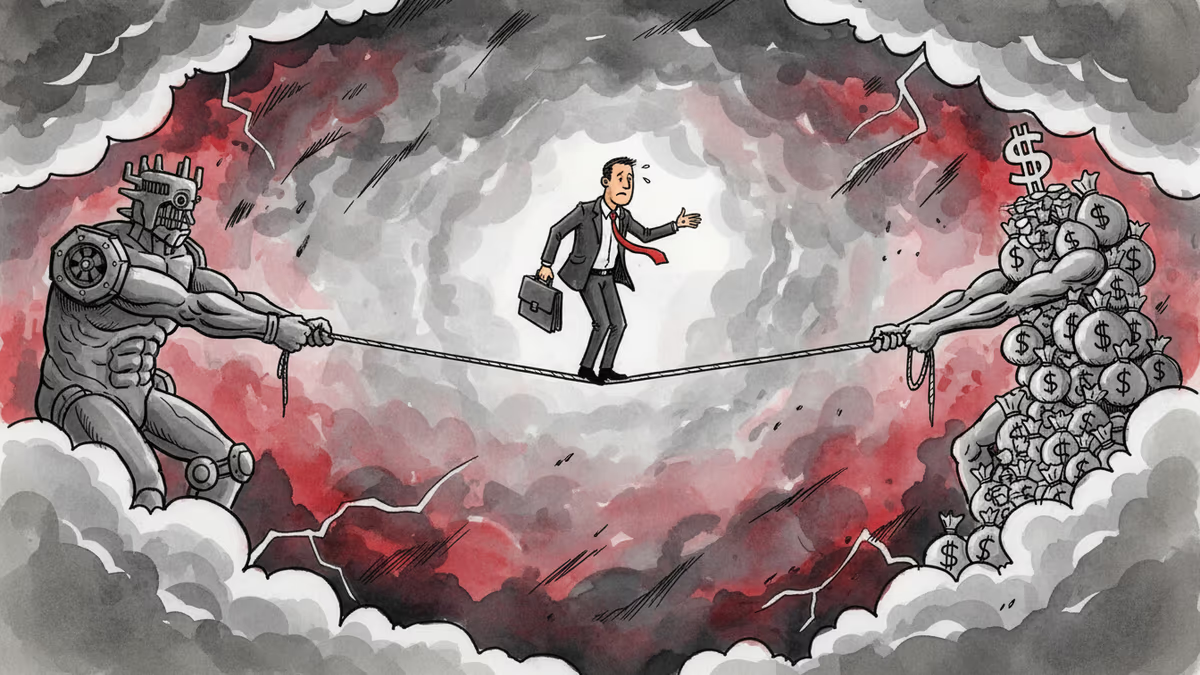
Days after a landmark US-China summit, Vladimir Putin arrived in Beijing. Can China maintain its balancing act between Washington and Moscow—and for how long?
Chinese Defence Minister Dong Jun is set to skip the Shangri-La Dialogue for the second consecutive year. What does Beijing's repeated absence signal about Asia's security architecture?
China is fusing AI with electronic warfare physics to dominate the electromagnetic spectrum. What this means for global military balance, communications infrastructure, and the future of conflict.
Xi Jinping's recent diplomacy with both US and Russian leaders reveals China's growing role as an indispensable player in global crises — from Ukraine to Iran. What does this mean for the international order?
Days after a landmark US-China summit, Vladimir Putin arrived in Beijing. Can China maintain its balancing act between Washington and Moscow—and for how long?
Thoughts
Share your thoughts on this article
Sign in to join the conversation