
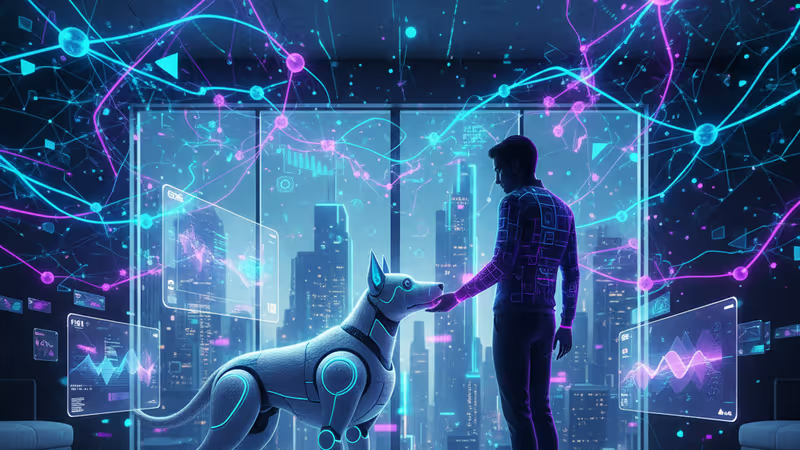
CES 2026 Robot Pets: Why AI is Swapping Screens for Fur and Paws
Explore how CES 2026 robot pets are redefining the boundary between tech and companionship. From Samsung's smart appliances to embodied AI, see the future of robotics.
Does AI want to steal your job or just be your best friend? At CES 2026, the answer seems to be the latter. From hyper-realistic Bichon Frisé robots to scent-diffusing vacuum cleaners, artificial intelligence is breaking free from digital screens to claim a physical presence in our living rooms.
The Rise of Physical Presence: CES 2026 Robot Pets and Beyond
According to reports from The Verge, while robot pets weren't the loudest stars in Las Vegas, they represent a significant shift in the tech landscape. We're seeing more than just purpose-built machines like Samsung's voice-controlled refrigerator or Bosch'sAlexa Plus-powered AI barista. The real evolution lies in AI taking on a tangible, often cuddly, form.

Utility is also getting a lifestyle upgrade. Narwal'sFlow 2 can now find lost earrings, while Anker'sEufy S2 moonlights as an aromatherapy diffuser. These gadgets don't just optimize chores; they attempt to enhance the atmosphere of the home, blurring the line between a tool and a companion.
From Screen-Based Intelligence to Embodied AI
This movement signals the arrival of 'Embodied AI'—intelligence that interacts with the real world through a physical body. Whether it's to bridge the 'uncanny valley' or to provide genuine emotional support, these robots are designed to be more approachable. The transition from AI as a software service to AI as a physical roommate is no longer a futuristic dream; it's the current headline of CES 2026.
Authors
Related Articles

The CES 2026 Vex AI pet robot is an autonomous companion that follows your pets and creates AI-edited videos of their daily lives.
OpenAI's 'code red' isn't just about competing with Google. It signals a new era where AI's biggest challenges are physical: data centers, power, and geopolitics.

Samsung Electronics' union branch revealed that 84% of survey respondents oppose the government's roughly $290 billion (₩400 trillion) semiconductor megaproject in Gwangju. Government, management, the union and shareholders are all reading the same national project in sharply different ways.

Nvidia shipped roughly a billion RISC-V cores in 2024, then announced it would run CUDA on the open standard. We break down how royalty-free instruction sets and open software stacks are trying to route around CUDA's lock-in. Part 2 of the Semiconductor Sovereignty series.
The CES 2026 Vex AI pet robot is an autonomous companion that follows your pets and creates AI-edited videos of their daily lives.
OpenAI's 'code red' isn't just about competing with Google. It signals a new era where AI's biggest challenges are physical: data centers, power, and geopolitics.
Samsung Electronics' union branch revealed that 84% of survey respondents oppose the government's roughly $290 billion (₩400 trillion) semiconductor megaproject in Gwangju. Government, management, the union and shareholders are all reading the same national project in sharply different ways.
Nvidia shipped roughly a billion RISC-V cores in 2024, then announced it would run CUDA on the open standard. We break down how royalty-free instruction sets and open software stacks are trying to route around CUDA's lock-in. Part 2 of the Semiconductor Sovereignty series.
Thoughts
Share your thoughts on this article
Sign in to join the conversation