
Bitcoin's CPI Whiplash: Why Flawed Data Just Exposed Crypto's Crisis of Confidence
A flawed CPI report caused a Bitcoin flash crash, revealing crypto's dangerous dependency on unreliable macro data. Our analysis explores this new 'data integrity' risk.
The Macro Signal Is Broken
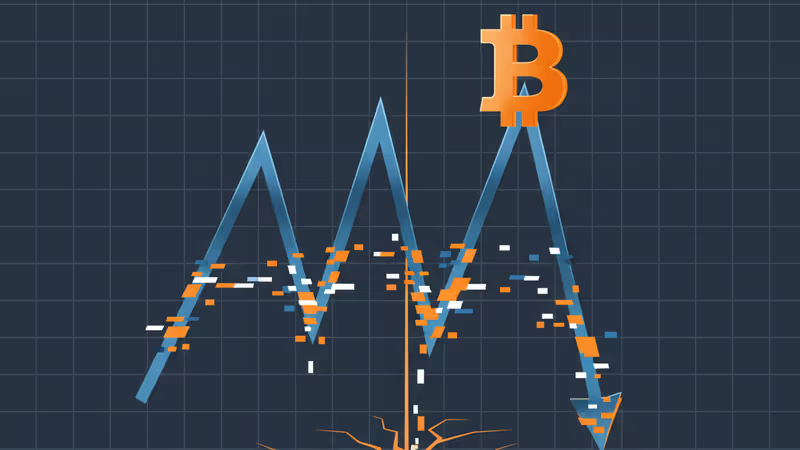
A flawed government statistic just triggered a billion-dollar reversal in Bitcoin, erasing a major rally in mere hours while equities held firm. This wasn't just another volatile day for crypto; it was a harsh lesson in a new and dangerous market risk: data integrity. For executives and investors, this event reveals a critical vulnerability in crypto's dependence on a macroeconomic system whose own instruments are now being questioned.
Why It Matters: The Narrative Shatters
The market's violent rejection of the soft November CPI data is the real story. Initially, the low inflation number (2.7%) was the perfect fuel for a risk-on rally, signaling potential Fed rate cuts. But the moment elite economists flagged a critical flaw in the Bureau of Labor Statistics' (BLS) rent calculation, the narrative evaporated.
This matters because it shows crypto's price is not just tethered to macro data, but to the *perceived credibility* of that data. When confidence in the signal breaks, the most speculative, narrative-driven assets are the first to be jettisoned. The Nasdaq's ability to retain its gains while Bitcoin nosedived isn't a fluke; it’s a flight to assets with underlying fundamentals (earnings, cash flows) when the macro map becomes unreliable. Crypto, for all its technological promise, had no such anchor.
The Analysis: A Slave to a Flawed Master
For years, Bitcoin has been pitched as an alternative to the traditional financial system. Yet, its price action in 2025 demonstrates it has become a high-beta leveraged play on Federal Reserve liquidity. This has turned into a double-edged sword. While it benefits from dovish signals, it's also acutely vulnerable to any instability in the source of those signals.
Think of the CPI report as the market's primary navigation chart for Fed policy. Thursday's events were the equivalent of discovering that chart was fundamentally misdrawn. While traditional equity markets slowed down and reassessed, the crypto market, with no fundamental earnings to fall back on, slammed into reverse. This stark divergence highlights a maturing, but fragile, market dynamic:
- The Confidence Discount: Crypto markets are now pricing in a 'confidence discount' on official economic data. The skepticism that once lived on the fringes of financial Twitter is now an immediate, price-moving force.
- Bear Market Psychology: In a bull market, questionable data might be overlooked. In the current environment, it’s treated as a confirmation of underlying weakness, providing an immediate catalyst for profit-taking and selling. The bulls are exhausted, and conviction is paper-thin.
PRISM Insight: Watch the Options Market, Not Just the Price
While the spot price showed panic, the crypto derivatives market tells a more nuanced story of strategic repositioning. According to Wintermute data, Bitcoin options activity is coalescing around a 'range-bound' outlook. This isn't a bet on a crash, but an expectation of a choppy, directionless grind as traders await clarity. Smart money isn't dumping indiscriminately; it's buying protection and selling volatility, anticipating that the market will be trapped in this new zone of macro uncertainty. This suggests the next major move will be driven by a definitive macro signal, not speculative momentum.
PRISM's Take: The Data Itself Is Now the Risk
The December 18th CPI fiasco is a watershed moment. It marks the point where crypto's integration with the macro landscape became a dangerous liability. The primary risk for a Bitcoin investor is no longer just a hawkish Fed, but the integrity of the very data the Fed uses to make its decisions.
The key takeaway is that the game has changed. Monitoring Fed statements is insufficient. Investors must now critically assess the quality and potential flaws of the underlying economic reports themselves. Until confidence in these foundational metrics is restored, crypto will remain the asset most vulnerable to shocks from a system it sought to replace. The resilience of equities is a stark reminder: in times of deep uncertainty, tangible value wins over pure narrative, every time.
Related Articles
A predicted 2026 crypto ETP boom, driven by SEC rule changes, is set to trigger a brutal market shakeout. Discover why most new funds are destined to fail.

Bitcoin's record $1.1T realized cap challenges the four-year cycle theory. Our analysis explores how macro trends are forging a new reality for BTC investors.

The Bitcoin-to-gold ratio hits a two-year low, challenging the 'digital gold' narrative. Our analysis explores why gold is winning the safe-haven battle.

Crypto markets flash warning signs as institutional traders bet on a Bitcoin price drop. Our analysis dives into what this means for investors and the economy.