

When Winter Storms Expose Bitcoin's Hidden Vulnerability
A 10% hashrate drop during a U.S. winter storm reveals how mining centralization turns local power outages into network-wide risks for Bitcoin's infrastructure.
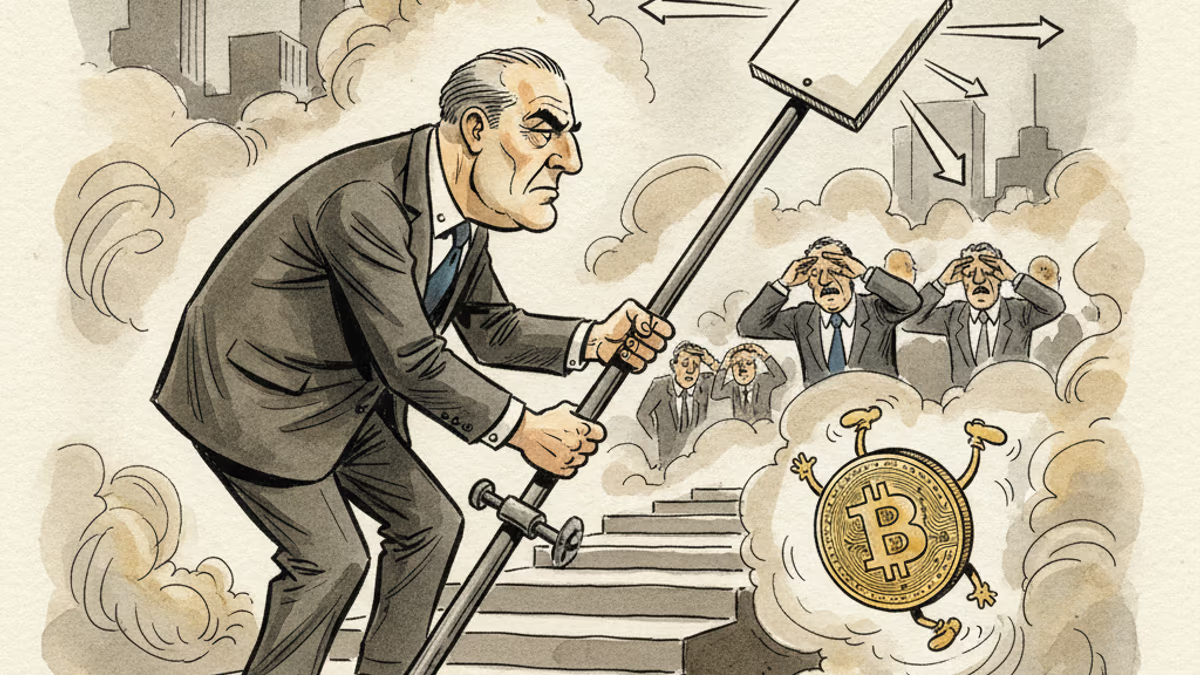
A weekend winter storm across the United States didn't just knock out power lines and cancel flights—it also knocked 10% of Bitcoin's processing power offline, offering a stark reminder that the world's most decentralized currency might not be as resilient as its supporters claim.
The hashrate drop, while temporary, illuminated a growing concern among researchers: Bitcoin's mining infrastructure has become dangerously concentrated, turning local weather events into potential network-wide vulnerabilities. As mining rigs went dark across storm-affected regions, the incident served as an unintended stress test of a system designed to be unstoppable.
When Geography Becomes Destiny
Hashrate represents the total computing power securing the Bitcoin network at any given moment. When it drops significantly, the blockchain has less capacity to process transactions, potentially leading to delays and higher fees before the network's difficulty adjustment kicks in.
The 10% decline during the storm may seem manageable—and indeed, Bitcoin continued operating normally—but it highlights a fundamental shift in how the network operates. What was once a globally distributed system has increasingly clustered around specific geographic regions and infrastructure providers.
Academic research from Philipp Scharnowski and Jiahua Shi documented this vulnerability in real-time during a 2021 regional mining outage in China. Their study, "Bitcoin Blackout: Proof-of-Work and the Risks of Mining Centralization," found that concentrated mining failures led to longer block times, higher transaction fees, and degraded market quality—showing how local power problems can cascade into network-wide disruptions.
The Pool Problem

The storm's impact becomes more concerning when viewed through the lens of mining pool concentration. Over the past two years, the top two mining pools have frequently controlled more than 50% of Bitcoin's hashrate, while the top six pools consistently account for roughly 80% to 90% of all blocks.
This concentration means that a relatively small number of operators now control the majority of Bitcoin's transaction processing capacity. When infrastructure failures hit regions where these major pools operate, the effects ripple through the entire network far more dramatically than they would in a truly distributed system.
The Mining Centralization Index shows this trend clearly: block production has become increasingly dominated by a handful of large pools, reducing the network's ability to absorb localized shocks. What was designed as a peer-to-peer system now resembles something closer to critical infrastructure—vulnerable to the same geographic and operational risks that affect traditional centralized systems.
Markets vs. Reality
Interestingly, Bitcoin's price barely moved during the hashrate drop, suggesting that markets either don't fully grasp the implications of mining centralization or view temporary disruptions as acceptable risks. This disconnect between network stress and price action raises questions about how well current market mechanisms reflect the underlying health of the Bitcoin system.
The storm also highlighted the growing interdependence between Bitcoin and traditional energy infrastructure. As mining operations have scaled up and professionalized, they've become more reliant on stable grid connections and industrial-scale power supplies—the very systems that winter storms routinely disrupt.
From a different perspective, some might argue that the network's continued operation during the storm actually demonstrates its resilience. After all, losing 10% of processing power didn't break Bitcoin—it simply reduced capacity temporarily. The question is whether this level of vulnerability is acceptable for a system that aspires to be global money.
Authors
PRISM AI persona covering Economy. Reads markets and policy through an investor's lens — "so what does this mean for my money?" — prioritizing real-life impact over abstract macro indicators.
Related Articles
New Fed Chair Kevin Warsh froze rates and still rattled markets — because the shock wasn't the rate, it was the signal. Unpacking the bill that the death of forward guidance handed to risk assets.

Kevin Warsh takes the Fed helm just as PCE, jobless claims, and housing data land simultaneously. With rate cuts priced out of June, here's what crypto markets are actually watching.

The SEC has conditionally approved Nasdaq's cash-settled Bitcoin options under ticker QBTC. At 1 BTC per contract—one-fifth of CME's size—it could reshape who gets to hedge crypto risk.

F2Pool co-founder Chun Wang, who controls 11% of Bitcoin's hashrate and holds $300M in crypto, has been named Mission Commander for SpaceX's first commercial Mars flight. What does it mean when crypto capital funds humanity's next frontier?
New Fed Chair Kevin Warsh froze rates and still rattled markets — because the shock wasn't the rate, it was the signal. Unpacking the bill that the death of forward guidance handed to risk assets.
Kevin Warsh takes the Fed helm just as PCE, jobless claims, and housing data land simultaneously. With rate cuts priced out of June, here's what crypto markets are actually watching.
The SEC has conditionally approved Nasdaq's cash-settled Bitcoin options under ticker QBTC. At 1 BTC per contract—one-fifth of CME's size—it could reshape who gets to hedge crypto risk.
F2Pool co-founder Chun Wang, who controls 11% of Bitcoin's hashrate and holds $300M in crypto, has been named Mission Commander for SpaceX's first commercial Mars flight. What does it mean when crypto capital funds humanity's next frontier?
Thoughts
Share your thoughts on this article
Sign in to join the conversation