
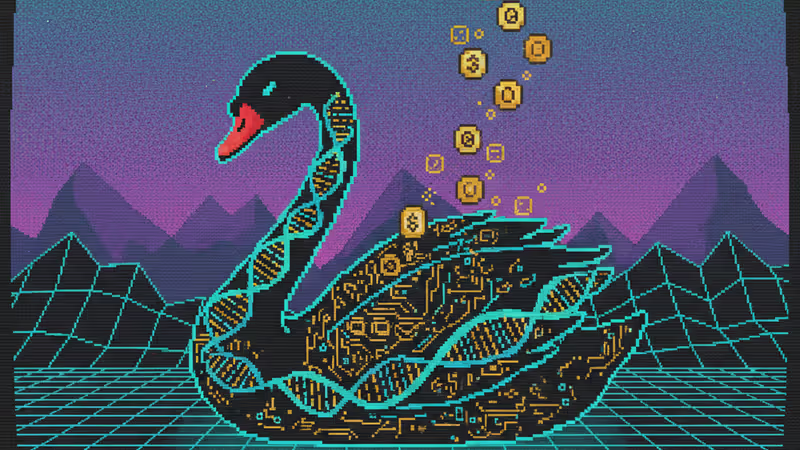
Biological Black Swans: Why 'Fake' Sounding Diseases Are a Biotech Goldmine
Discover why rare medical conditions are not just curiosities, but a biotech goldmine driving the future of gene editing, neurotech, and personalized medicine.
The Lede: Beyond Medical Curiosity
While scrolling, you might encounter stories of seemingly impossible medical conditions—a man whose muscles turn to bone, a woman allergic to water, or twins who can see through each other's eyes. It's easy to dismiss these as fringe oddities. That is a strategic mistake. For the forward-thinking executive, these biological 'edge cases' are not mere curiosities; they are mission-critical data points revealing the vulnerabilities and untapped potential of the human operating system. They are the black swan events of biology, and decoding them is the key to the next trillion-dollar wave in biotech, neurotechnology, and personalized medicine.
Why It Matters: The Outlier is the Oracle
Studying the average human yields incremental improvements. Studying the extreme outliers, however, reveals the fundamental rules of our biology. When a core system fails in a rare and specific way, it acts as a diagnostic flag for the entire mechanism. This has profound second-order effects:
- De-risking R&D: Rare diseases, often caused by single-gene mutations, provide a clear, unambiguous target. Solving for one of these is like finding a master key that can unlock treatments for far more common, complex conditions.
- Unlocking New Platforms: Understanding how a brain can fail to recognize a limb (Body Integrity Dysphoria) provides a roadmap for building more seamless brain-computer interfaces (BCIs). Cracking the code of muscle turning to bone (FOP) could revolutionize tissue regeneration and anti-aging therapies.
- Defining the Future Market: The insights gleaned from these conditions are the foundation for the next generation of therapeutics—from hyper-personalized gene therapies to neuro-implants that rewrite our sensory experience. Ignoring them is like ignoring the first personal computers in the 1970s.
The Analysis: Decoding Humanity's Source Code
Historically, medicine’s greatest leaps have come from studying the rare. Hemophilia research led to our understanding of blood clotting for everyone. The study of 'bubble boy' disease pioneered bone marrow transplants. The current crop of extreme biological outliers points to the next frontiers of innovation.
Fibrodysplasia Ossificans Progressiva (FOP): The Blueprint for Tissue Control
In this condition, the body's repair mechanism goes haywire, turning muscle and tendon into a second, immobilizing skeleton. This isn't just a tragic disease; it’s a masterclass in the genetic switches that control tissue formation. Companies working on regenerative medicine, bone grafts, and even reversing fibrosis in common diseases like cirrhosis are racing to understand the ACVR1 gene mutation responsible for FOP. It’s a direct look at the body’s 'create bone' command line.
Body Integrity Dysphoria (BID): The Ghost in the Machine
BID, where a person feels a desperate need to amputate a perfectly healthy limb, reveals a profound mismatch between the brain's internal body map and physical reality. The limb doesn't register in the brain's 'firmware.' This is invaluable data for the neurotech sector. For companies like Neuralink or Blackrock Neurotech, understanding this 'API error' between brain and body is crucial for developing prosthetics that feel truly 'real' and creating immersive virtual realities that are indistinguishable from the physical world.
Aquagenic Urticaria: The Ultimate Immune Failure
An allergy to water—the fundamental building block of life—represents a catastrophic failure in the immune system's most basic function: distinguishing 'self' from 'other.' While incredibly rare, it provides a stark model for autoimmune diseases like lupus or rheumatoid arthritis, where the same system attacks the body. Solving this puzzle could lead to a paradigm shift in immunology, moving beyond symptom suppression to a genuine 'reboot' of the immune system's core recognition protocols.
PRISM Insight: The Long Tail is the New Core
The investment thesis is shifting. For decades, pharma focused on blockbuster drugs for common ailments. The new frontier is the 'long tail' of rare diseases. The convergence of low-cost genomic sequencing and AI-powered drug discovery platforms means that targeting these conditions is no longer a niche, high-cost endeavor. It's now the most efficient R&D engine available.
Venture capital is flooding into startups that treat rare diseases not as an endpoint, but as a 'beachhead' strategy. A company that develops a gene therapy for a rare neurological disorder gains the platform, regulatory approval, and manufacturing expertise to then tackle Alzheimer's or Parkinson's. Look for accelerating investment in companies that use rare disease insights as a lever to solve mass-market problems.
PRISM's Take: Stop Studying Normal
The future of human health, enhancement, and technology will not be found by analyzing the 99%. It will be unlocked by obsessively decoding the 1%. These rare conditions, which sound like science fiction, are the Rosetta Stones for our own biology. They are nature's stress tests, revealing the critical code that governs our existence. The organizations that recognize these 'freaks of nature' as the blueprints for the future will not just lead the next revolution in medicine—they will redefine what it means to be human.
Related Articles

Viral morality quizzes are more than just a distraction. They're creating a massive dataset on human ethics that is shaping the future of AI decision-making.
A celebrity cameo is more than a stunt. We analyze how Netflix is using 'Stranger Things' to master transmedia storytelling and build a next-gen media empire.
Corey Feldman's allegations reveal a critical flaw in the trauma-as-content economy, creating new liabilities for Hollywood studios and streaming platforms. A PRISM analysis.

Netflix's Stranger Things Broadway cameo is more than a stunt. It's a strategic move to build a transmedia empire, making live events essential canon.