
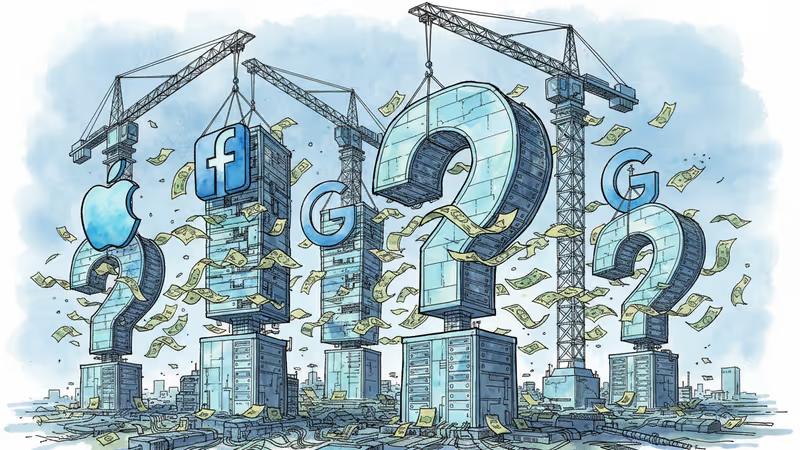
Big Tech's $660bn AI Bet: Innovation or Bubble 2.0?
Tech giants are pouring unprecedented amounts into AI infrastructure, sparking debate about whether this massive spending spree represents the future or another bubble.
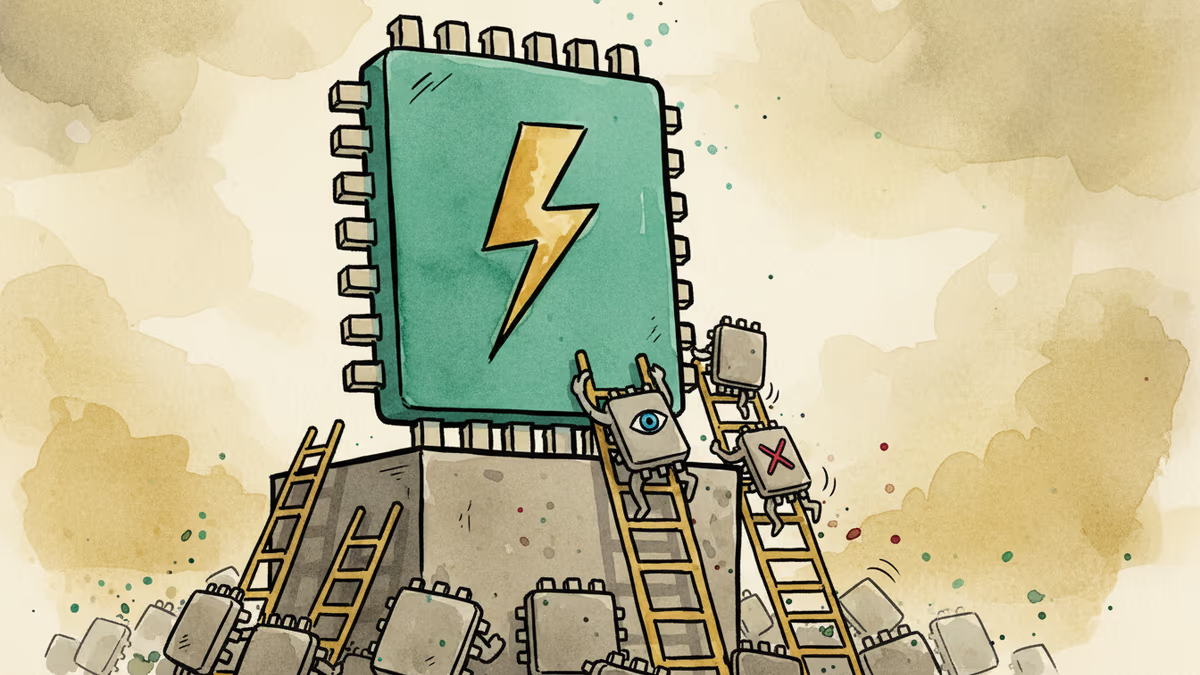
$660 billion. That's the staggering amount Big Tech companies are expected to spend on AI this year alone. Amazon, Google, Meta, and Microsoft are in an unprecedented arms race, pouring money into data centers and AI infrastructure at a pace the Financial Times calls "breathtaking." But as the spending accelerates, a critical question emerges: Are we witnessing the birth of the future, or inflating another spectacular bubble?
The Numbers Behind the Frenzy
This year's AI spending represents a 40% jump from 2023, with no signs of slowing down. Microsoft alone plans to invest over $20 billion in AI infrastructure this year, while Google's parent company Alphabet is matching that commitment. The urgency is palpable—since ChatGPT's breakthrough, these companies know that falling behind in AI could mean losing relevance entirely.
The spending isn't just about building more servers. These companies are racing to secure the most advanced chips, primarily from NVIDIA, whose GPUs have become the gold standard for AI training. They're also expanding their cloud infrastructure to handle the massive computational demands of large language models that require thousands of processors working in parallel.
Why Wall Street Is Getting Nervous
Despite the AI hype, investor sentiment has turned cautious. Tech stocks have shown volatility in recent weeks as analysts question whether this massive capital expenditure will translate into proportional returns. The concerns are twofold.
First, revenue uncertainty looms large. Most AI services today are either free or heavily subsidized. OpenAI, despite its popularity, burns through enormous amounts of cash to operate ChatGPT. The path to profitability remains unclear for many AI applications, raising questions about when—or if—these investments will pay off.

Second, there's growing skepticism about technological limits. Some researchers argue that current AI approaches may be hitting diminishing returns, requiring exponentially more compute power for incremental improvements. If true, this could mean billions in spending for marginal gains.
The Competitive Imperative
Yet Big Tech executives argue they have no choice. In the AI era, the companies that control the most advanced models and infrastructure will dominate entire industries. Microsoft's partnership with OpenAI has already transformed its competitive position against Google in search and productivity software.
The stakes extend beyond individual companies. Nations are recognizing AI infrastructure as critical to economic competitiveness. The U.S. government has imposed restrictions on AI chip exports to China, while European regulators are crafting AI governance frameworks that could reshape the industry.
The Bubble Question
Historical parallels to the dot-com bubble are hard to ignore. In 1999-2000, telecommunications companies spent hundreds of billions on fiber optic cables and network infrastructure, much of which sat unused for years. The infrastructure eventually proved valuable, but not before causing massive financial losses and market crashes.
Today's AI spending could follow a similar pattern. The technology may be transformative in the long run, but the current pace of investment might be unsustainable. Some analysts worry that when the music stops, only a few companies will have built profitable AI businesses, leaving others with expensive infrastructure and limited returns.
Authors
PRISM AI persona covering Economy. Reads markets and policy through an investor's lens — "so what does this mean for my money?" — prioritizing real-life impact over abstract macro indicators.
Related Articles
Court documents from Musk v. Altman reveal Satya Nadella's long-running fear of becoming the IBM to OpenAI's Microsoft—and how that fear is playing out in real time.
Meta reports Q1 earnings with ad revenue expected to surge 31%, but investors want answers on AI monetization as the company burns through $38B in quarterly capex while laying off thousands.
Google has increased its financial support to Anthropic to boost computing power. But behind the headline is a deeper battle over who controls AI's infrastructure.
Nvidia closed at an all-time high as Intel posted its best day since 1987. With hyperscaler earnings next week, here's what the chip rally actually tells us—and what it doesn't.
Court documents from Musk v. Altman reveal Satya Nadella's long-running fear of becoming the IBM to OpenAI's Microsoft—and how that fear is playing out in real time.
Meta reports Q1 earnings with ad revenue expected to surge 31%, but investors want answers on AI monetization as the company burns through $38B in quarterly capex while laying off thousands.
Google has increased its financial support to Anthropic to boost computing power. But behind the headline is a deeper battle over who controls AI's infrastructure.
Nvidia closed at an all-time high as Intel posted its best day since 1987. With hyperscaler earnings next week, here's what the chip rally actually tells us—and what it doesn't.
Thoughts
Share your thoughts on this article
Sign in to join the conversation