

Beyond the Chatbot: Why BBVA's 120,000-Seat OpenAI Deal Redefines AI in Finance
BBVA's massive deployment of ChatGPT Enterprise to 120,000 employees isn't just a tech upgrade. It's a strategic shot across the bow, redefining the AI arms race in finance.
The Lede: The End of AI Experiments
BBVA's decision to deploy ChatGPT Enterprise to all 120,000 employees is not another tech procurement story. It is a declaration that the era of siloed, tentative AI pilot programs in banking is over. This move represents a full-stack, enterprise-wide commitment to generative AI, firing the starting gun on a new, high-stakes arms race in the financial services industry. For investors and executives, the message is clear: the 'wait-and-see' strategy for AI is now a fast-track to obsolescence.
Why It Matters: Setting a New Industry Benchmark
This isn't about improving a customer service chatbot or automating a back-office task. This is a fundamental bet on transforming the entire human capital of a global bank into an AI-augmented workforce. The second-order effects are far more significant than the initial headline:
- Competitive Pressure: Rivals like JPMorgan Chase, Bank of America, and Goldman Sachs, which have been developing their own internal AI tools, are now under immense pressure to demonstrate a comparable scale of ambition and deployment. BBVA has publicly set the bar for what 'AI transformation' looks like.
- Validation for Regulated Industries: By making such a large-scale commitment, BBVA and OpenAI are signaling to the market that they have found a way to navigate the labyrinth of financial compliance, data privacy, and security concerns that have previously kept generative AI on the sidelines.
- The Battle for the Enterprise Stack: This is a monumental win for the OpenAI/Microsoft Azure ecosystem. It establishes ChatGPT Enterprise as the leading contender for large-scale, regulated deployments, forcing competitors like Google (Gemini) and Anthropic (Claude) to prove they can deliver at a similar scale and with equivalent security assurances.
The Analysis: From Algorithmic Trading to Augmented Bankers
From Back-Office AI to a Front-Line Co-pilot
For decades, AI in banking has been a back-office affair—a world of algorithms for fraud detection, credit scoring, and high-frequency trading. These systems were powerful but invisible to most employees and all customers. The BBVA-OpenAI partnership represents a radical shift. The goal is to put a powerful generative AI 'co-pilot' in the hands of every employee, from investment analysts and wealth managers to marketing staff and software developers. The new competitive moat isn't just proprietary data; it's the speed and insight of an entire workforce augmented by AI.
A Bet on People, Not Just Platforms
While the focus is on technology, the true strategic insight here is about human capital. BBVA is betting that the winning bank of the next decade won't be the one that replaces the most employees with AI, but the one that most effectively empowers its existing talent with AI. By providing a common, powerful platform, they aim to unlock latent productivity, accelerate idea generation, and create a more responsive, intelligent organization. The challenge, however, will be less about the technology and more about the massive cultural shift and training required to make this vision a reality.
PRISM Insight: The Real Challenges Ahead
The Trillion-Dollar Compliance Question
The most significant, and least-discussed, aspect of this deal is the implied compliance and security framework. For a global bank to deploy a third-party LLM at this scale, it must have received profound assurances from OpenAI regarding data residency, model privacy, and auditability. This suggests a new level of maturity in Enterprise AI platforms, where a 'private-by-design' architecture is a non-negotiable prerequisite. This isn't just about API access; it's a deep partnership that likely involved months of scrutiny from BBVA's notoriously risk-averse legal and compliance departments. This breakthrough will serve as a blueprint for other highly regulated sectors like healthcare and insurance.
The Risk of Strategic Lock-In
By going all-in with OpenAI, BBVA gains a first-mover advantage but also accepts a significant strategic risk: vendor lock-in. As they build custom solutions and workflows on top of OpenAI's models, extricating themselves to adopt a potentially superior model from a competitor in the future will become exponentially more difficult and expensive. This deal highlights a crucial strategic dilemma for CTOs and CEOs everywhere: do you bet big on one horse to move fast, or do you build a more flexible, multi-model strategy that might be slower to deploy? BBVA has made its choice, and the industry will be watching closely to see if the benefits of speed outweigh the risks of dependency.
PRISM's Take
BBVA's move is an act of strategic aggression that fundamentally alters the landscape for digital transformation in finance. It redefines 'table stakes' from having an 'AI strategy' to executing an enterprise-wide AI implementation. The real test won't be in the deployment of the software, but in BBVA's ability to re-wire its corporate culture and workflows around a human-AI collaborative model. This isn't just about building an AI-native bank; it's about creating an army of AI-native bankers. Every board in the financial sector must now confront the reality that cautious experimentation is no longer a viable strategy. The race has begun.
Related Articles
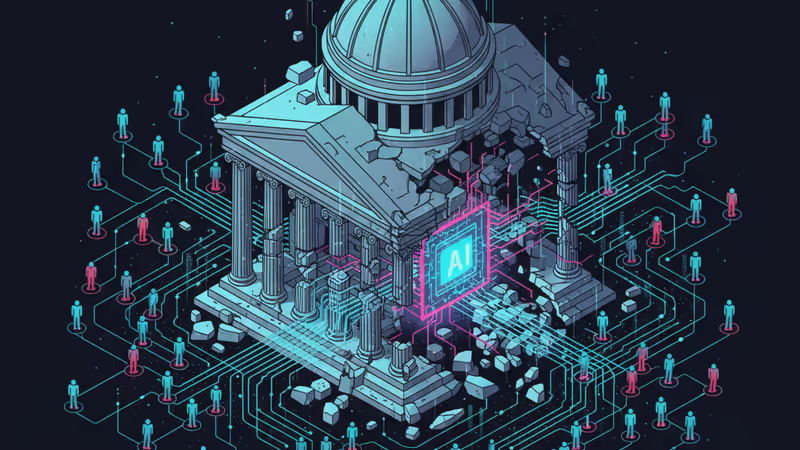
BBVA's massive rollout of ChatGPT Enterprise to 120,000 employees is more than a tech deal. It's a high-stakes bet on the future of AI-native banking.

BNY is arming 20,000 employees with OpenAI. This isn't just about efficiency—it's a new blueprint for enterprise AI that will create a new class of winners and losers.

Chai Discovery's $130M raise at a $1.3B valuation isn't about a single drug. It's a strategic move by OpenAI's ecosystem to build the dominant AI platform for biotech.

OpenAI's quiet GPT-5.2 update is a strategic signal. Our analysis reveals why this shift from hype to stability marks a new, more mature era for the AI industry.