
Beyond the Algorithm: What Viki's April 2026 Top 5 Actually Reveals
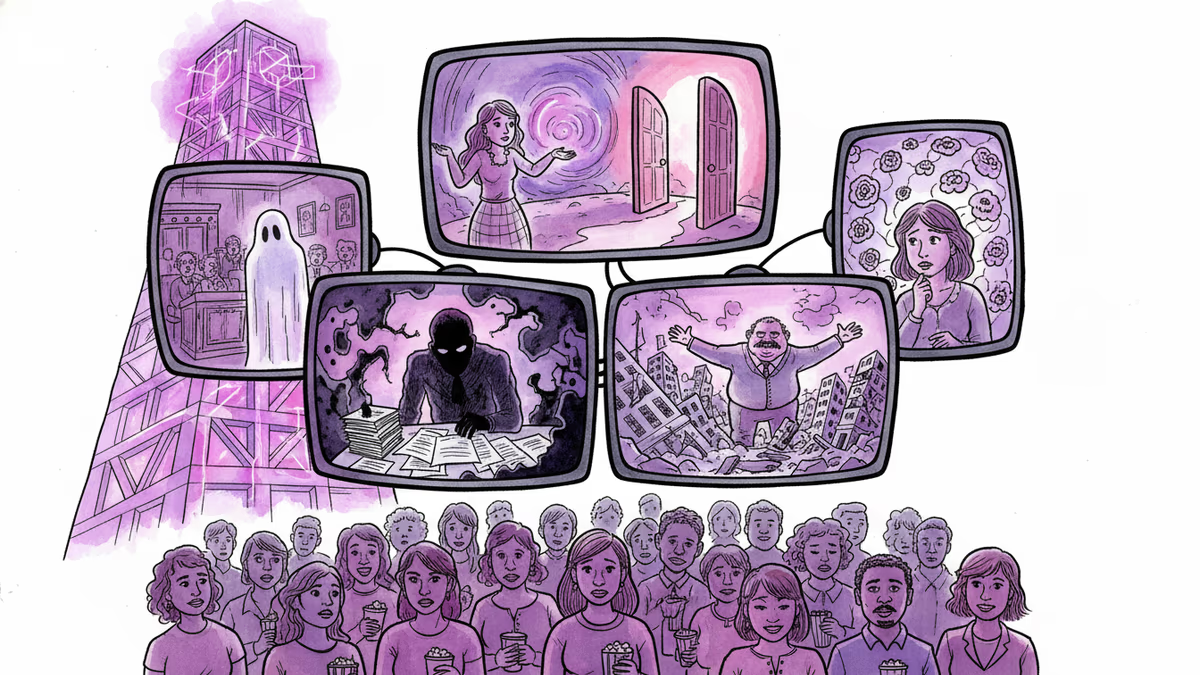
Viki's April 2026 top K-dramas—Yumi's Cells 3, Climax, Phantom Lawyer, Mad Concrete Dreams, The Practical Guide to Love—reveal a fan-driven platform ecosystem that diverges sharply from Netflix's algorithm-curated K-content pipeline.
While Netflix spent an estimated $1 billion+ on Korean content in 2025 alone, a quieter scoreboard has been keeping its own count. Viki's monthly fan-voted chart doesn't move on algorithmic weight—it moves on the kind of sustained audience engagement that no recommendation engine can manufacture. April 2026's Top 5 is worth reading carefully, because the lineup tells a story that goes well beyond five drama summaries.
Five Shows, Five Different Bets
The April roster spans romance, legal fantasy, political thriller, crime noir, and romantic comedy—one of each. That breadth is not accidental. Netflix's K-drama charts over the past two to three years have skewed heavily toward survival thrillers and prestige crime dramas, partly because those genres travel most efficiently across language barriers and partly because Netflix's own commissioning priorities have shaped supply. Viki's audience—predominantly North American and Southeast Asian viewers who rely on fan subtitles—has historically shown a broader appetite, and this month's chart reflects that.
Yumi's Cells 3 is the most structurally remarkable entry. The original webtoon IP launched its first drama season in 2021, and the franchise has now sustained fan engagement across five years and three seasons—a genuinely rare feat in K-drama IP history, where most webtoon adaptations exhaust their momentum within a single run. Kim Go Eun's Yumi has graduated from ordinary office worker to established author, and the show's new romantic arc with editorial PD Kim Jae Won tracks that evolution. The implicit logic of the season structure is worth noting: the writers appear to have aged the story alongside the audience, giving Season 1 viewers—now five years older—a protagonist whose life stage roughly mirrors their own.
The Weight of Power and Property
The two heaviest entries on the chart are Climax and Mad Concrete Dreams, and both are rooted in anxieties that run deeper than genre convention.

Climax casts Ju Ji Hoon as a prosecutor navigating a power cartel with calculated ambition. The prosecutor-as-protagonist has become a recurring figure in Korean drama since roughly 2016, when the real-world impeachment of a sitting president made the mechanics of institutional power a subject of mass public fascination. The genre has since produced a steady stream of legal and political thrillers—Secret Forest, Juvenile Justice, and now Climax—that treat the state apparatus not as background but as the actual subject of the story. International viewers often read these as straightforward procedurals; Korean audiences tend to layer in a different kind of recognition.
Mad Concrete Dreams operates on a different register of anxiety. Ha Jung Woo plays a landlord—a status that carries specific cultural freight in South Korea, where property ownership has functioned as the primary vehicle of middle-class wealth accumulation for decades. His character achieves that coveted status only to find himself crushed by debt and dragged into a staged kidnapping that spirals out of control. The drama frames the landlord as simultaneously victim and perpetrator, which maps onto a broader social ambivalence: in a country where the total fertility rate has fallen below 0.8 and younger generations increasingly view homeownership as structurally inaccessible, the landlord figure has become a complicated symbol. Mad Concrete Dreams seems aware of this tension, even if it resolves it through thriller mechanics rather than social commentary.
Platform Ecology: What Viki Selects For
Phantom Lawyer—Yoo Yeon Seok as a ghost-seeing attorney, Esom as his skeptical counterpart—represents the chart's genre experiment. The legal-fantasy hybrid borrows from the supernatural romance tradition that Goblin and Hotel Del Luna established in the late 2010s and grafts it onto a courtroom procedural. Whether that fusion reads as inventive or awkward likely depends on the viewer's tolerance for tonal mixing, but the fact that it landed in the Top 5 on Viki specifically is consistent with the platform's track record of surfacing mid-budget genre hybrids that major OTT platforms didn't commission.
The Practical Guide to Love rounds out the list with the most conventional setup: Han Ji Min as a woman navigating a classic love triangle through the blind date circuit. The show's lightness is a feature, not a flaw—Viki's audience has always maintained space for comfort romance in a way that prestige-focused platforms have gradually deprioritized.
This is the structural point worth sitting with. Viki operates on a fan-subtitling and community-engagement model that Rakuten has preserved even as the broader streaming market has consolidated around algorithmic curation. A show that reaches Viki's Top 5 has earned its position through sustained viewer participation—rewatching, community discussion, subtitle contribution—rather than front-page placement. That selection mechanism is different enough from Netflix's that the two platforms' charts should probably be read as measuring different things entirely.
This content is AI-generated based on source articles. While we strive for accuracy, errors may occur. We recommend verifying with the original source.
Related Articles

MBC's action-comedy Fifties Professionals introduces Kwon Yul as an unpredictable new antagonist. Here's why this drama's premise matters beyond the casting news.
tvN's Spooky in Love teaser drops with Park Eun Bin as a ghost-seeing hotel heiress. Behind the occult romance lies a calculated industry strategy worth unpacking.

JTBC's Reborn Rookie pairs veteran actor Son Hyun Joo with idol-turned-actor Lee Jun Young in a body-swap drama. A look at the genre's industrial logic and what it signals about Korean TV's audience strategy.

JTBC's upcoming comedy crime drama Apartment casts Ji Sung, Ha Yoon-kyung, Park Byung-eun, and Moon Sori in a story where an ex-gangster enters a residents' committee election. What does the project reveal about JTBC's 2026 strategy?
MBC's action-comedy Fifties Professionals introduces Kwon Yul as an unpredictable new antagonist. Here's why this drama's premise matters beyond the casting news.
tvN's Spooky in Love teaser drops with Park Eun Bin as a ghost-seeing hotel heiress. Behind the occult romance lies a calculated industry strategy worth unpacking.
JTBC's Reborn Rookie pairs veteran actor Son Hyun Joo with idol-turned-actor Lee Jun Young in a body-swap drama. A look at the genre's industrial logic and what it signals about Korean TV's audience strategy.
JTBC's upcoming comedy crime drama Apartment casts Ji Sung, Ha Yoon-kyung, Park Byung-eun, and Moon Sori in a story where an ex-gangster enters a residents' committee election. What does the project reveal about JTBC's 2026 strategy?
Thoughts
Share your thoughts on this article
Sign in to join the conversation