
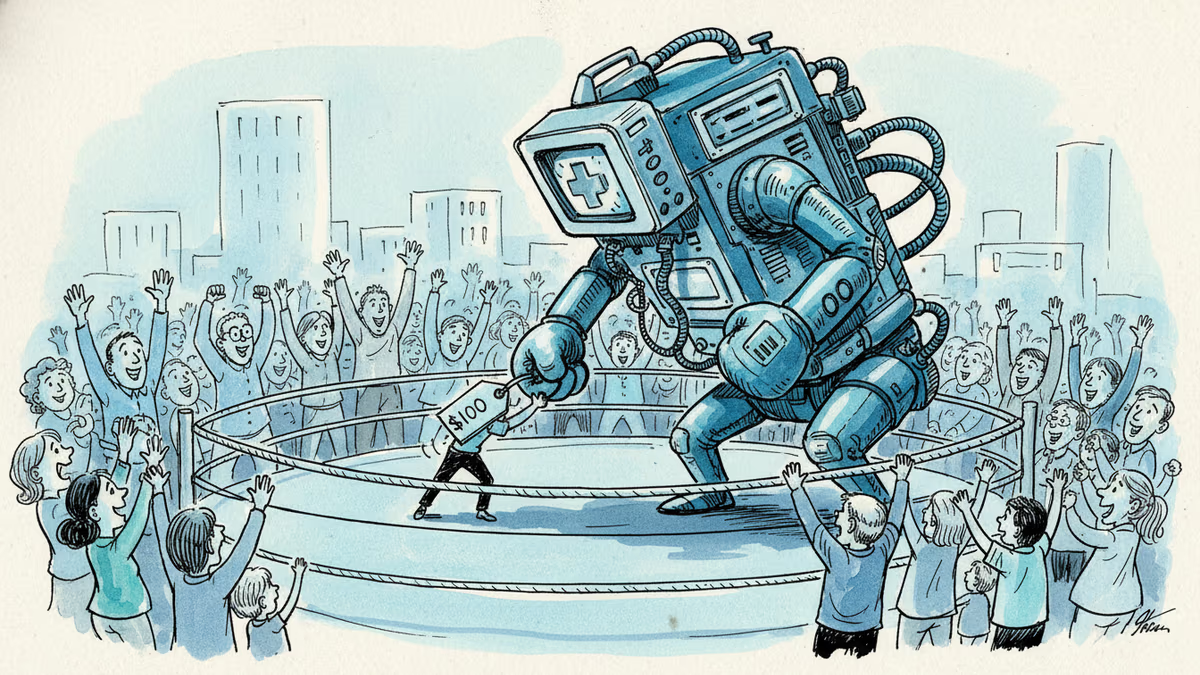
The $100 Hearing Aid Taking on $4,000 Medical Devices
Since FDA approval in 2022, the hearing aid market has transformed dramatically. Low-cost alternatives are disrupting traditional medical devices, sparking an accessibility revolution.
Four Years, 45 Devices, One Surprising Truth
The difference between a $100 hearing aid and a $4,000 medical device isn't as dramatic as you'd think. Since the FDA approved over-the-counter hearing aids in 2022, the market has experienced unprecedented disruption. What was once a prescription-only medical device industry dominated by audiologists has been invaded by tech giants like Apple, Sony, and Jabra, triggering a price war that's reshaping everything.
After four years of hands-on testing across 45 different models, professional reviewers have reached a startling conclusion. The Jabra Enhance Select 300 topped the rankings, with Sony's CRE-C20 close behind. But here's the kicker: Apple's AirPods Pro 3rd generation earned special recognition as "the easiest way for anyone to get started with hearing aid tech."
This isn't just about cheaper alternatives—it's about fundamentally different approaches to hearing loss treatment.
The 10 Million Under 60 We're Missing
Forget the cartoon stereotype of hunched-over seniors shouting "WHAT?!" at everyone. Hearing loss doesn't discriminate by age. Nearly 10 million Americans under 60 deal with hearing challenges, yet most delay treatment indefinitely.
The reasons are brutally clear. Traditional hearing aids meant multiple audiologist visits, custom fittings, ongoing maintenance, and costs reaching thousands of dollars with minimal insurance coverage. Add the psychological burden of wearing what feels like a medical device, and it's no wonder people postpone help.
But today's in-the-ear (ITE) devices have evolved beyond recognition. They're virtually indistinguishable from wireless earbuds, complete with smartphone integration, app-based customization, and Bluetooth streaming. Tech companies have successfully stripped away the clinical stigma, replacing it with familiar consumer electronics appeal.
Self-Fitting vs. Professional Prescription: The Real Difference

The breakthrough innovation isn't just lower prices—it's self-fitting technology. Traditional hearing aids required audiologists to create detailed audiograms and manually adjust frequency amplification for each user's specific hearing loss pattern. Now, smartphone apps conduct simple hearing tests and automatically tune the devices accordingly.
The trade-offs are real but nuanced. Preset budget models amplify all frequencies universally, missing the precision of personalized fitting. However, for mild to moderate hearing loss, that difference may be less significant than expected.
The Jabra Enhance Select 300 exemplifies this new approach: 30 hours of continuous use, 72 hours with the charging case, and four listening modes (All Around, Restaurant, Music, Outdoor) that users can customize through an app. It's prescription-quality performance without the prescription requirement.
The Battery Revolution That Changed Everything
Traditional hearing aid users know the frustration: replacing batteries smaller than pencil erasers every week or two, struggling with tiny components, worrying about children or pets swallowing them. The shift to lithium-ion batteries and wireless charging cases has eliminated these pain points entirely.
Like earbuds, modern hearing aids simply drop into charging cases when not in use. The cases themselves provide 3-7 additional charges before needing power. Battery life varies dramatically—from 24+ hours down to 8 hours—but for most users, dead batteries become a non-issue.
Multiple Perspectives on Disruption
Healthcare professionals remain divided. Some welcome increased accessibility, noting that untreated hearing loss contributes to social isolation and cognitive decline. Others worry about oversimplified solutions missing complex hearing conditions that require professional intervention.
Insurance companies are watching nervously. If OTC devices prove effective for mild to moderate hearing loss, it could reduce coverage pressure for expensive prescription alternatives while potentially improving population health outcomes.
Traditional manufacturers face an existential challenge. Companies that built business models around high-margin, professionally-fitted devices must now compete with consumer electronics giants offering similar functionality at fraction of the cost.
Authors
Related Articles

From period trackers to newborn blood samples, the data our bodies generate is being harvested, sold, and subpoenaed. A deep look at who benefits—and who pays the price.

Fitbit founders James Park and Eric Friedman launch Luffu, an AI-powered family health platform that shifts focus from individual tracking to coordinated family caregiving.

YouTube's advanced SRV3 caption format is currently unavailable due to a bug. Google confirms a fix is underway following a massive creator outcry.

BioticsAI has secured FDA clearance for its AI-powered fetal abnormality detection software. The 2023 TechCrunch Disrupt winner aims to combat U.S. maternal health disparities through automation.
From period trackers to newborn blood samples, the data our bodies generate is being harvested, sold, and subpoenaed. A deep look at who benefits—and who pays the price.
Fitbit founders James Park and Eric Friedman launch Luffu, an AI-powered family health platform that shifts focus from individual tracking to coordinated family caregiving.
YouTube's advanced SRV3 caption format is currently unavailable due to a bug. Google confirms a fix is underway following a massive creator outcry.
BioticsAI has secured FDA clearance for its AI-powered fetal abnormality detection software. The 2023 TechCrunch Disrupt winner aims to combat U.S. maternal health disparities through automation.
Thoughts
Share your thoughts on this article
Sign in to join the conversation