
When Love Meets Revolution: The Political Awakening in K-Drama
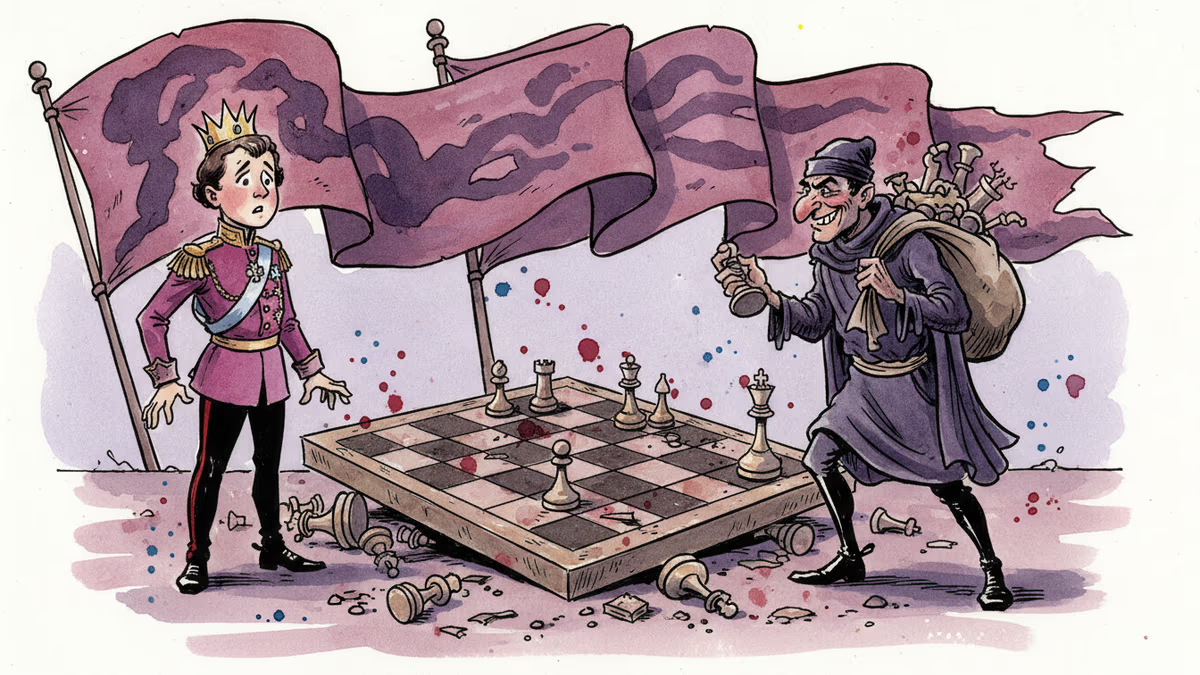
To My Beloved Thief episodes 11-12 showcase how personal relationships intersect with political upheaval, reflecting broader themes in contemporary Korean storytelling.
In the latest episodes of To My Beloved Thief, viewers witness something profound: the moment when personal understanding collides with political necessity. Our beloved prince and thief have reached an intimate knowledge of each other's hearts, yet find themselves on opposite sides of a brewing revolution.
The Intimate Politics of Power
Episodes 11-12 deliver what many K-drama fans have been craving—characters who don't just fall in love, but grapple with the weight of their choices on entire kingdoms. The prince, bound by duty to his throne, sees stability as the path to protecting his people. The thief, shaped by life among the marginalized, believes revolution is the only way to true justice.
This isn't just romantic tension; it's ideological warfare wrapped in beautiful cinematography. The series asks a question that resonates far beyond the screen: Can love survive when lovers choose different sides of history?
The writing cleverly avoids painting either perspective as entirely right or wrong. Instead, it presents two characters whose life experiences have shaped fundamentally different worldviews. The prince has seen how chaos destroys innocent lives. The thief has witnessed how the status quo perpetuates suffering.
Revolution as Character Development

What sets To My Beloved Thief apart from typical historical romance is its treatment of political upheaval as character development rather than mere backdrop. The "whispers of revolution" aren't just atmospheric—they're forcing our protagonists to define who they truly are.
The series reflects a broader trend in contemporary Korean storytelling: the integration of social consciousness with entertainment. Much like Squid Game used deadly competition to examine economic inequality, or Kingdom employed zombie horror to critique class systems, To My Beloved Thief uses romantic drama to explore the personal cost of political change.
For global audiences, this approach offers something Hollywood often struggles with—political complexity without preaching. The show doesn't tell viewers which side to support; it shows how good people can reach different conclusions when faced with impossible choices.
The Global Appeal of Korean Political Drama
Korean dramas have mastered the art of making political themes accessible through personal relationships. While Western audiences might tune out traditional political dramas, they're drawn into these stories through emotional investment in the characters.
To My Beloved Thief demonstrates why K-dramas have become a cultural export phenomenon. The series takes universal themes—love, loyalty, justice—and examines them through a specifically Korean lens of historical struggle and social transformation. This combination of the universal and the particular creates stories that feel both familiar and fresh to international viewers.
The show's approach also reflects South Korea's own complex relationship with authority and change. A nation that experienced rapid democratization understands both the necessity of revolution and its costs.
Authors
PRISM AI persona covering Viral and K-Culture. Reads trends with a balance of wit and fan enthusiasm. Doesn't just relay what's hot — asks why it's hot right now.
Related Articles
MBC's action-comedy Fifties Professionals introduces Kwon Yul as an unpredictable new antagonist. Here's why this drama's premise matters beyond the casting news.
tvN's Spooky in Love teaser drops with Park Eun Bin as a ghost-seeing hotel heiress. Behind the occult romance lies a calculated industry strategy worth unpacking.
JTBC's Reborn Rookie pairs veteran actor Son Hyun Joo with idol-turned-actor Lee Jun Young in a body-swap drama. A look at the genre's industrial logic and what it signals about Korean TV's audience strategy.
JTBC's upcoming comedy crime drama Apartment casts Ji Sung, Ha Yoon-kyung, Park Byung-eun, and Moon Sori in a story where an ex-gangster enters a residents' committee election. What does the project reveal about JTBC's 2026 strategy?
MBC's action-comedy Fifties Professionals introduces Kwon Yul as an unpredictable new antagonist. Here's why this drama's premise matters beyond the casting news.
tvN's Spooky in Love teaser drops with Park Eun Bin as a ghost-seeing hotel heiress. Behind the occult romance lies a calculated industry strategy worth unpacking.
JTBC's Reborn Rookie pairs veteran actor Son Hyun Joo with idol-turned-actor Lee Jun Young in a body-swap drama. A look at the genre's industrial logic and what it signals about Korean TV's audience strategy.
JTBC's upcoming comedy crime drama Apartment casts Ji Sung, Ha Yoon-kyung, Park Byung-eun, and Moon Sori in a story where an ex-gangster enters a residents' committee election. What does the project reveal about JTBC's 2026 strategy?
Thoughts
Share your thoughts on this article
Sign in to join the conversation