

BBVA's OpenAI Alliance: Why Its 120,000-Employee AI Rollout is a Warning Shot to the Entire Financial Industry
BBVA's deployment of ChatGPT to 120,000 staff isn't just a tech upgrade. It's a strategic move that redefines the AI arms race in finance. Here's why it matters.
The Lede: This Isn't About a Better Chatbot
While competitors dabble in isolated AI pilots, Spanish banking giant BBVA is making a definitive, enterprise-wide bet on generative AI. By deploying ChatGPT Enterprise to its entire 120,000-person workforce, BBVA isn't just buying software; it's signaling a fundamental strategic pivot to become an "AI-native" bank. For tech executives and investors, this move is a critical case study—a high-stakes test of whether a legacy institution can truly rewire its operational DNA around AI, setting a new, aggressive benchmark for the entire global finance sector.
Why It Matters: The End of AI Tourism
For years, large enterprises, particularly in regulated fields like finance, have been "AI tourists." They've run small-scale experiments in siloed departments—AI for fraud detection here, a machine learning model for credit scoring there. BBVA’s move effectively ends that era of cautious observation. This isn't a pilot program; it's a full-scale industrialization of generative AI.
The second-order effects are profound:
- Competitive Pressure: Rivals like Santander, HSBC, and JPMorgan Chase can no longer justify a wait-and-see approach. BBVA has transformed AI adoption from an R&D expense into a strategic imperative. The question for their boards is no longer "Should we?" but "How fast can we catch up?"
- The Talent Mandate: This move redefines what a valuable banking employee is. It’s no longer just about financial acumen, but the ability to leverage AI as a cognitive partner. It triggers a massive race to upskill and retrain workforces, creating a new talent gap focused on AI-human collaboration.
- Redefining Core Banking: The goal of an "AI-native banking experience" goes far beyond customer service. It implies using AI to accelerate everything from software development and regulatory compliance checks to personalized wealth management advice and predictive market analysis.
The Analysis: From Cost Center to Competitive Weapon
A Break from a Painful Past

Let's be clear: banking's history with customer-facing AI is littered with failures. Early, clunky chatbots frustrated customers and were quickly abandoned. The difference here is both scale and scope. BBVA isn't just pointing AI at the customer; it's arming every employee, from the back office to the front lines. The bet is that augmenting 120,000 human workers—improving their productivity, creativity, and decision-making—will generate far more value than a simple customer-facing bot ever could. It’s a shift from AI as a cost-saving tool to AI as a revenue-generating and capability-enhancing platform.
The OpenAI Partnership is the Real Story
This isn't just a simple SaaS license. The announcement stresses that BBVA and OpenAI will "develop AI solutions" together. This co-development model is critical. It suggests BBVA won’t be a passive customer but an active partner, likely shaping future enterprise-grade features for OpenAI while building proprietary solutions on top of the core platform. For a highly regulated industry, this deep partnership is essential to navigate the immense hurdles of data privacy, model accuracy, and compliance. They aren't just using ChatGPT; they are working to build a compliant, finance-specific version of it from the inside.
Investment Thesis: Bet on AI Industrialization
For investors, the key takeaway is the concept of "Operational Alpha." For decades, financial firms sought an edge through informational alpha (better data) or trading alpha (smarter algorithms). BBVA's strategy is a hunt for a new kind of advantage: radical operational efficiency and speed delivered by AI. The companies that win in the next decade will not be those who simply have AI, but those who successfully weave it into every single business process. This creates a new investment filter: which companies are merely buying AI tools, and which are fundamentally reorganizing their operations around them?
Business Implications: Your 'AI Strategy' is Now Obsolete
For tech and fintech leaders, any AI strategy that lives solely within the IT or data science department is now obsolete. BBVA's move demonstrates that a successful AI transformation is a cultural and organizational challenge, not just a technical one. The core questions for every executive are:
- How are we equipping every employee, not just a select few, with AI tools?
- How are we redesigning workflows to leverage AI, rather than just plugging AI into old processes?
- What is our strategy for building a culture of responsible, effective AI-human collaboration?
PRISM's Take: The Great AI Filter Has Begun
BBVA's all-in commitment on OpenAI is more than a headline; it's a filter that will begin to separate the future-ready from the legacy-bound. This move forces every major corporation to answer a difficult question: Are we treating generative AI as a feature or as the future foundation of our company? BBVA has placed its bet, turning its entire 120,000-person organization into a living laboratory for the AI-powered enterprise. The era of playing it safe is officially over. Watching from the sidelines is no longer a strategy; it's a concession.
This content is AI-generated based on source articles. While we strive for accuracy, errors may occur. We recommend verifying with the original source.
Related Articles

Despite fierce competition, the CEOs of Polymarket and Kalshi have co-invested in 5(c) Capital, a $35M VC fund targeting prediction market infrastructure. What this signals for the industry.
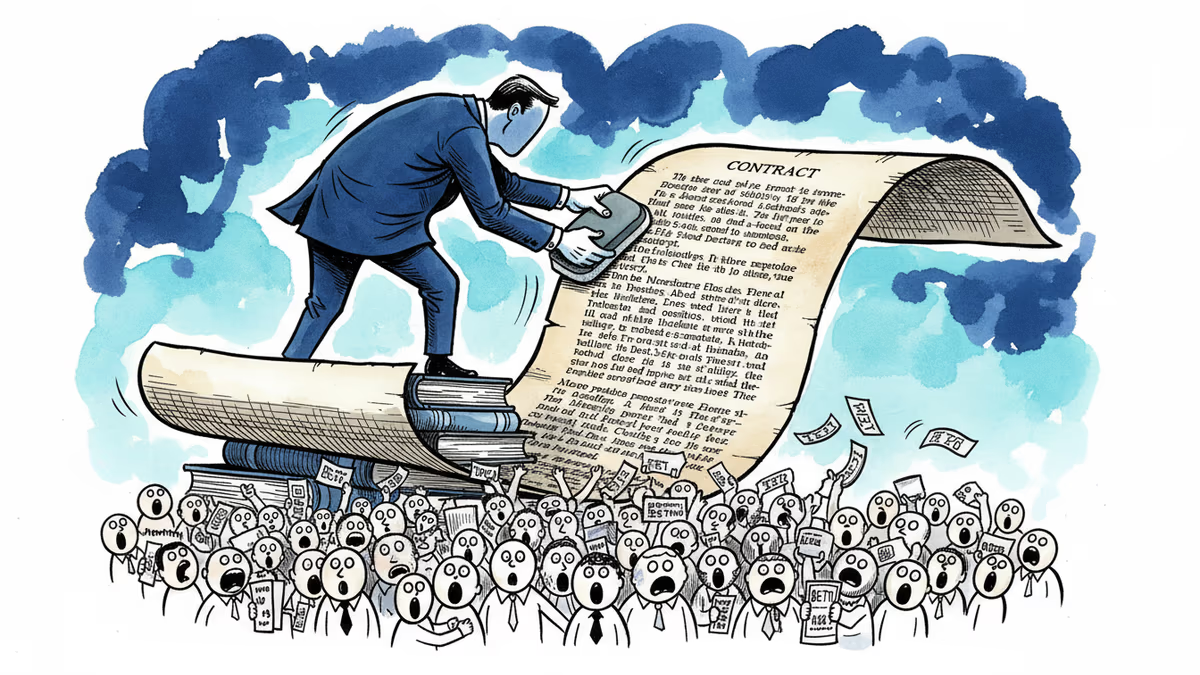
A class action lawsuit accuses Kalshi of changing payout rules after Iran's Supreme Leader Khamenei was killed. The case cuts to the heart of prediction market credibility.

A massive dispute over Iran's supreme leader prediction market exposes the dark side of betting on world events. How Kalshi's rule interpretation sparked trader revolt.
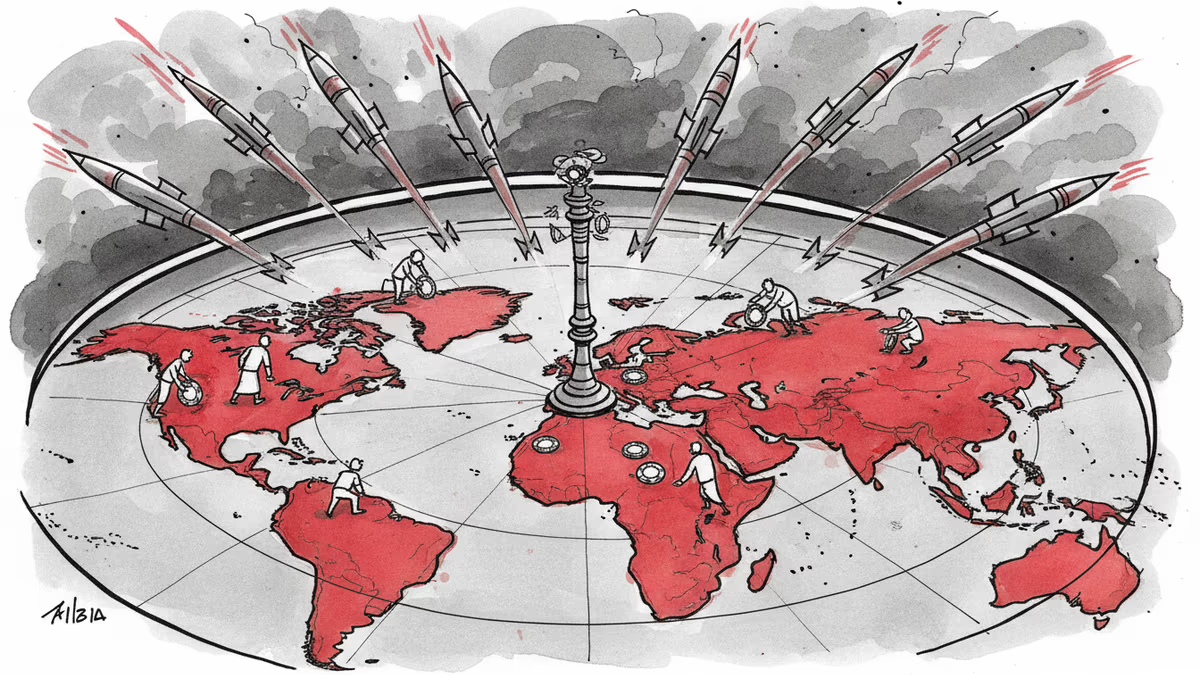
Iran bombing predictions drew $529M in bets, raising insider trading concerns. Exploring the ethical dilemmas of prediction markets in conflict zones.
Despite fierce competition, the CEOs of Polymarket and Kalshi have co-invested in 5(c) Capital, a $35M VC fund targeting prediction market infrastructure. What this signals for the industry.
A class action lawsuit accuses Kalshi of changing payout rules after Iran's Supreme Leader Khamenei was killed. The case cuts to the heart of prediction market credibility.
A massive dispute over Iran's supreme leader prediction market exposes the dark side of betting on world events. How Kalshi's rule interpretation sparked trader revolt.
Iran bombing predictions drew $529M in bets, raising insider trading concerns. Exploring the ethical dilemmas of prediction markets in conflict zones.
Thoughts
Share your thoughts on this article
Sign in to join the conversation