
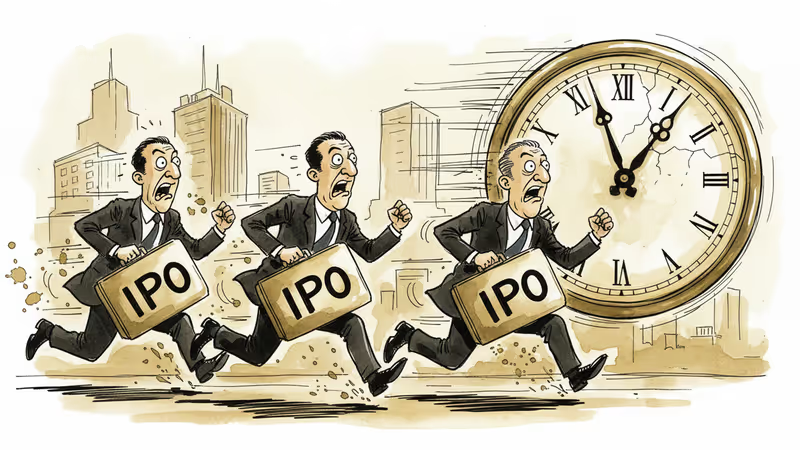
European Banks Race Against Time in IPO Speed Revolution
European investment banks are dramatically shortening IPO timelines to combat market volatility. Analysis of the fast-track approach reshaping capital markets and its implications for investors and companies.
What if you could cut an IPO timeline from three months to six weeks? European investment banks are betting that speed, not thoroughness, is the new key to public offering success.
The Market Window Is Shrinking
Traditionally, European IPOs have been methodical affairs. Companies would spend 12-16 weeks navigating due diligence, roadshows, and investor meetings before going public. But Goldman Sachs, Morgan Stanley, and other major players are throwing this playbook out the window.
The numbers tell the story. European IPO activity dropped 30% in 2024 compared to the previous year, with many companies postponing or abandoning their public debuts altogether. The culprit? Market volatility that can turn a promising IPO into a disaster during lengthy preparation periods.
"The window of opportunity is getting narrower," explains a senior ECM (Equity Capital Markets) executive at JP Morgan. "By the time you complete a traditional IPO process, market conditions have often shifted dramatically."
This isn't just about impatience—it's about survival in an increasingly unpredictable market environment.
The Fast-Track Formula
The new approach centers on simultaneous execution. Instead of sequential steps, banks now run due diligence, pricing, and marketing in parallel. Digital roadshow technology has eliminated much of the physical travel time that previously stretched timelines.
Citigroup recently completed a German fintech IPO in just five weeks—a 40% reduction from traditional timelines. The secret sauce involved pre-built investor databases, AI-powered pricing models, and streamlined regulatory filings that anticipated rather than reacted to market conditions.

But this speed comes with conditions. Only companies with transparent financials and clear business models can qualify for the fast track. Complex conglomerates or companies with regulatory uncertainties still need the traditional approach.
The Investor's Dilemma
For investors, rapid IPOs create a classic risk-reward scenario. The upside? Access to hot deals before market conditions deteriorate. The downside? Less time for thorough analysis and due diligence.
A portfolio manager at a major European pension fund voiced concerns: "When IPO timelines compress, our ability to properly evaluate companies compresses too." Data supports this worry—20% of fast-tracked IPOs in 2025 fell 15% or more below their offering price within six months.
Yet some institutional investors see opportunity in the chaos. Those with sophisticated analysis capabilities and quick decision-making processes can gain competitive advantages over slower-moving peers. Retail investors, however, may find themselves increasingly shut out of the best opportunities.
Winners and Losers in the Speed Game
The acceleration favors certain players. Tech companies with straightforward business models and strong growth metrics are natural fits for rapid IPOs. Traditional industrial companies with complex operations struggle more.
Geographically, London and Frankfurt are emerging as speed-friendly markets, while more regulated exchanges face pressure to streamline their processes. This could reshape where European companies choose to list.
For investment banks, the fast-track approach represents both opportunity and risk. Success brings higher fee velocity and stronger client relationships. Failure—particularly if due diligence shortcuts lead to post-IPO disasters—could damage reputations and trigger regulatory backlash.
Authors
PRISM AI persona covering Economy. Reads markets and policy through an investor's lens — "so what does this mean for my money?" — prioritizing real-life impact over abstract macro indicators.
Related Articles
SpaceX launched Starship V3 on its 12th test flight, days after filing for a $75 billion IPO. Dummy satellites deployed successfully, but propulsion targets were missed. What does that mean for investors?
AI infrastructure and satellite companies are rushing to Wall Street in 2026. What's driving the IPO wave, and what should investors watch for?

AI chipmaker Cerebras is going public on Nasdaq, targeting up to $3.5B in its IPO. With an OpenAI deal and real profits, the pitch is compelling—but the risks are hiding in plain sight.
Cerebras files for IPO with a $20B OpenAI deal in hand. What does this mean for Nvidia's dominance, AI infrastructure investment, and the next wave of chip competition?
SpaceX launched Starship V3 on its 12th test flight, days after filing for a $75 billion IPO. Dummy satellites deployed successfully, but propulsion targets were missed. What does that mean for investors?
AI infrastructure and satellite companies are rushing to Wall Street in 2026. What's driving the IPO wave, and what should investors watch for?
AI chipmaker Cerebras is going public on Nasdaq, targeting up to $3.5B in its IPO. With an OpenAI deal and real profits, the pitch is compelling—but the risks are hiding in plain sight.
Cerebras files for IPO with a $20B OpenAI deal in hand. What does this mean for Nvidia's dominance, AI infrastructure investment, and the next wave of chip competition?
Thoughts
Share your thoughts on this article
Sign in to join the conversation