
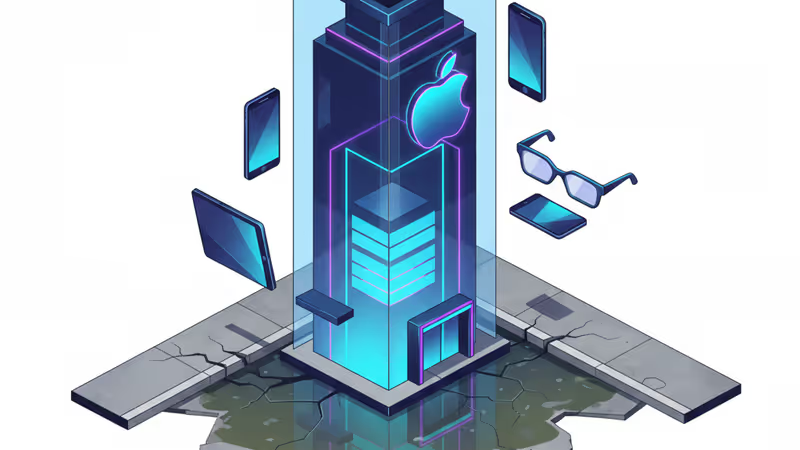
Apple's $30 Million Detroit Bet: Is It Creating Coders or Just Good PR?
Apple invested $30M in its Detroit Developer Academy to create opportunity. While it changed some lives, others faced low stipends and a tough job market. An analysis of Big Tech's education promises.
Is Big Tech's ladder of opportunity actually working? Apple's Developer Academy in Detroit, born from a pledge to advance racial equity after the Black Lives Matter protests, was an ambitious promise. After nearly $30 million in investment over the past four years, the program has opened doors for some but left others facing a harsh economic reality.
A Life-Changing Opportunity
Since its launch in 2021, the academy has welcomed over 1,700 students, with about 600 completing its intensive 10-month course. For some, the experience was transformative. "It changed my life," says Min Thu Khine, who now mentors coding students and works at an Apple Store Genius Bar. "My dream is to be a software engineer at Apple." The program provides students with iPhones and MacBooks and spends an estimated $20,000 per student.
The Reality Behind the Promise
However, not every story has a happy ending. Lizmary Fernandez, who joined the academy while studying to be an immigration attorney, says the cost-of-living stipend was so inadequate that "a lot of us got on food stamps." After graduating, she felt she lacked the experience and portfolio to land a coding job and is now a flight attendant. According to academy officials, about 71% of graduates from the last two years found full-time jobs. For comparison, University of Washington computer scientist Amy J. Ko notes that her department's undergraduate program has a 95% job placement rate. Furthermore, some graduates reported that the curriculum's heavy focus on Apple's ecosystem, like iOS, left them with limited proficiency in competing platforms such as Android, hindering their job search.
Big Tech's Education Play in the AI Era
Apple's initiative highlights the complex reality of corporate-led education efforts. Google and Microsoft have recently committed billions to similar AI education and job training programs. The challenge is the rapid evolution of technology. With generative AI threatening to automate some entry-level software engineering jobs, it raises a fundamental question: can a curriculum built around a single platform provide sustainable skills? The true measure of these programs' success will be their ability to equip students with the resilience to navigate a constantly shifting job market.
This content is AI-generated based on source articles. While we strive for accuracy, errors may occur. We recommend verifying with the original source.
Related Articles
Get the 2024 Apple Mac mini with the M4 chip, 16GB RAM, and 256GB SSD for just $479 at Amazon, a $120 discount from its $599 list price. Near all-time low price.

Apple is pausing its plans to comply with a Texas age verification law after a federal court blocked its implementation, escalating the clash between child safety and user privacy.

The mysterious 'System Data' category is eating up iPhone storage, sometimes taking over 100GB. We explain what it is, why you can't delete it, and the one trick you can try.

Apple will permit third-party iOS app stores and alternative payment systems in Brazil starting in 2026, settling a 2022 antitrust case. The move follows similar changes in the EU.
Get the 2024 Apple Mac mini with the M4 chip, 16GB RAM, and 256GB SSD for just $479 at Amazon, a $120 discount from its $599 list price. Near all-time low price.
Apple is pausing its plans to comply with a Texas age verification law after a federal court blocked its implementation, escalating the clash between child safety and user privacy.
The mysterious 'System Data' category is eating up iPhone storage, sometimes taking over 100GB. We explain what it is, why you can't delete it, and the one trick you can try.
Apple will permit third-party iOS app stores and alternative payment systems in Brazil starting in 2026, settling a 2022 antitrust case. The move follows similar changes in the EU.