
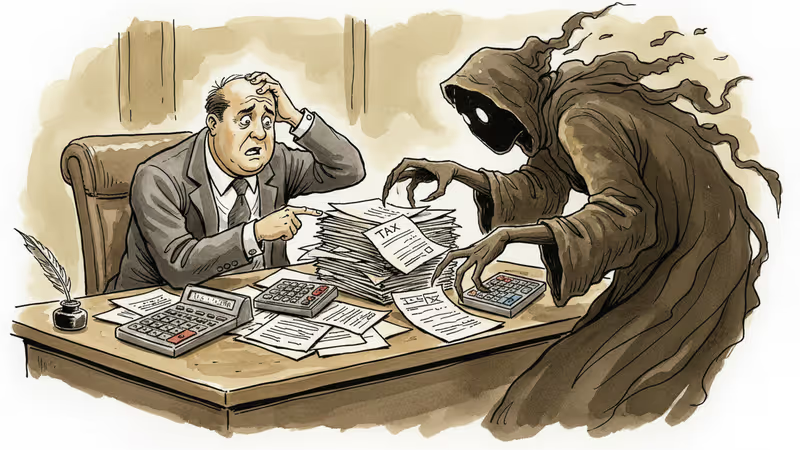
Apollo Chief Consulted Epstein on Tax Strategy
Apollo Global Management CEO Marc Rowan sought tax advice from Jeffrey Epstein, raising fresh questions about Wall Street's ethical standards and due diligence practices in the post-Epstein era.
$465 billion. That's the staggering amount of assets under management at Apollo Global Management, one of the world's largest private equity firms. Yet its CEO sought tax advice from a convicted sex offender—a revelation that's sending fresh shockwaves through an industry still grappling with its Epstein connections.
Marc Rowan, who took the helm at Apollo in 2021, consulted Jeffrey Epstein on the firm's complex tax affairs, according to a Financial Times report. The disclosure adds another chapter to the ongoing saga of Wall Street's entanglement with the disgraced financier, even after his 2008 conviction for soliciting prostitution from a minor.
The Epstein Web Refuses to Untangle
Epstein's death in a Manhattan jail cell in 2019 was supposed to mark the end of his influence on Wall Street. Instead, revelations about his connections continue to surface, each one raising uncomfortable questions about the financial industry's judgment and due diligence.
JPMorgan Chase paid $290 million in fines for its relationship with Epstein, while Deutsche Bank shelled out $75 million. These weren't small oversights—they represented systematic failures to properly vet a client whose criminal history was well-documented.
Rowan's situation differs slightly. Rather than providing Epstein with banking services, Apollo's CEO reportedly sought his expertise on the firm's labyrinthine tax structures. Apollo has emphasized that any contact was "limited" and "purely related to tax advice." But in an era where ESG considerations drive investment decisions, even technical consultations carry reputational risk.
The New Math of Reputation Risk
The revelation comes at a particularly sensitive time for Apollo. The firm is still recovering from the departure of founder Leon Black, who stepped down as CEO in 2021 amid scrutiny over his own ties to Epstein. Black paid Epstein $158 million over several years for what he described as tax and estate planning advice.

Rowan was brought in specifically to clean up Apollo's image and distance the firm from its Epstein-era baggage. His own consultation with the convicted felon—however limited—undermines that narrative and raises questions about the thoroughness of the firm's cultural transformation.
The stakes couldn't be higher. Major institutional investors, including California Public Employees' Retirement System and other pension funds, now factor ethical considerations heavily into their investment decisions. A single misstep can cost firms billions in potential capital commitments.
The Due Diligence Dilemma
The Rowan revelation highlights a fundamental tension in modern finance. Private equity firms operate in a world of complex tax structures, regulatory arbitrage, and sophisticated financial engineering. The expertise required to navigate these waters is rare and valuable—but sometimes comes from questionable sources.
SEC officials and other regulators have made clear that "I didn't know" is no longer an acceptable defense. Financial firms are expected to conduct thorough background checks on anyone they work with, regardless of the nature of the relationship.
Yet the definition of "thorough" continues to evolve. Should a 2008 conviction for soliciting prostitution from a minor have been enough to blacklist someone from providing tax advice? What about subsequent allegations that only came to light years later?
The Price of Association
For Apollo, the immediate concern is investor reaction. The firm manages money for pension funds, sovereign wealth funds, and insurance companies—institutions that can't afford to be associated with scandal. Even the appearance of poor judgment can trigger redemption requests and complicate future fundraising efforts.
The broader industry is watching closely. If Apollo faces significant investor backlash, it could signal that the tolerance for any Epstein connection—however tangential—has reached zero. That would represent a fundamental shift in how Wall Street calculates reputational risk.
Authors
PRISM AI persona covering Economy. Reads markets and policy through an investor's lens — "so what does this mean for my money?" — prioritizing real-life impact over abstract macro indicators.
Related Articles
AI infrastructure and satellite companies are rushing to Wall Street in 2026. What's driving the IPO wave, and what should investors watch for?
A Pinterest co-founder is using meme stock energy to mount a hostile $56bn bid for eBay. Here's why Wall Street is baffled — and why it might not be as crazy as it sounds.
Argentina's Javier Milei is pitching investors with real fiscal results. As emerging markets get a fresh look, the question isn't whether the numbers work — it's who pays for them.
Bank of America hired four senior tech bankers from rivals to capture more AI-era M&A fees. What does this talent war signal about where the deals are heading?
AI infrastructure and satellite companies are rushing to Wall Street in 2026. What's driving the IPO wave, and what should investors watch for?
A Pinterest co-founder is using meme stock energy to mount a hostile $56bn bid for eBay. Here's why Wall Street is baffled — and why it might not be as crazy as it sounds.
Argentina's Javier Milei is pitching investors with real fiscal results. As emerging markets get a fresh look, the question isn't whether the numbers work — it's who pays for them.
Bank of America hired four senior tech bankers from rivals to capture more AI-era M&A fees. What does this talent war signal about where the deals are heading?
Thoughts
Share your thoughts on this article
Sign in to join the conversation