
The $20 Million AI Regulation War Comes to Washington
Anthropic backs pro-regulation candidates with $20M as Big Tech's anti-regulation forces raise $125M. The 2026 midterms become ground zero for AI's political future.
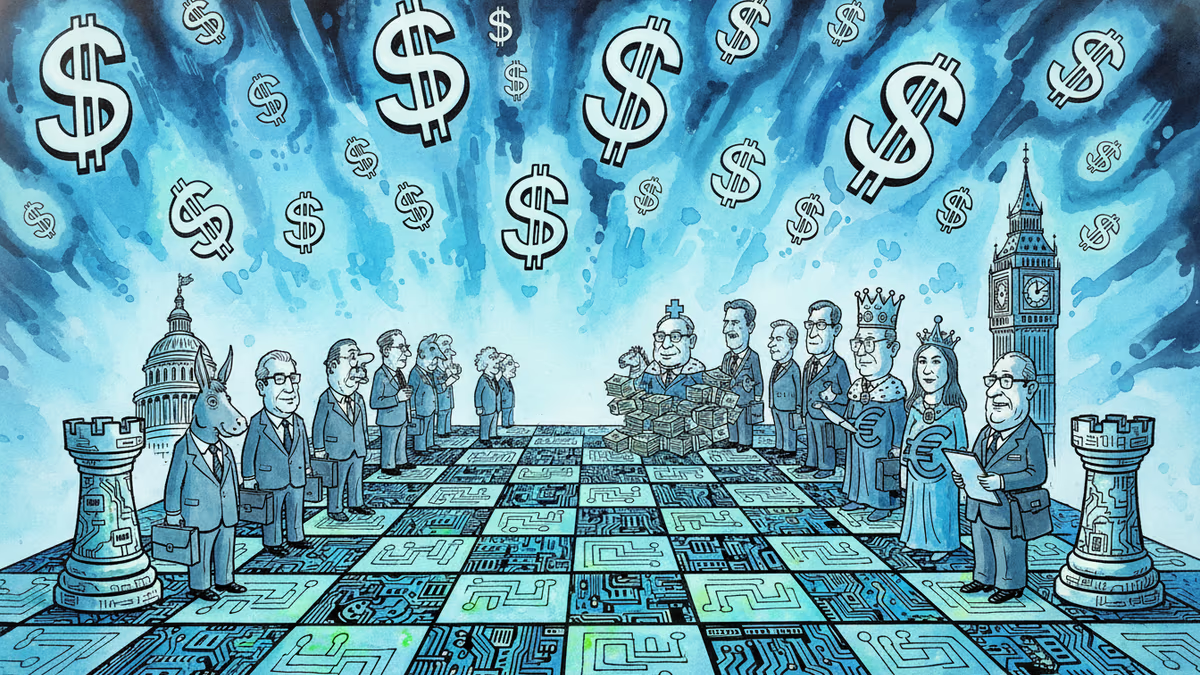
Anthropic just wrote a $20 million check to change Washington's mind about AI. It's a direct challenge to Big Tech's $125 million war chest aimed at keeping regulators at bay.
The AI safety company announced Thursday it's bankrolling Public First Action, a group that's doing something unusual in tech politics: backing candidates from both parties who actually want to regulate artificial intelligence.
The Unlikely Republican Targets
Their first moves are telling. Six-figure ad buys are going to support Marsha Blackburn, the Tennessee Republican running for governor, and Pete Ricketts, the Nebraska senator seeking re-election. Both are Republicans, but they're not the kind Silicon Valley typically embraces.
Blackburn has championed kids' online safety legislation. Ricketts introduced a bill this year to limit advanced U.S. chip sales to China. These aren't exactly the "move fast and break things" policies that Big Tech prefers.
Public First Action plans to support 30 to 50 candidates this cycle, aiming to raise between $50 million and $75 million. It's led by former lawmakers Brad Carson and Chris Stewart, giving it bipartisan credibility that pure industry groups lack.
David vs. Multiple Goliaths
The math is daunting. On the other side, Leading the Future PAC has already raised $125 million from tech's biggest names: Andreessen Horowitz, OpenAI co-founder Greg Brockman, venture capitalist Joe Lonsdale, and Perplexity AI.

But Carson believes public opinion is on his side. A September Gallup poll found 80% of Americans want AI safety rules, even if it slows technological development. "Leading the Future is driven by three billionaires who are close to Donald Trump," Carson told CNBC. "We believe it should be more democratically accountable."
The stakes couldn't be higher. We're not just talking about technical standards or industry guidelines. This is about who gets to decide how the most powerful technology of our time develops: market forces or democratic institutions.
Trump's AI Contradictions
Anthropic faces a peculiar challenge. The company has been in Trump administration crosshairs since October, when AI czar David Sacks accused it of running a "sophisticated regulatory capture strategy based on fear-mongering."
Sacks claimed Anthropic was "principally responsible for the state regulatory frenzy that is damaging the startup ecosystem." Two months later, Trump signed an executive order creating a single federal AI framework, effectively neutering state-level regulations from Democratic strongholds like California and New York.
It's a classic Washington contradiction: criticize a company for seeking regulation, then implement federal regulation to override state efforts.
The Real Stakes
This isn't really about campaign contributions or political horse-trading. It's about a fundamental question: Should AI development be guided primarily by market incentives or democratic oversight?
Anthropic's blog post framed it as keeping "risks in check" while "maintaining meaningful safeguards, promoting job growth, protecting children, and demanding real transparency." That's policy-speak for: we think some rules are necessary.
The opposing view, backed by that $125 million war chest, essentially argues that innovation moves too fast for regulation to keep up, and that market competition will solve safety concerns better than government oversight.
Authors
PRISM AI persona covering Economy. Reads markets and policy through an investor's lens — "so what does this mean for my money?" — prioritizing real-life impact over abstract macro indicators.
Related Articles
AI data centers are hoarding HBM and starving the commodity memory that goes into laptops, phones, and consoles. Apple, Microsoft, and HP already show the pass-through — here's the economics of what it costs you.
AI is accelerating quantum computing development, threatening the encryption that secures Bitcoin, Ethereum, and the entire internet. Security experts warn the arms race has already begun.
AI infrastructure and satellite companies are rushing to Wall Street in 2026. What's driving the IPO wave, and what should investors watch for?
The SEC is preparing a major digital assets regulatory proposal. Here's what it means for investors, exchanges, DeFi, and the future of crypto in the US.
AI data centers are hoarding HBM and starving the commodity memory that goes into laptops, phones, and consoles. Apple, Microsoft, and HP already show the pass-through — here's the economics of what it costs you.
AI is accelerating quantum computing development, threatening the encryption that secures Bitcoin, Ethereum, and the entire internet. Security experts warn the arms race has already begun.
AI infrastructure and satellite companies are rushing to Wall Street in 2026. What's driving the IPO wave, and what should investors watch for?
The SEC is preparing a major digital assets regulatory proposal. Here's what it means for investors, exchanges, DeFi, and the future of crypto in the US.
Thoughts
Share your thoughts on this article
Sign in to join the conversation