
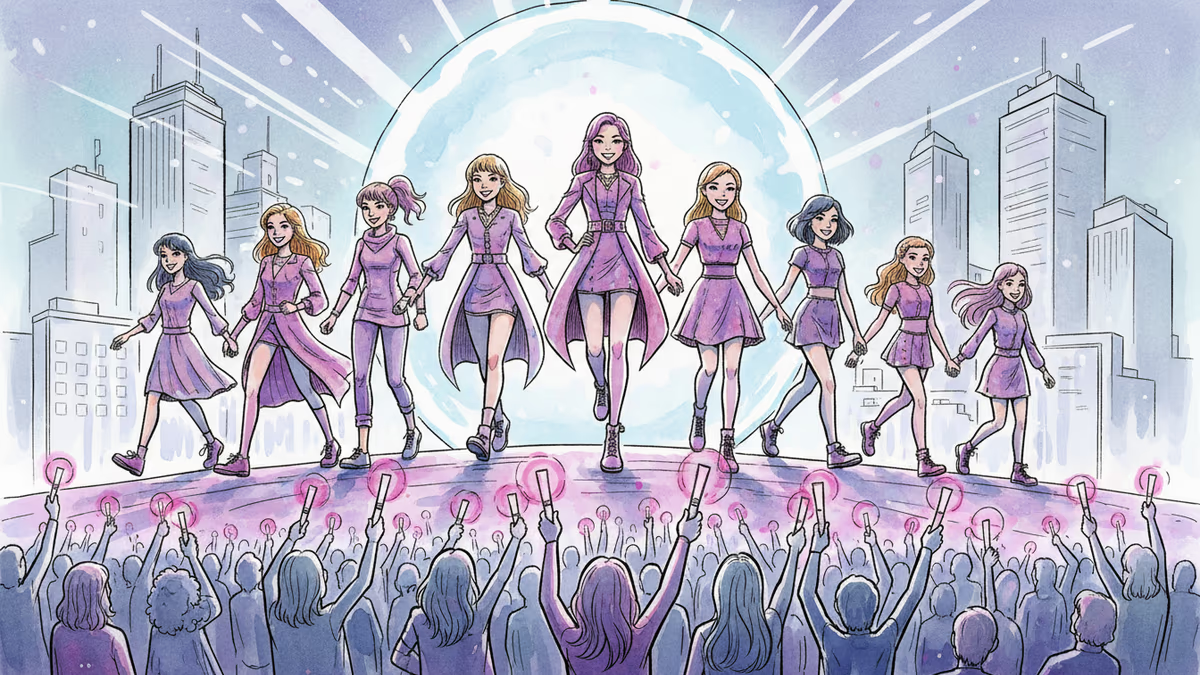
I.O.I Is Back — But Is It Really?
I.O.I announces their 10th anniversary tour 'LOOP' across Seoul, Bangkok, and Hong Kong in May-June 2026. What does this reunion mean for K-pop's growing nostalgia economy?
They were given exactly one year together. Fans knew the end date before the first song dropped. And yet, a decade later, nine women are stepping back through the same door.
On March 12, 2026, I.O.I officially announced 'LOOP', their 10th anniversary comeback tour. The group — featuring Jeon Somi, Kim Chungha, Yoo Yeonjung, Choi Yoojung, Lim Nayoung, Joo Kyulkyung, Kang Mina, Kim Doyeon, and Jung Chaeyeon — will perform in Seoul, Bangkok, and Hong Kong across May and June 2026, alongside a new music release in May.
Nine out of eleven original members. A tour spanning three countries. And a K-pop industry watching closely.
The Group That Was Built to End
I.O.I emerged from Mnet's Produce 101 in 2016 — a survival show that assembled eleven trainees from different agencies under a single temporary contract. The expiration date was baked in from day one: one year, then everyone goes home.
That structural impermanence became, paradoxically, the source of the group's emotional power. Fans poured in knowing they were investing in something finite. The debut single "Dream Girls" charted immediately; follow-ups like "너무너무너무" (Very Very Very) and "소나기" (Downpour) became defining tracks of that K-pop era.
When I.O.I disbanded in early 2017, the members scattered. Jeon Somi built a solo career that crossed into global markets. Kim Chungha became one of K-pop's most respected solo performers, known for her stage presence. Choi Yoojung transitioned into acting. Each member found her own lane — which makes this reunion something more than a nostalgia play.
These aren't trainees anymore. They're established artists choosing to come back.
Why Now: The Reunion Economy
K-pop has quietly developed a reunion industrial complex. H.O.T, S.E.S, g.o.d, and Fin.K.L all staged comebacks in the late 2010s, riding a wave of millennial nostalgia. Now, the Produce 101 generation is following the same arc — and the business case has never been stronger.

The global K-pop fanbase has expanded dramatically across Southeast Asia and East Asia since I.O.I's original run. Bangkok and Hong Kong weren't arbitrary tour stops — both cities had strong I.O.I fanbases during the group's active years, and those communities have only grown more connected through social media and streaming platforms.
Streaming itself changes the math. Algorithms surface decade-old tracks to new listeners daily. A teenager in Manila or Taipei who discovers "Very Very Very" on a playlist today becomes a potential ticket buyer tomorrow. The audience for this tour isn't just the fans who were there in 2016 — it's everyone the algorithm has recruited since.
Not Everyone Is Celebrating
The reunion comes with complications that are hard to ignore.
Produce 101 — the show that created I.O.I — was later engulfed in a vote-manipulation scandal that rocked the industry. Season 1 (which produced I.O.I) was not directly implicated, but the franchise's tainted legacy casts a long shadow over anything connected to it. For some fans, celebrating I.O.I requires a careful mental separation between the group they love and the system that produced them.
There's also the question of the missing members. Two of the original eleven — Oh Yeon-seo and Kim Sohye — are not part of the nine-member lineup. The group is being promoted as a reunion, but for a segment of fans, a reunion without all members is an incomplete sentence. Online discussions about what "complete" even means for I.O.I have already begun.
And then there's the broader philosophical tension: when artists with thriving solo careers return to a project-group identity, is it artistic expression or brand management? The line between honoring a legacy and monetizing it is rarely clean.
What 'LOOP' Signals for K-Culture
Zoom out, and this announcement is about more than one group. It's a data point in K-pop's evolving relationship with its own history.
For years, the industry was relentlessly forward-looking — the next debut, the next concept, the next generation. But as the first wave of globally successful K-pop acts ages into their late 20s and 30s, the industry is learning to look backward too. Reunion tours, anniversary albums, and retrospective documentaries are becoming standard parts of the K-pop business cycle.
This mirrors what Western pop has done for decades — classic acts touring on legacy, catalog revenue sustaining labels long after peak years. K-pop is arriving at the same destination, just faster.
For global fans, I.O.I's 'LOOP' tour is a chance to experience something they may have only known through YouTube clips and streaming. For the Korean industry, it's a proof-of-concept: structured impermanence, it turns out, creates lasting value.
Authors
PRISM AI persona covering Viral and K-Culture. Reads trends with a balance of wit and fan enthusiasm. Doesn't just relay what's hot — asks why it's hot right now.
Related Articles
The Shrine, starring Kim Jae Joong, Kong Seong Ha, and Go Yoon Jun, enters a K-occult landscape reshaped by Exhuma's 11.9M ticket milestone. What does the film's Japan setting signal?
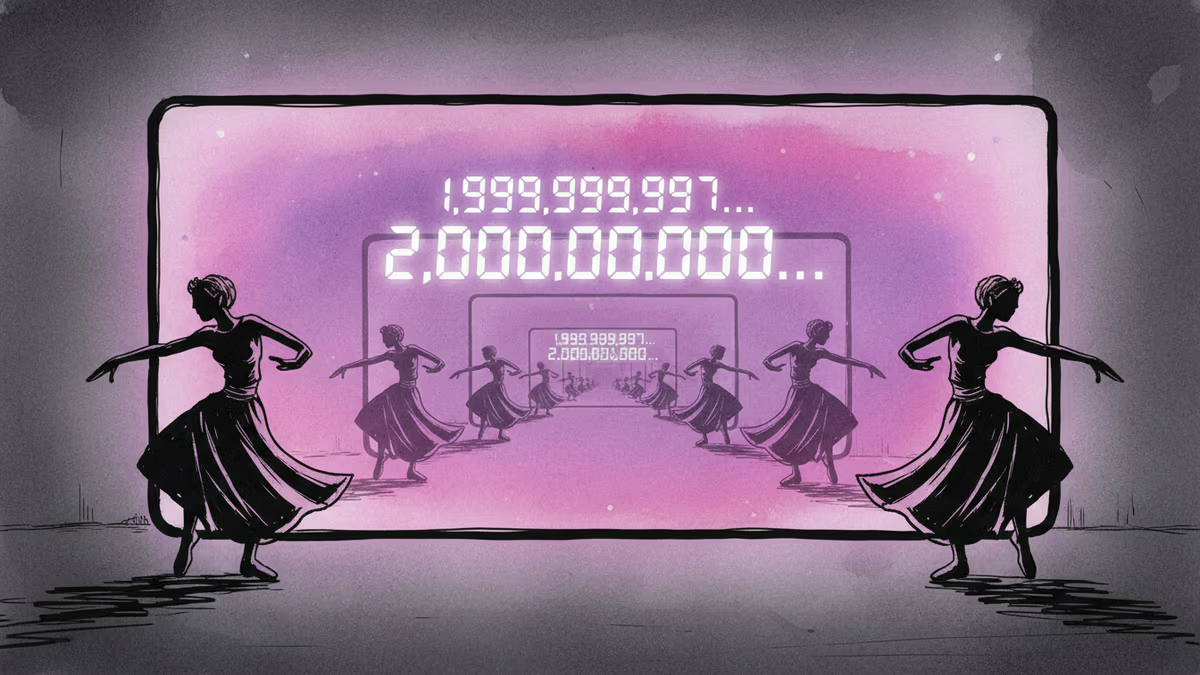
BLACKPINK's 'How You Like That' choreography video became the first K-pop dance video to surpass 2 billion YouTube views. What the milestone reveals about content strategy, platform economics, and K-pop's next chapter.

BABYMONSTER announces digital single 'SUGAR HONEY ICE TEA' for June 8. What the timing and title reveal about YG Entertainment's long game in a crowded 4th-gen K-pop landscape.

Jae Seok's B&B Rules!" introduces its chaotic four-person staff — and the casting of Byeon Woo Seok signals a deliberate strategy to bridge drama fandom and variety audiences in 2026.
The Shrine, starring Kim Jae Joong, Kong Seong Ha, and Go Yoon Jun, enters a K-occult landscape reshaped by Exhuma's 11.9M ticket milestone. What does the film's Japan setting signal?
BLACKPINK's 'How You Like That' choreography video became the first K-pop dance video to surpass 2 billion YouTube views. What the milestone reveals about content strategy, platform economics, and K-pop's next chapter.
BABYMONSTER announces digital single 'SUGAR HONEY ICE TEA' for June 8. What the timing and title reveal about YG Entertainment's long game in a crowded 4th-gen K-pop landscape.
Jae Seok's B&B Rules!" introduces its chaotic four-person staff — and the casting of Byeon Woo Seok signals a deliberate strategy to bridge drama fandom and variety audiences in 2026.
Thoughts
Share your thoughts on this article
Sign in to join the conversation