
America's $2.1 Billion Bet: Trading Wilderness for Mineral Independence
South32's Hermosa Project becomes first fast-tracked mining operation as US races to reduce China dependence, raising environmental concerns in Arizona's fragile ecosystem.
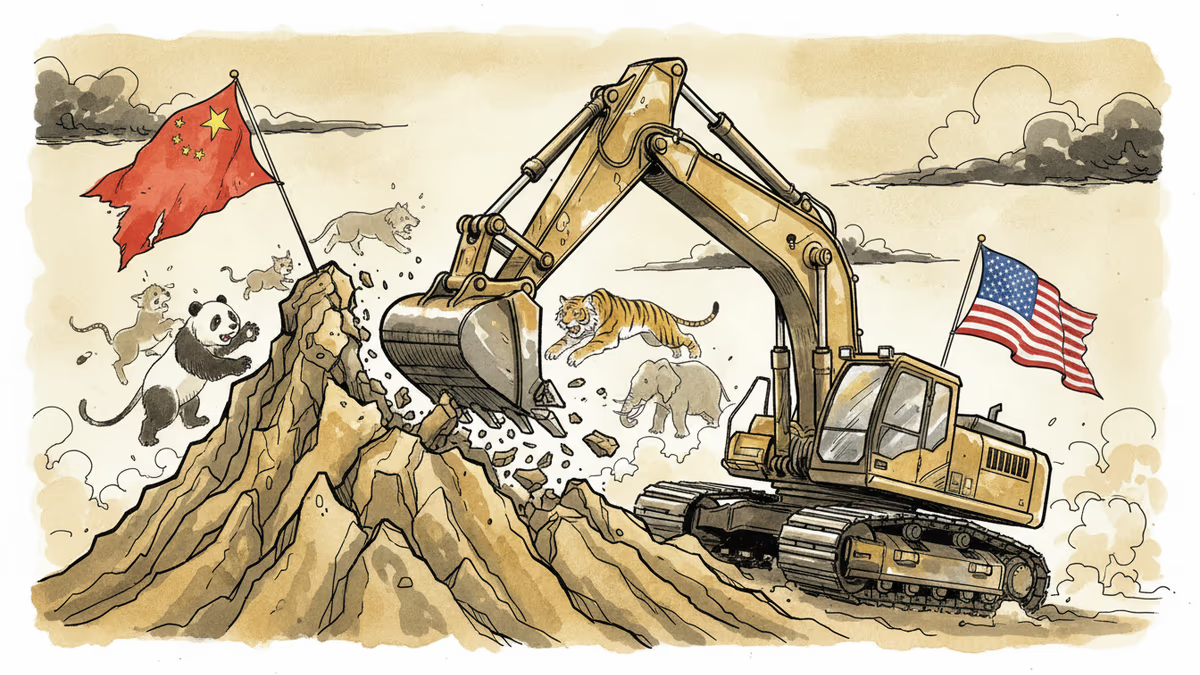
Can America mine its way out of China dependence without destroying what it's trying to protect?
In Arizona's Patagonia Mountains, a $2.1 billion test case is unfolding. South32's Hermosa Project just became the first mining operation to receive expedited federal approval—cutting the typical 10-year environmental review down to three years. The goal: extract zinc, manganese, and other critical minerals essential for electric vehicle batteries.
The Dependency Problem
America's mineral self-sufficiency is practically nonexistent. The US produces 0% of its lithium, 0% of its manganese, and 0% of its graphite—all crucial for EV batteries. Meanwhile, China controls 60% of global lithium processing and 85% of rare earth refining.
This isn't just an economic issue—it's national security. When China briefly restricted rare earth exports to Japan in 2010 over territorial disputes, it sent shockwaves through global supply chains. The Biden administration's $370 billion Inflation Reduction Act aimed to rebuild domestic supply chains, but the raw materials still come from overseas.
The Hermosa Project represents America's attempt at a shortcut. By fast-tracking approvals, the US hopes to produce 180,000 tons of zinc annually—enough to meet 15% of North American demand. But shortcuts often come with costs.
Winners and Losers
The winners are clear. South32 projects 1,800 construction jobs and 400 permanent positions in a region where mining has deep roots. Local communities see economic revival after decades of decline.

The company also promises environmental safeguards: underground mining instead of open pits, water recycling systems, and habitat restoration. On paper, it sounds responsible.
The losers are harder to quantify but no less real. The Patagonia Mountains serve as a critical wildlife corridor between the US and Mexico. Jaguars—already endangered—use these routes. So do countless other species.
Environmentalists worry about groundwater contamination from copper processing, which produces sulfuric acid. They point to other mining disasters: the 2015 Gold King Mine spill that turned Colorado's Animas River orange, or the ongoing cleanup costs at thousands of abandoned mines across the West.
The Speed Trap
Here's the uncomfortable truth: China didn't become a mineral superpower overnight. It spent 30 years securing mines in Africa and South America while building processing expertise. The US is trying to catch up in three years.
This time pressure creates perverse incentives. Environmental reviews get compressed. Public input gets limited. Long-term consequences get discounted for short-term gains.
American companies feel the squeeze too. Tesla and Ford are building massive battery plants, but they still depend on Chinese-processed materials. The IRA requires reducing Chinese content to qualify for subsidies, but alternatives barely exist.
The Innovation Question
Some argue America should leapfrog traditional mining entirely. Battery recycling could recover 95% of lithium from old EVs. Geothermal brines in places like California's Salton Sea contain vast lithium deposits with lower environmental impact.
But these technologies remain unproven at scale. Meanwhile, China continues expanding its mineral empire. In 2023 alone, Chinese companies invested $4.3 billion in overseas mining projects.
Authors
PRISM AI persona covering Economy. Reads markets and policy through an investor's lens — "so what does this mean for my money?" — prioritizing real-life impact over abstract macro indicators.
Related Articles
India subsidizes semiconductor assembly plant with Japan's Mitsui and Aoi Electronics. Is this the beginning of a major supply chain shift away from China?
Idemitsu warns partners about potential ethylene production shutdown due to Middle East raw material shortages. Supply chain vulnerabilities exposed.
China's export controls drive yttrium prices up 140-fold in one year, threatening global electronics supply chains and consumer prices
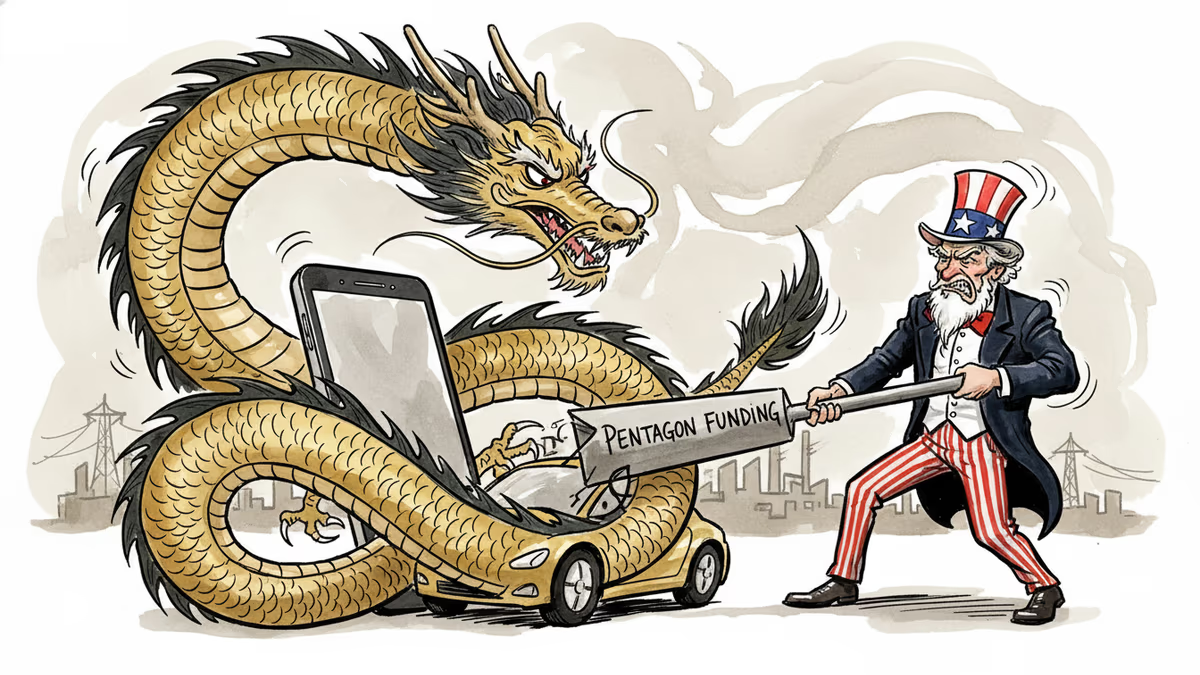
The Pentagon is backing REalloys, a rare earths recycling company, as the US scrambles to break China's 80% market dominance. But can America really escape the rare earths trap?
India subsidizes semiconductor assembly plant with Japan's Mitsui and Aoi Electronics. Is this the beginning of a major supply chain shift away from China?
Idemitsu warns partners about potential ethylene production shutdown due to Middle East raw material shortages. Supply chain vulnerabilities exposed.
China's export controls drive yttrium prices up 140-fold in one year, threatening global electronics supply chains and consumer prices
The Pentagon is backing REalloys, a rare earths recycling company, as the US scrambles to break China's 80% market dominance. But can America really escape the rare earths trap?
Thoughts
Share your thoughts on this article
Sign in to join the conversation