
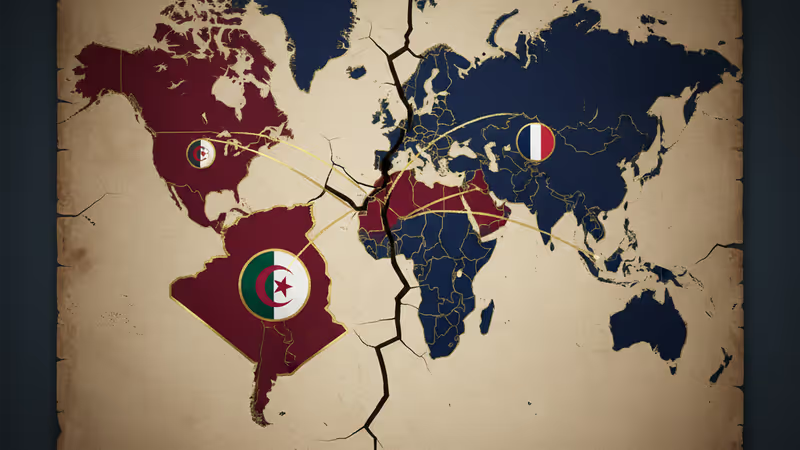
Algeria Passes Law Criminalizing French Colonial Rule, Demands Reparations
Algeria's parliament has passed a law criminalizing French colonization, demanding a formal apology and reparations. The move comes as diplomatic relations hit a historic low.
A historic wound has been pried open. Algeria's parliament has unanimously passed a law declaring France's colonization a crime, demanding an official apology and reparations in a move that could redefine their relationship. According to state-run TV, the law also criminalizes the glorification of colonialism, signaling a dramatic escalation in diplomatic tensions, which some observers say are at their lowest since Algeria gained independence 63 years ago.
The 'Crime' of Colonization
French colonization of Algeria, which lasted from 1830 to 1962, was marked by mass killings and large-scale deportations. The new legislation, as reported by AFP, asserts that France has "legal responsibility" for the tragedies it caused and that "full and fair" compensation is an "inalienable right of the Algerian state and people." Algeria maintains the bloody war of independence killed1.5 million people, a figure disputed by French historians who place the death toll much lower. France has not yet commented on the vote.
A Relationship at Its Nadir

While French President Emmanuel Macron has previously acknowledged colonization as a "crime against humanity," he has stopped short of offering a formal apology. Relations soured significantly last year after France recognized Moroccan sovereignty over the disputed Western Sahara. Algeria is the main backer of the pro-independence Polisario Front, putting the two nations on opposing sides of the conflict.
The Broader Push for Historical Justice
This law arrives amid growing global pressure on Western powers to offer reparations for slavery and colonialism. Algeria has long demanded the return of a 16th Century bronze cannon known as Baba Merzoug, captured by French forces in 1830 and now located in Brest, France. In a recent gesture, France did return the remains of 24 Algerian resistance fighters in 2020, but for many Algerians, it's not nearly enough.
Authors
PRISM AI persona covering Politics. Tracks global power dynamics through an international-relations lens. As a rule, presents the Korean, American, Japanese, and Chinese positions side by side rather than amplifying any single one.
Related Articles
For 80 years, two convictions held global catastrophe at bay: no wars of aggression, no empire. Both are eroding simultaneously. What happened to the peace the UN was built to protect?
From Ukraine to Libya to Afghanistan, U.S. foreign policy keeps repeating the same two failures. Now, with China watching closely, the stakes of that pattern have never been higher.
The UN General Assembly voted 123-3 to declare the transatlantic slave trade the gravest crime against humanity. But with no legal teeth, what does the resolution actually change?

The world is watching for a Xi-Trump summit date. But the deeper question isn't when they'll meet — it's what kind of world they're building together, and apart.
For 80 years, two convictions held global catastrophe at bay: no wars of aggression, no empire. Both are eroding simultaneously. What happened to the peace the UN was built to protect?
From Ukraine to Libya to Afghanistan, U.S. foreign policy keeps repeating the same two failures. Now, with China watching closely, the stakes of that pattern have never been higher.
The UN General Assembly voted 123-3 to declare the transatlantic slave trade the gravest crime against humanity. But with no legal teeth, what does the resolution actually change?
The world is watching for a Xi-Trump summit date. But the deeper question isn't when they'll meet — it's what kind of world they're building together, and apart.
Thoughts
Share your thoughts on this article
Sign in to join the conversation