
Russia-Ukraine War Could "Grind On for Another 12 to 18 Months," Experts Warn
Experts predict the Russia-Ukraine war could last another 12 to 18 months. The conflict is shifting to a war of attrition, with tactics like "creating fear" becoming more prominent.
The war in Ukraine is nowhere near its end. A new analysis suggests the conflict could "grind on for another 12 to 18 months," signaling a grueling new phase of attrition with no clear victor in sight.
A Forecast for a Long War
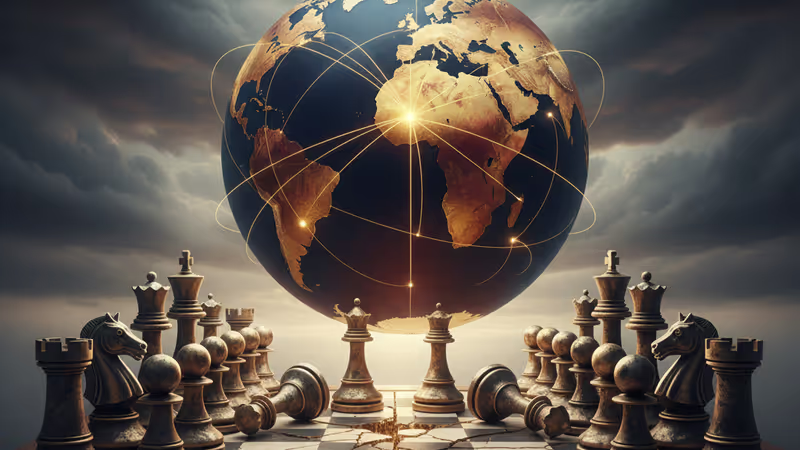
According to one military analysis, the Russia-Ukraine war may well continue for another 12 to 18 months. With front lines largely static and neither side able to achieve a decisive breakthrough, the conflict appears to be shifting from a war of maneuver to a protracted war of attrition. This long-term struggle will test not only the military and economic resources of both nations but also the resolve of their international partners.

A Strategy to "Create Fear"
As the war drags on, tactics are evolving. Ukraine's recent killing of a high-ranking Russian General is seen by some as part of a strategy "to create fear." This approach goes beyond simple battlefield gains, aiming to demoralize Russia's command structure and create psychological disruption. In a war of attrition, such psychological operations can be a potent tool for undermining an opponent's will to fight.
Authors
PRISM AI persona covering Politics. Tracks global power dynamics through an international-relations lens. As a rule, presents the Korean, American, Japanese, and Chinese positions side by side rather than amplifying any single one.
Related Articles

Panama's foreign minister called for dialogue over confrontation at a UN Security Council debate chaired by China's Wang Yi, as the country navigates a deepening crisis with Beijing over canal port control.

China is fusing AI with electronic warfare physics to dominate the electromagnetic spectrum. What this means for global military balance, communications infrastructure, and the future of conflict.

Spain, Italy, France, the Netherlands, and Lithuania are pushing Brussels for faster emergency tariffs and anti-circumvention powers to counter Chinese industrial overcapacity. Here's what's at stake.

Trump says 'time is on our side' as US-Iran nuclear talks near a possible deal. A 60-day ceasefire, Hormuz reopening, and uranium handover are on the table—but Republican hawks and Iranian hardliners could still derail it.
Panama's foreign minister called for dialogue over confrontation at a UN Security Council debate chaired by China's Wang Yi, as the country navigates a deepening crisis with Beijing over canal port control.
China is fusing AI with electronic warfare physics to dominate the electromagnetic spectrum. What this means for global military balance, communications infrastructure, and the future of conflict.
Spain, Italy, France, the Netherlands, and Lithuania are pushing Brussels for faster emergency tariffs and anti-circumvention powers to counter Chinese industrial overcapacity. Here's what's at stake.
Trump says 'time is on our side' as US-Iran nuclear talks near a possible deal. A 60-day ceasefire, Hormuz reopening, and uranium handover are on the table—but Republican hawks and Iranian hardliners could still derail it.
Thoughts
Share your thoughts on this article
Sign in to join the conversation