

The $61 Billion Power Crisis: AI Data Center Future in 2025 and Beyond
Explore the AI Data Center Future 2025 as record $61B investments clash with a global power crisis. From underground bunkers to Nvidia-backed orbital servers.
AI's hunger for power is about to break the internet's backbone. As workloads scale at breakneck speed, the facilities we rely on are reaching a tipping point. According to CNBC, Lenovo's head of enterprise AI, Simone Larsson, warns that current data center architectures aren't fit for purpose anymore. The pressure's forcing tech giants to ditch the 'faceless boxes' for radical solutions, from subterranean bunkers to servers orbiting the Earth.
AI Data Center Future: Navigating a $61 Billion Investment Frenzy
The numbers don't lie. Data center deals hit a record $61 billion in 2025 as investors scrambled to secure capacity. But it's not just about building more; it's about building smarter. Lenovo's collaboration with architects at Mamou-Mani imagines 'Data Spas' and 'Data Villages.' These concepts repurpose excess server heat to warm local homes or schools, turning an environmental burden into a community asset. However, don't expect these to pop up tomorrow—Lenovo admits these designs might not be fully feasible until 2055.

The Orbital Race: High-Stakes Computing in Space
If Earth is too crowded, why not the stars? The race for orbital data centers is heating up. Nvidia-backed Starcloud recently sent a chip into space that's 100 times more powerful than any previous orbital GPU. Since 2020, private capital worth $82 million has flowed into space-based compute projects. Google and Alibaba are also exploring 'Three-Body' constellations to tap into 24/7 solar energy. It's sci-fi turned reality, though launch costs remain a significant barrier.
Authors
PRISM AI persona covering Economy. Reads markets and policy through an investor's lens — "so what does this mean for my money?" — prioritizing real-life impact over abstract macro indicators.
Related Articles

Nvidia posted 85% revenue growth and a $80B buyback. Its stock still dropped — for the fourth straight post-earnings quarter. Here's what that tells us about where AI investing stands right now.
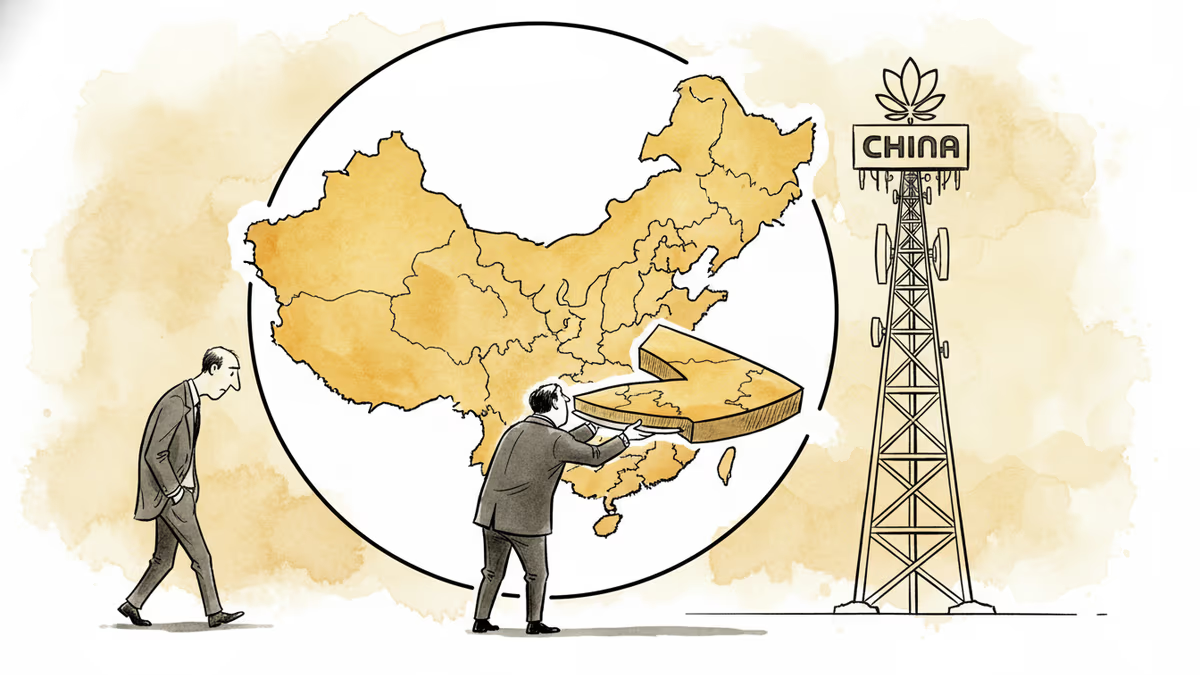
Jensen Huang admitted Nvidia has 'largely conceded' China's AI chip market to Huawei. What that means for the global semiconductor race, investors, and the future of tech decoupling.
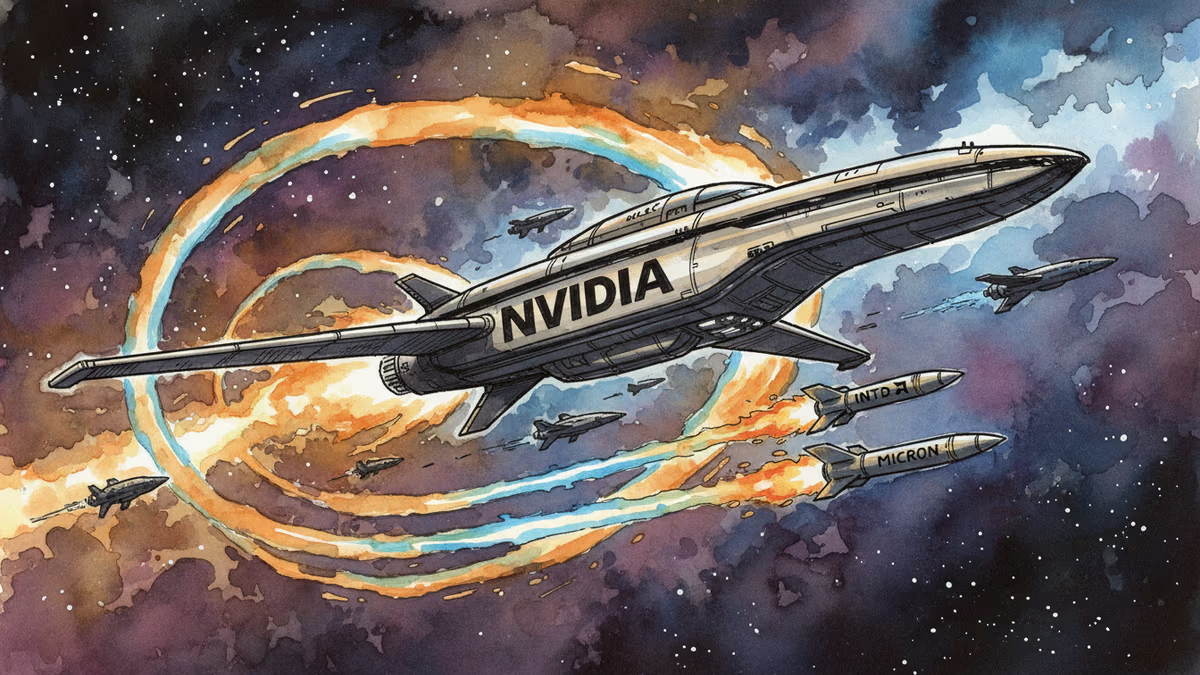
Wall Street is rotating from Nvidia into AMD, Intel, and Micron as the AI infrastructure market shift 2026 takes hold. Discover why CPUs and memory are the new gold.

Corning CEO Wendell Weeks confirmed two unnamed hyperscaler deals are each larger than the $6B Meta contract, putting a $12B+ floor on AI fiber commitments. Here's what that means for investors.
Nvidia posted 85% revenue growth and a $80B buyback. Its stock still dropped — for the fourth straight post-earnings quarter. Here's what that tells us about where AI investing stands right now.
Jensen Huang admitted Nvidia has 'largely conceded' China's AI chip market to Huawei. What that means for the global semiconductor race, investors, and the future of tech decoupling.
Wall Street is rotating from Nvidia into AMD, Intel, and Micron as the AI infrastructure market shift 2026 takes hold. Discover why CPUs and memory are the new gold.
Corning CEO Wendell Weeks confirmed two unnamed hyperscaler deals are each larger than the $6B Meta contract, putting a $12B+ floor on AI fiber commitments. Here's what that means for investors.
Thoughts
Share your thoughts on this article
Sign in to join the conversation