
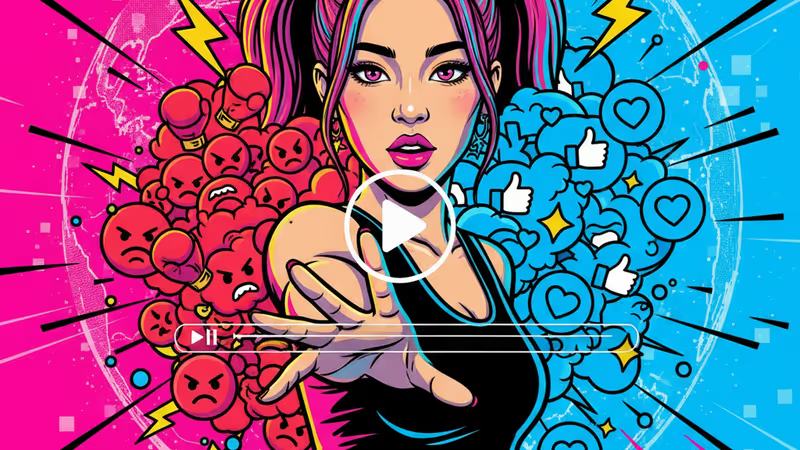
aespa's Winter and the 10-Second Clips That Ignited a Global Fandom War
aespa's Winter is at the center of a viral storm over her behavior with staff. We break down why the clips went viral and what it reveals about the cultural divide in K-Pop fandom.
A Micro-Interaction, A Macro-Explosion
In the hyper-scrutinized world of K-Pop, sometimes all it takes is a few seconds of footage to create an internet-wide firestorm. That's exactly what happened when two behind-the-scenes clips of aespa's Winter went viral, racking up over 16 million views and igniting a fierce debate that highlights a massive cultural divide within global fandom.
This isn't just about an idol's tone of voice; it's a flashpoint for conversations about parasocial relationships, workplace culture, and how context gets dangerously lost in translation online.
The Story: How Two Casual Moments Became a Controversy
The controversy stems from two short clips posted to aespa's official YouTube channel. In the first, a hairstylist tells Winter she needs to use a hairpiece because her natural hair is "too thin." Winter responds with a playful, exaggerated whine: "Ahhhh, don’t say it like that. My bangs can hear that."
In the second clip, a staff member asks her to be careful not to spill cake on her outfit. Winter replies, "Then should I not eat it?" before the staff member clarifies she can, but to just be careful.
To many international fans, these moments seemed like harmless, playful banter common in behind-the-scenes content. But for a significant portion of the Korean netizen community—already viewing her critically amid unsubstantiated dating rumors with BTS's Jungkook—it was seen as something else entirely: unprofessional and disrespectful.
Best Reactions: A Fandom Divided
The reaction was immediate and polarized, creating two completely separate conversations online. The contrast is a masterclass in cultural interpretation.
The Korean Netizen Perspective: A Question of Respect
For many Korean viewers, the interactions were seen as a breach of workplace etiquette, where respect for staff (who are often older and in a service role) is paramount. The tone was perceived not as playful, but as entitled.
- "What the f*ck is up with the way she talks. They’re literally just asking her to please be careful... and she twists it into ‘so what, am I not supposed to eat gifts then?’ That’s completely missing the damn point.." - A user on X, criticizing her response to the staff member concerning the cake.
- "The staff are probably gonna have a hell of a time bending over backwards to cater to Winter." - A highly-shared sentiment on X.
- "I just feel bad for the staff who have to make the clothes, source them, and bust their asses. To an idol it’s probably just ‘an outfit,’ that’s it…" - Another netizen, reflecting on the perceived lack of appreciation for the staff's labor.
The International Fan Perspective: A Misunderstood Joke
Conversely, a large number of global fans rushed to her defense, arguing that the clips were being maliciously decontextualized. They saw a young woman joking around with staff members she likely has a close, informal relationship with.
- "You can literally see the stylist smiling right after. They are stripping all context to fuel a hate train. It's manufactured outrage." - A common defense on fan forums.
- "Western celebs are praised for this kind of 'sassy' personality. It’s obviously a joke. The cultural difference in what’s considered rude is massive." - A fan on X pointing out the cultural gap.
- "They were already looking for a reason to hate her because of the dating rumors. This isn't about the cake or the hair, it's about finding a weapon to attack her with." - A comment connecting the backlash to the pre-existing negative sentiment.
Cultural Context: Why This Resonates So Differently
This isn't just a simple disagreement; it's a textbook example of cultural context collapse. In South Korea's hierarchical social structure, the way one speaks to colleagues, elders, or service providers carries significant weight. Winter's informal, whining tone—even if meant as a joke—can be interpreted as a subtle form of gapjil (abuse of power), where someone in a position of fame and power talks down to staff.
In many Western cultures, however, this kind of playful, slightly dramatic interaction is often seen as a sign of comfortable familiarity. It's viewed as entertainment, a peek behind the curtain at a celebrity's "real" personality. What reads as a red flag for disrespect in one culture reads as a green flag for authenticity in another. The internet, by removing the guardrails of shared cultural understanding, forces these two interpretations into a direct and volatile conflict.
PRISM Insight: The Weaponization of Ambiguity
What we're witnessing is a phenomenon we call the "Weaponization of Ambiguity." The core issue isn't the clips themselves, which are objectively ambiguous. The real story is how that ambiguity is exploited by different groups to confirm a pre-existing bias.
For those already primed by dating rumors to dislike Winter, these clips are definitive proof of her "bad character." Every whine, every sarcastic-seeming comment, is filtered through a negative lens. For her loyal fans, the same ambiguity is proof of her charming and playful nature, and the backlash is seen as a coordinated attack by "antis."
This incident reveals a critical vulnerability in modern digital culture: a short, decontextualized video is the perfect vessel for outrage. It requires no prior knowledge to understand, it's easily shareable, and it allows viewers to project their own biases onto the subject. This isn't a debate about what happened; it's a war over its meaning. And in the digital arena, the most emotionally resonant interpretation—whether positive or negative—often wins.
Related Articles
EXO Baekhyun's wild dating rumor was met not with anger, but with hilarious memes. Here's why the fan reaction is a masterclass in modern damage control.

Aespa's Winter is facing a massive backlash over two viral clips showing her 'attitude' towards staff. We break down why it went viral and what it says about K-pop culture.
An unverified rumor about EXO's Baekhyun went viral, creating a massive online debate. We analyze the fan reactions and what they reveal about K-Pop culture.

aespa's Winter faced massive fan backlash over dating rumors. We break down the message that flipped public opinion and what it reveals about modern celebrity PR.