
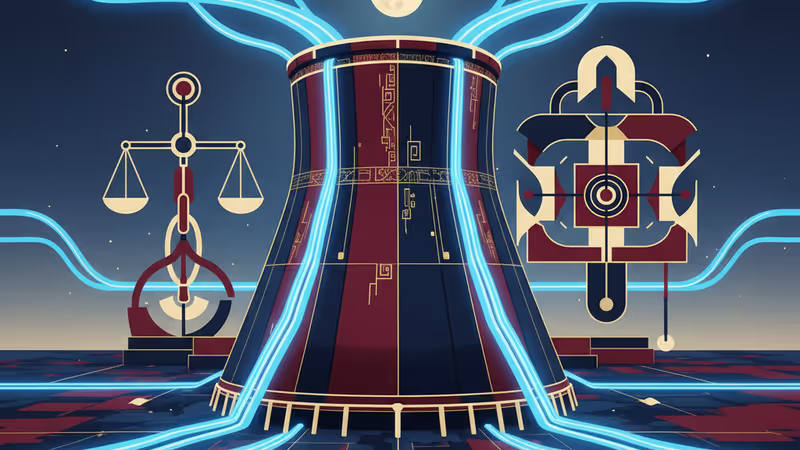
14 Years After Fukushima: World's Largest Nuclear Plant, Kashiwazaki-Kariwa, Gets Restart Approval
14 years after the Fukushima disaster, TEPCO has won local approval to restart a reactor at the world's largest nuclear plant, Kashiwazaki-Kariwa. It's a major turning point for Japan's energy policy.
Japan's nuclear ambitions are flickering back to life. On December 23, 2025, Tokyo Electric Power Company (TEPCO) announced it received formal consent from the governor of Niigata Prefecture to restart Unit 6 of its Kashiwazaki-Kariwa nuclear power plant—the largest in the world. This marks the first time a nuclear plant operated by TEPCO, the company behind the 2011Fukushima disaster, has won local approval to bring a reactor back online.
A Decision After a Long Silence
The governor's consent, delivered on the afternoon of December 23rd, ends a 14-year hiatus for the massive plant, which has been entirely idle since the 2011 catastrophe. The decision follows years of rigorous safety reviews, infrastructure upgrades, and protracted negotiations with the local community. The Japanese government and TEPCO have argued that the restart is essential for strengthening the country's energy security and stabilizing electricity prices.
An Anxious Return Amid Controversy
However, the path to reactivation is fraught with public anxiety. Opposition from local residents and civic groups remains fierce, rooted in a deep-seated distrust of TEPCO due to its role in the Fukushima disaster. Ongoing safety concerns at other Japanese nuclear facilities, such as a recent tritium-laced water leak at the Fugen reactor, only fuel the skepticism. While the business community welcomes the prospect of a stable power supply, opponents point to seismic risks and the unsolved problem of spent nuclear fuel, demanding the decision be reversed.
This content is AI-generated based on source articles. While we strive for accuracy, errors may occur. We recommend verifying with the original source.
Related Articles

It's the 10th anniversary of the Dentsu 'karoshi' (overwork death) tragedy. The victim's mother says her 'suffering only increases.' How much has Japan's work culture truly changed in a decade?
South Korea conducted its second regular defense drill of the year near the Dokdo islets, a territory also claimed by Japan, drawing a swift diplomatic protest from Tokyo.
Japan's transport ministry is considering fixed-amount payments for car owners affected by a major flood in a Yokkaichi underground parking lot. The decision could set a major precedent for government liability in infrastructure failures.
Chinese scholars are reigniting a historical debate, arguing that Japan's late Emperor Hirohito should be held legally responsible for the crimes of Unit 731.
It's the 10th anniversary of the Dentsu 'karoshi' (overwork death) tragedy. The victim's mother says her 'suffering only increases.' How much has Japan's work culture truly changed in a decade?
South Korea conducted its second regular defense drill of the year near the Dokdo islets, a territory also claimed by Japan, drawing a swift diplomatic protest from Tokyo.
Japan's transport ministry is considering fixed-amount payments for car owners affected by a major flood in a Yokkaichi underground parking lot. The decision could set a major precedent for government liability in infrastructure failures.
Chinese scholars are reigniting a historical debate, arguing that Japan's late Emperor Hirohito should be held legally responsible for the crimes of Unit 731.